Military jets are roaring over SLO County. Where do they fly — and why are they so loud?
The scream of supersonic military jet planes zooming over the North Coast seemed more frequent, louder, more intense and longer lasting than usual in early May, according to area residents.
Perhaps a low cloud ceiling contributed to the amplification, as has been the case in the past, but the ear-blasting noise this time seemed to go beyond that, according to those posting online complaints and comments.
Some county residents appreciate the whining roar of military aircraft training in the skies above their homes. But for others, it’s a window-rattling, headache-producing reverberation
So why are those planes allowed to fly over populated areas?
There’s a map designating where military jets can fly, and the altitudes at which they can operate.
The jets fly so fast that the sound barrage doesn’t last too long, at least not usually.
That wasn’t the case on May 11.
Susan Atencio wrote in a text that “I am so stressed and angry by these jets that fly over our house here in Cambria five days a week! Today was horrific!”
She and others called the San Luis Obispo office of U.S. Rep. Salud Carbajal for help in determining what was happening, from where and why.
Greg Haas, Carbajal’s senior aide in that office, confirmed that “there has been an uptick in training activity in recent weeks. We have spoken with the Navy in our monitoring of what’s happening.”
U.S. Navy Capt. Kevin Garcia said that his naval command office in San Diego has received inquiries, including from Carbajal’s office.
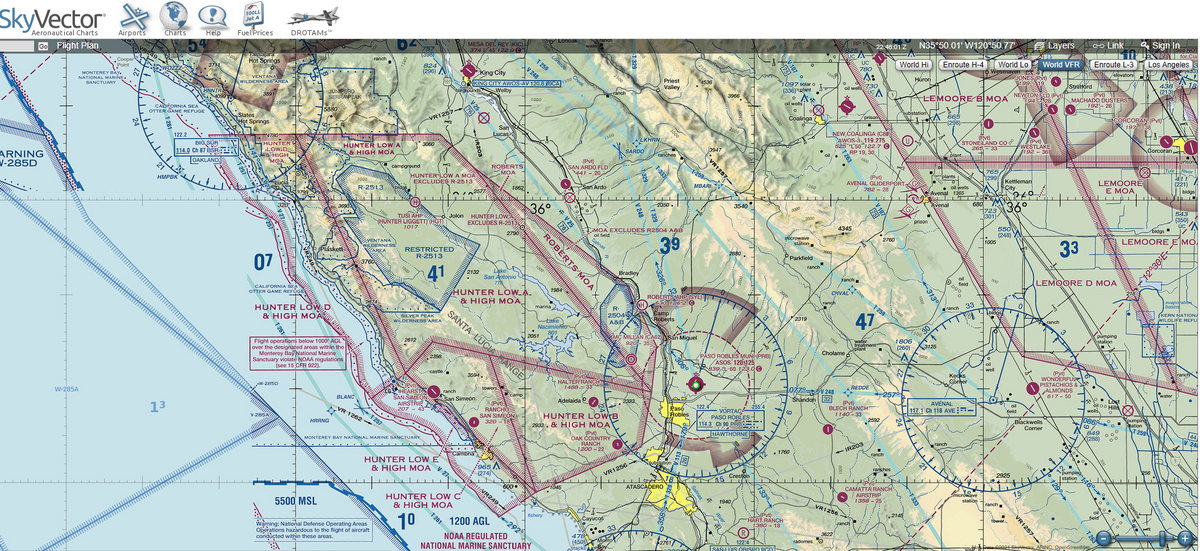
Where do military jets fly in SLO County?
Lieut. Alyssa Larosa, a spokeswoman at the San Diego base for Strike Fighter Wing Pacific, confirmed that there were F/A-18 supersonic combat jets flying over the North Coast on May 11 — specifically military planes flying out of Naval Air Station Lemoore southwest of Fresno and due west from Visalia.
According to NASA, an F/A-18 can fly at Mach 1.7, or up to nearly 1,200 mph.
The training missions were conducted according to FAA regulations, Larosa said, at altitudes controlled by maps of so-called “military operating areas” about allotted air space. Each sector has limits on how high and how low the jets can fly.
The maps, available at Skyvector.com, are divided into various segments, which show where military flights can go.
For instance, a sector from somewhat north of Lucia to halfway between Cambria and Cayucos is covered by the Hunter range. As the name indicates, Fort Hunter Liggett is in the northern portion of that range.
Military jets can fly in, across and through those areas.
Within the southern portion of the Hunter range, there are three sub-areas designated separately, because each has different altitude parameters.
One sliver of a sub-area lies along the coastline, including Piedras Blancas, San Simeon, Cambria, Harmony and slightly beyond.
A second, wedge-shaped slice, which includes Hearst Castle in San Simeon, fills in the gap between the other two segments.
The third, largest of the three segments stretches inland from the eastern edge of the second area to beyond Adelaida but before Paso Robles city limits.
Larosa said military airplanes in the “Hunter Low Delta Range over Cambria can fly from 1,500 feet above ground up to 6,000 feet.”
The maps also show that there are various zones over the ocean that are designated as national defense operating areas, Larosa said, where “operations could be hazardous to the flight of aircraft conducted” within those sectors.
Weather can affect plane noise
Fog, low clouds and land altitude apparently can also play a part in how loud noises from an overhead military jet sound at ground level.
In the past, Navy and Air Force officials have told The Cambrian that weather conditions can amplify significantly the roar of military planes performing training maneuvers. They said that, when the weather pattern includes a low ceiling, the jet noise bounces downward off the dense cloud layer, back down to the ground, making normal levels of noise sound much louder.
That can be especially true when there’s a sonic boom, the officials said of the roar that a plane can make if its speed breaks the sound barrier, producing a distinctive shockwave that can shake and even break windows.
The higher up you are on the ground, the closer you are to the sound and the louder it can seem.
This story was originally published May 19, 2021 at 2:39 PM.