
Goodbye, weaners: Elephant seal pups are leaving SLO County beaches but others are back
Elephant seals are on the beach at Piedras Blancas north of San Simeon, but docents will not be there to help the public understand them.
Friends of the Elephant Seal canceled all docent shifts and closed its office until further notice, to avoid spreading coronavirus.
Taking a walk is part of sheltering in place. The boardwalk is always open, so come out and enjoy the fresh air and sunshine.
Check out the FES website at www.elephantseal.org for information about the seals. The E-Seal News brochure will be available at the bluff.
Goodbye, weaners
Weaned pups, the smallest elephant seals on the beach, sleep among their older cousins and adult females.
The weaners are this year’s cohort of pups. They nursed up to a healthy layer of blubber before their mothers left them behind on the beach.
That blubber now sustains them. They’ll live off it until they hunt their own food out in the open ocean, on their first migration.
Seal pups, born from December through February, are born black, but they molt that newborn coat after they are weaned at four to six weeks old.
Their new, mature skin is dark on top, light on the belly. Their skin will never look better.
The young weaners will leave the beach, one by one, heading north. No one shows them the way; it’s one of the mysteries of animal migration. Some may get as far north as Alaska, but most don’t get that far.
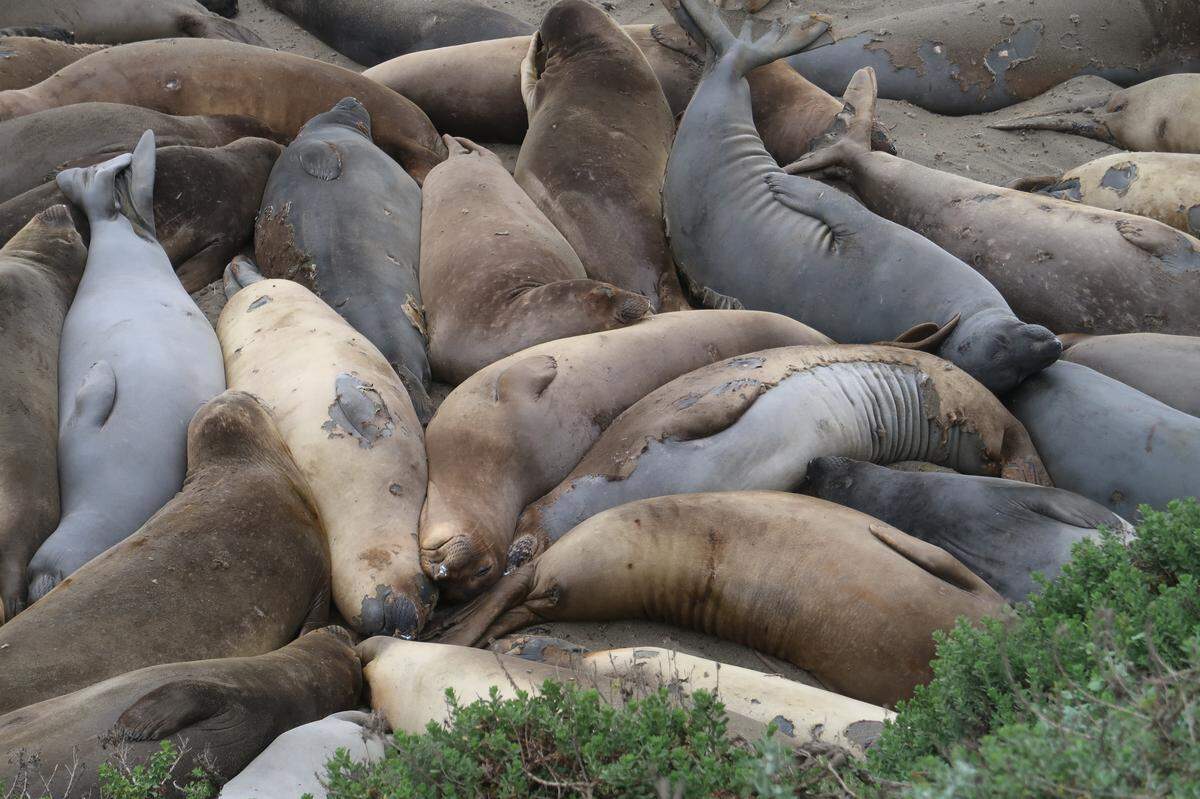
Well-fed females return to Central Coast shore
In April and May, all the adult females and the juveniles of both sexes return from feeding to molt their skin.
That’s all 5,600 females who had pups on the seven or so miles of beaches that are considered the Piedras Blancas rookery, as well as the females who, for one reason or another, didn’t have a pup this year.
They arrive on the beach one by one. The new skin is already forming beneath the old skin.
Within a few days, the old skin begins to peel off — first around body openings such as eyes and nose, and around scars.
Where to spot elephant seals on beaches
The bulls that frequented San Simeon Cove are gone, and with them the winter guides who helped beachgoers negotiate sharing the beach with two-ton seals.
That new program, and State Parks tours at Arroyo Laguna, were well received by visitors.
Weaner pups who have left their birth beach but haven’t gotten very far end up stranded at San Simeon Cove and other beaches.
If they are underweight and exhausted, they may be rescued by a Marine Mammal Center team. This is the busy season for seal rescue.
Seals are thus far unaffected by coronavirus, but wildlife trafficking in other species is thought to be the source of the coronavirus crossover into human infection.
Seals can carry other diseases that can affect humans and dogs — so if you see one on the beach, don’t go near it or touch it.
Instead, call the Marine Mammal Center operations center in Morro Bay at 805-771-8300. They will send out a team to evaluate it and rescue it if necessary.