
Fire danger still a major threat to Cambria’s Monterey pine forest. But it’s getting better
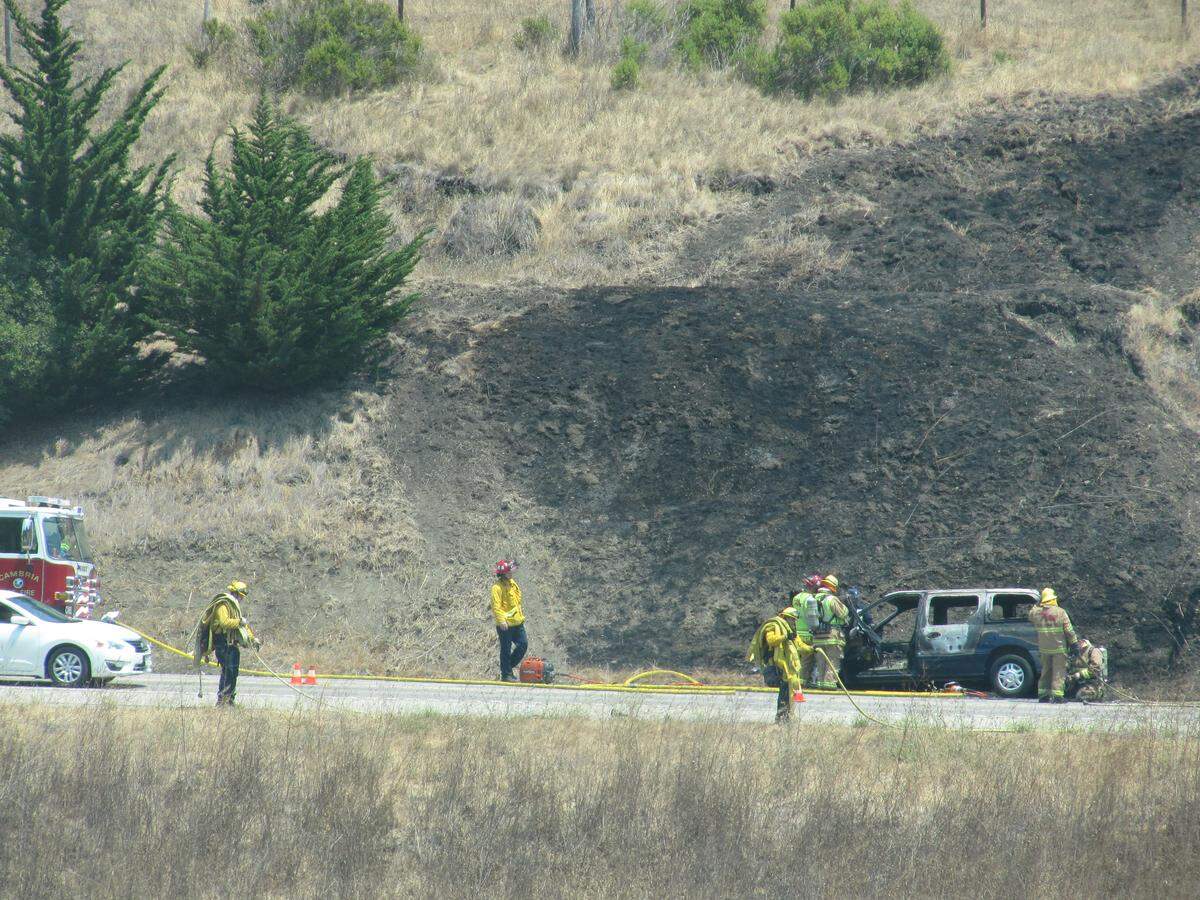
A blue Ford minivan, engulfed in flames at the roadside edge of northbound Highway 1 near the Main Street exit in Cambria, set the adjacent grassy hillside ablaze about noon Sunday, July 29.
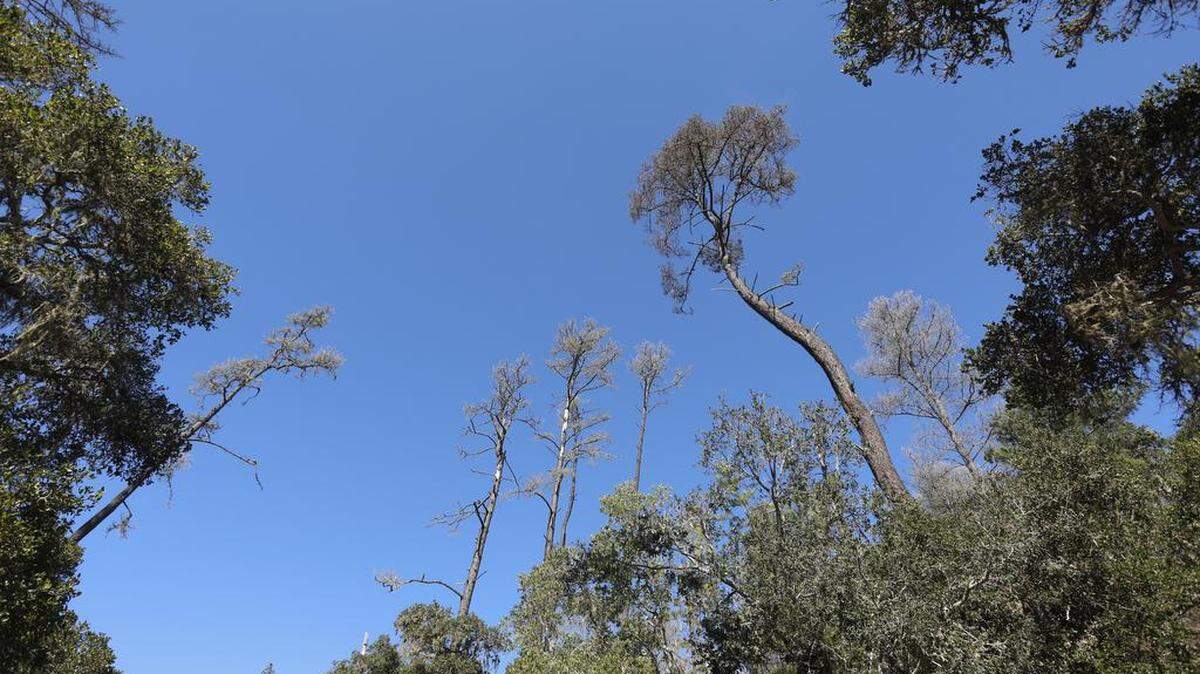
Witnesses could see the North Coast’s nearby rare native forest of Monterey pines. Quick emergency response kept the fire from reaching that potential tinderbox, but public safety and the potential conflagration were foremost in the minds of those battling the blaze.
Local fire crews and CHP officers rapidly tamped the van fire, according to a witness shaken by the close call. But it took more than an hour to unscramble the 7-mile-long traffic jam that had piled up on the highway in both directions, from Harmony to Cambria Drive and beyond.
Lots of people were on the roads that day. It was, after all, a cool summer Sunday on the coast, only 12 days after the popular Big Sur stretch of Highway 1 had reopened after being inaccessible to through traffic for 18 months.
The bumper-to-bumper lanes of stalled traffic “makes you wonder how people would get out if we had a fire up here on Lodge Hill,” Cambria resident Karen Dean wrote that day.
Ramona Voge, another Cambria resident who was among those caught in the traffic jam Sunday, wrote on Facebook the next day, “I’ve come to the conclusion that we are in BIG trouble” if there’s a fire that produces that kind of impact on the area’s traffic.
“No one was going anywhere,” she wrote. “Thankfully, there was almost no wind, no heat, and firefighters, as usual, did a fantastic job in shutting down the fire in quick fashion.”
Wake-up call
The van fire was yet another wake-up call about California’s brutal 2018 fire season so far, and how easily a small incident like a van fire could trigger a conflagration of disaster on the North Coast.
Earlier this month, officials had tallied up nearly 200,000 California acres that had burned since Jan. 1. It’s more than double the average by July 9 of the previous five years, according to an analysis of federal and state fire statistics. published in the Mercury News.
And that was before the current onslaught of so many fierce wildfires blazing across the state.
Relentless fires continue sweeping through Redding, Yosemite, Idlwyld, the Mendocino area and about a dozen other regions of hard-hit California.
In recent years, the state’s fire season has become more intense and longer, prompting some officials to declare that it is now year-round.
Those roaring and sometimes deadly infernos over hundreds of thousands of acres have shifted the focus of many Cambrians onto local conditions — especially during the typical danger months of August through October.
Their concerns bring to the forefront the crucial need to care for and protect the North Coast’s rare native Monterey pine forest while mitigating fire risks that lurk within it.
However, tree experts and fire officials have been anticipating and preparing for the 2018 fire season for some time, studying the forest, caring for it and educating the public.
Agencies and individual property owners have been clearing weeds, brush and dead trees in the annual mandated weed abatement exercise.
Cambria’s services district has cleared various firebreak areas on the Fiscalini Ranch Preserve and has mowed and/or treated other sections.
Cal Fire is continuing to pull French broom and spray weeds, but has ended (until rains return) any burning of stacked logs and brush.
Forest health
The North Coast’s forest is one of three remaining native Monterey pine forests on the U.S. mainland; two more exist on Mexican islands.
The forest has been under duress for decades from beetle attacks, pitch canker fungus and other diseases, old age, encroaching development and other causes. A punishing five-year drought was the final blow for many of the pines and other trees, producing a high mortality rate, increased fire danger and hefty expense for property owners who had to have dead trees removed.
For the moment, the news about the health of the Cambria-San Simeon forest seems encouraging, especially given recent foggy mornings and evenings along the coast.
But forest moisture levels could change quickly and fire danger would ramp up dramatically, according to fire officials.
Alan Peters, Cal Fire’s unit forester, said the March “mini-miracle” rains produced “an abundant grass crop very similar to 2017. Because of this, 2018 has the same fire potential as last year, and there has already been high fire activity in the North County.
“The late rains have kept fuel moistures higher than normal along the coast, which has minimized (local) fire activity thus far,” he said. But through the rest of summer and fall, fires “will likely become progressively more active as the vegetation continues to dry out. The biggest unknowns are the fire-weather events that will occur, including wind events, heat waves and thunderstorms” that can put lightning into the equation.
Peters said that in Cambria’s forest, “after the past two (rainy) winters, the rate of tree mortality continues to be closer to endemic levels similar to 2013 and earlier. The effects of the drought are less apparent now … many of the trees that died in 2015 during the peak of the mortality event have lost their needles, have been removed or have fallen over.”
“Despite rainy winters,” he said, “a significant number of trees throughout the forest, especially in the larger older size class, will continue to die individually and in small groups. The older trees are typically the most vulnerable to insect attack resulting from environmental stressors, most importantly competition for limited water and nutrients.”
Tree death “has slowed dramatically,” he said, in part “because the big wave of tree mortality reduced this competition among the surviving trees.”
Other experts seem to agree with Peters’ assessment.
“Even though we got more rain last year,” biologist Holly Sletteland wrote in a July 2 email interview, “it was still below normal: 15 inches instead of an average of 19 for Cambria, and it was VERY late” in the season.
Sletteland used to be the project manager for Friends of the Fiscalini Ranch Preserve, and still volunteers at the 430-acre-plus oceanside property that’s owned by the community.
“We had to hand-water seedlings that were planted in both 2016 and 2017,” Sletteland said, “and still ended up losing quite a few.”
She continued, “We also still have trees dying, both large, mature trees as well as good-sized saplings. That was expected, as they were seriously stressed during the drought.
“It does seem to be slowing down a little, though,” she concluded.
Crosby Swartz, chairman of the Cambria Forest Committee, said tree conditions in forested areas near the ocean “seem to be normal, although we’re still seeing some trees dying, probably triggered by the drought” and advanced age of the pines.
In forest areas farther away from the ocean, there are still a lot of dead and dying trees, he said.
The drought exacerbated the forest’s normal life cycle, he said, “accelerating the demise of weaker trees. Then smaller trees take their place. We lose a bunch of 80-foot trees and then we have a bunch of small trees coming up.”
Diagnosis
The good news?
“Certainly, the health of the forest is in the normal range,” Swartz said. “There’s not too much that needs to be done,” other than removing hazardous trees “anywhere near a trail, for instance, or a dead tree within range of falling on your house. The concern is not only for people in the home, but for firefighters.”
And those oak moths fluttering around the forest?
“They come in blooms or cycles,” Swartz said. “There’s not much you can do. We have our trees sprayed, but the moths are all over the place. I’ve heard that the tree can recover from defoliation (from the moths) once or twice a year.”
He added: “The bottom line is there’s a limit to what you can do. Watch your trees. Have them treated if they need it. Take care of dead trees that are hazards.”