SLO County town’s rarely used water plant could get more affordable. Here’s how
AI-generated summary reviewed by our newsroom.
- Pilot tests show proposed project cuts brine volume 97.5% and trims disposal costs.
- ZLD could end up to nine daily 4,500–6,000‑gallon tanker hauling trips, cutting costs
- Scaled system may recover about 95,550 gallons/day pure water, yield baggable salt waste.
Officials say promising initial test results from a pilot project prove the process could potentially reduce the cost of running Cambria’s controversial, idled water reclamation facility, making it more viable and affordable to run.
The “zero -liquid discharge” process would accomplish that by drastically reducing by 97.5% the liquid in the plant’s leftover brine, according to the experts, including Clark Easter, founder and CEO of Global Water Innovations Inc.
The final brine treatment step in the Cambria Community Services District’s reclamation process has been a pricey sticking point for getting the larger, decade-old facility up and running consistently, other than just during declared water shortage emergencies.
That’s all the plant’s current permit allows for the frequently water-challenged community of about 6,000 people.
If Global Innovation’s full-sized zero liquid discharge (ZLD) project works as billed, and as tests seem to prove it would, it could substantially lower the CSD’s cost for disposing of the brine more efficiently and economically.
The current option for handling the brine long term would be hauling it out of town by 4,500- to 6,000-gallon tanker trucks to a licensed disposal site, such as one in Oceano. That’s 53 miles from the plant.
“Up to nine truck trips per day would be required during peak operation,” the CSD’s permit application says.
“What we are piloting represents a breakthrough in brine treatment — making inland desalination affordable and practical at many inland sites that have impaired water of various sorts,” Easter said.
The initial test batch is designed “to evaluate system performance and confirm operational readiness,” CSD general manager Matt McElhenie told The Tribune by email.
Initial calculations look good so far, Cambria officials say
If the idled water reclamation plant at 990 San Simeon Creek Road was running regularly, the Cambria Community Services District’s costs just to haul away the brine and pay disposal fees for it currently would cost about $0.25 per gallon, equating to about $25,000 a day, according to Easter.
That firm has completed the pilot testing and, on its website, bills itself as “project developers of cost-effective, zero brine, renewably powered desalination solutions for agriculture and cities.”
“We are now demonstrating over 97.5% recovery (of water) from Cambria’s brine,” Easter told The Tribune on Friday.
The pilot process left behind pure water from at an estimated cost of around $0.03 per gallon, and “according to my understanding, that would make their reverse-osmosis plant affordable to run during droughts,” Easter said.
The Global Water process reduces the salty brine to a “semi-solid brine concentrate,” according to the CSD’s application for a permanent operations permit for the water-reclamation facility.
That document, which indicates the zero-liquid disposal process is the district’s preferred handling of the brine, was accepted Oct. 15 by the county after years of negotiating and consulting, and now is being reviewed for environmental and other impacts.
There’s another significant potential benefit to the zero-liquid discharge concept, Easter said.
Global Water Innovation’s process also “can recover at least 95,550 gallons per day of pure water from that 98,000 gallons per day of brine (the plant’s estimated output), leaving behind only 2,450 gallons per day of a highly concentrated brine.”
Having tentatively wrapped up the pilot testing in mid-December, “we will be analyzing data for several weeks,” Easter said.
Global Water Innovations will ship the final, highly concentrated brine from Cambria’s pilot test to another facility to be tested and dried.
“We anticipate that their process will allow us to get the salts sufficiently dry that they can be bagged and sent to landfill,” Easter said.
How water reclamation works
The water reclamation facility pulls blended fresh, brackish and treated wastewater from the district’s primary underground aquifer near San Simeon Creek, then treats it and removes various elements, including salt, before reinjecting the retreated water back into the aquifer.
The desalting process produces a lot of hyper-salty, leftover brine laced with other elements that cannot be added as is to the aquifer, so the water reclamation concept’s initial design in 2014 included a big pond from which that liquid could mostly evaporate.
Unfortunately, the pond plan didn’t prove out, and the project has been mostly mothballed for years while ratepayers continue to shell out monthly toward a more than $13 million, 20-year loan that still has years to go before it’s paid off.
The project’s primary loan “is scheduled to be fully paid off in 2038 under the current amortization schedule,” McElhenie said in October. He noted that “the district also carries standard municipal infrastructure debt associated with water-distribution improvements and wastewater capital projects.”
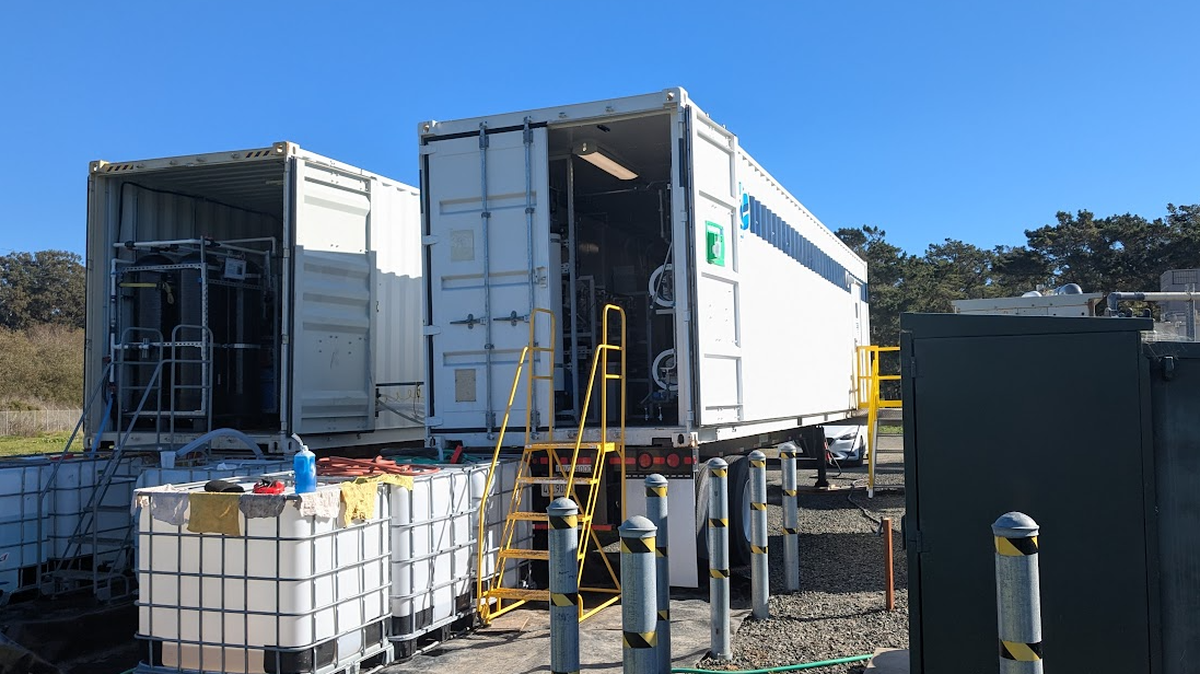
As the pilot’s testing has progressed, Easter and CCSD staffers led tours of the project installed recently near the water reclamation plant.
Among tour invitees were California Coastal Commission staffers, engineers from the Wallace Group, members of the CSD’s Resources & Infrastructure Committee, some ratepayers and others, according to Karen Dean, the committee’s chairperson.

“We did ask about cost of a full-size permanent ZLD unit, but Clark said he could not give us an estimate at this time,” Dean said.
Among their other questions were several about electricity use, she said.
Those answers could be forthcoming from Easter soon, according to Dean and McElhenie.
Easter’s report could go before the CSD’s directors early in the first quarter of 2026, although Easter said he wants to present the stats to the board in January.