Paso Robles investigation supports Ty Lewis’ allegations against Chris Bausch
AI-generated summary reviewed by our newsroom.
- Bausch refused to be interviewed during a misconduct probe into his own behavior.
- Investigator sustained several harassment claims filed by former city manager Lewis.
- City paid $643,000 in legal fees and settlements from general and insurance funds.
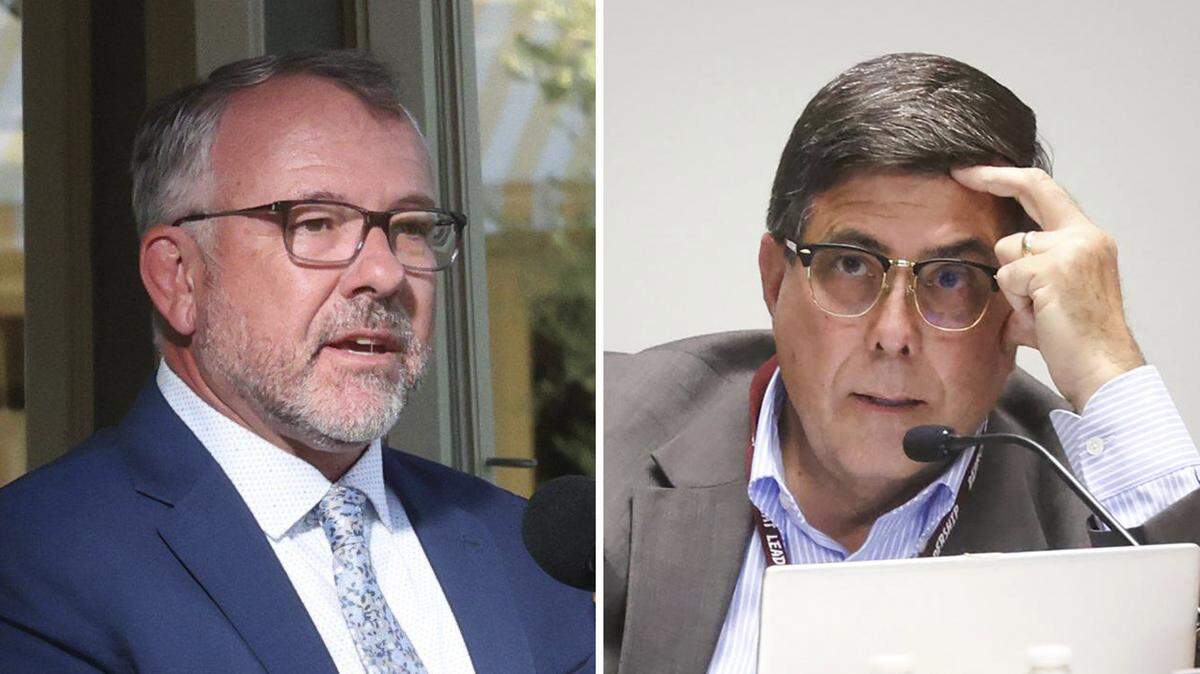
The summary of Paso Robles’ investigation into the harassment complaint by former city manager Ty Lewis against Councilman Chris Bausch supported several of Lewis’ allegations, while also noting it was missing one key interview: Bausch himself.
Bausch apparently refused to participate in the investigation into his own conduct, the summary showed.
The executive summary was released as part of the settlement of The Tribune’s public records lawsuit against Bausch and the city, which was filed in March and resolved on Monday.
As part of the settlement, the city agreed to pay $277,000 in legal fees: $250,000 to The Tribune and $27,000 to Bausch after Bausch refused to sign it unless the city covered at least part of his personal defense. The settlement costs will be covered by taxpayers and are coming out of the city’s general fund, which provides money for core city services, including police, fire, street maintenance and parks, the city said.
The investigator, Valentina Reiner, wrote that she reached out to several different individuals with relevant knowledge of the allegations. In total, she interviewed 16 people and obtained documents from Lewis, the city and an unnamed witness. It noted that an unnamed person reached out after the fact-gathering portion of the investigation was completed, but the information provided was outside the scope of the investigation so the individual was not interviewed.
She said Bausch did not participate, calling his “missing interview” a “significant caveat” to the findings of the investigation.
The four-page summary is only a small piece of the totality of the investigation into Lewis’ claim. It does not include interview transcripts, documents or specific methodology.
It also did not address the conduct of other people Lewis named in his claim as allegedly conspiring to ruin his reputation and oust him from his position as the city’s top administrator, including Cal Coast News reporter Karen Velie, former City Council candidates Linda George, Michael Rivera and Glenn O’Hagan and local Republican Party leader Gary Lehrer.
“An interview produces a spontaneous, tested and detailed account on the issues, and the missing interview could potentially have generated information that supported or refuted allegations with an impact on the outcome,” she wrote.
Lewis settled his claim against the city and Bausch for $365,000 on Jan. 26. The city paid him $145,954 from its general fund with the remaining $220,000 covered by the city’s insurer.
Several of Lewis’ claims sustained, investigative summary says
The summary found that several of Lewis’ allegations against Bausch regarding harassment and creating a hostile work environment were sustained or partially sustained, meaning they were confirmed based on a preponderance of the evidence.
The investigation found that Bausch did make “unwelcome, offensive remarks based on sex” when he told Lewis of a rumor that Lewis was at sex parties and asked if Lewis was sure there were no photos of him at a sex party with men or women at some point in 2022 or 2023. It did not sustain that the offensive comment was based on gender, sexual orientation or perceived sexual orientation.
“Such remarks during a regular work meeting, without supplying context, specifics or work-related basis for them, would be inappropriate and reasonably offensive,” the summary said, noting there was supporting evidence included in Lewis’ account and in accounts of others who Lewis told about the interaction.
The investigation also found that Bausch made a comment about Lewis being “in bed” with a specific woman Bausch named on two separate occasions — once on an unknown date in 2022 or 2023 and again on April 8, 2024, but noted that it was unclear if “in bed” had a sexual implication, such as an affair, or if it was a political or financial implication.
“The phrase itself is a sexual metaphor which could reasonably be perceived as crude and inappropriate in a workplace discussion,” the summary said.
While the allegations were sustained, the investigation found these three instances to be “limited and sporadic” and said the evidence did not substantiate conduct that was frequent, pervasive or at a level sufficient to interfere with Lewis’ performance or alter his work performance.
But that doesn’t mean the comments were appropriate or welcome, the summary said.
In his claim, Lewis said the stress from the hostile environment created by Bausch led him experience several health challenges, including sleep distress, stomach and gastrointestinal issues and severe anxiety leading up to a May 7, 2024, City Council meeting where he suffered a fainting spell. He was then diagnosed with extreme hypertension that made him unable to work.
The investigation discounted a third comment on April 8, 2024, about Lewis being “in bed” with a different female, with Lewis himself clarifying that the comment did not occur.
On April 8, 2024, Bausch did make a comment to Lewis about him not saying the Pledge of Allegiance and not bowing his head or praying during invocations, but it did not substantiate that the comment was based on Lewis’ religion or in a derogatory way.
“Remarking on or questioning why Lewis did not bow his head during invocations was more likely than not religion-based, because invocations are typically, inherently religious in content,” the summary said.
While religious topics and practice are not banned from the workplace, employees also have the right to not participate in the practices, the summary said.
“With variations in the evidence, it was not sufficient to establish more of Bausch’s verbiage or further context,” the investigation found, again noting Bausch’s missing interview.
The investigation further found that all of the sustained remarks, two of which were during one-on-one meetings, were discourteous and disrespectful, adding that Bausch did engage in “pointed staring and negative facial expressions at Lewis in some verbal interactions with him in council meetings.”
The sustained allegations did not substantiate generalized discourtesy, disrespect or intimidation by Bausch apart from the specific remarks, the investigation found.
The summary said there was credible evidence that Bausch’s approach with Lewis and others “can be inquisitorial, overtly doubting or suspicious, with an air of superior knowledge,” noting that much of the information was generalized.
It also noted that many examples did not relate directly to Bausch’s conduct specifically toward Lewis, which was the conduct under investigation.
Evidence did support that “Bausch invoked a pointed, purposeful stare and projected an angry or negative expression in verbal communications with Lewis and with others with whom Bausch seemed to disagree,” the summary said. “There was cross-corroboration of this behavior by Lewis and others.”
The executive summary did not state an overarching finding on the culmination of the sustained allegations.
This story was originally published September 9, 2025 at 11:47 AM.