Jewish movie showing in SLO led to accusations of antisemitism. What happened?
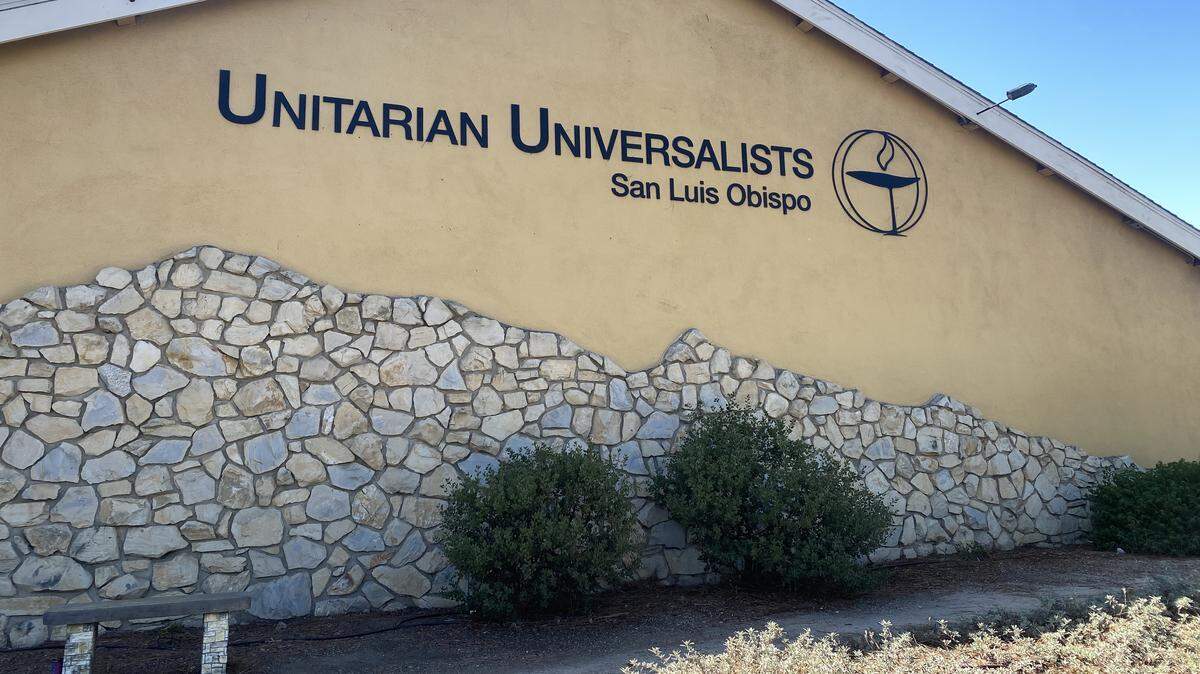
On a Friday evening in early August, about 120 people packed into the social hall of the Unitarian Universalists church in San Luis Obispo, all gathered to watch the film, “Israelism.”
The documentary explores the journey of two young American Jews as they grapple with Judaism’s relationship with Israel, and Israel’s treatment of Palestine. A question-and-answer panel discussion followed the film screening.
What was designed as an inclusive, informative event, however, saw the aftermath devolve into anything but that, amid accusations of antisemitism and conflicting accounts of what actually occurred.
“Our intent was, again, just to provide education and a place for people to connect,” panelist and Jewish Voices for Peace volunteer Donna Hare Price said. “We wanted to address the liberation of all people and have that platform for diverse voices and dissenting voices so we could all feel part of a community.”
In the wake of the movie and discussion, a coalition of Jewish organizations released a statement alleging that an audience member called for a repeat of the Oct. 7 attack on Israel, when Hamas killed about 1,200 people and took about 250 hostages.
Other witnesses, however, said they did not hear such a statement.
The grievances shared by the Jewish organizations then lingered when the various parties were unable to connect, work through what happened and repair their relationships.
BEHIND THE STORY
MOREWhy did we report this story?
Tribune reporter Stephanie Zappelli spent two weeks tracking down exactly what happened at the showing of the “Israelism” movie in SLO and how the response was handled in the aftermath. Click on the arrow to read more.
Should we even write about it?
At first, Stephanie said that writing an article about the antisemitism allegations felt like throwing a match on smoldering kindling. She worried the article would cause further division in the community and harm efforts to resolve the conflict. So she spent the better part of two weeks interviewing witnesses and stakeholders to piece together as clear of a picture of what happened at the film screening as possible, and to gain an understanding of how an article would impact the community.
Why we decided to go ahead
As days passed, the community conversation about the event escalated, with misinformation spreading by word of mouth and on social media. Many people who weren’t there weighed in with little knowledge of what actually happened. Ultimately, that’s what prompted Stephanie to write the story. Her goal with this article was to set the record straight: to share as many witness accounts of the event as possible and to provide an opportunity for respected community organizations like the Jewish Community Center and the Diversity Coalition to be in conversation with one another. She hopes people can come away from the article keeping Rev. Brigitta Vieyra’s messagein mind: Here, we’re watching a community struggling to connect and repair. We must approach each other in good faith, with openness and mutual accountability, to come to a resolution.
As a result, the well-intentioned evening spiraled into a weeks-long public battle, dividing the community instead of bringing it together.
The Tribune looked into the event and its aftermath as part of its Reality Check series, interviewing 10 people to fully understand what happened.
First impressions of the event were positive
In planning for the Aug. 8 event, the organizers prepared for an audience of about 25 people, but there wasn’t a way to RSVP, so the group didn’t have an accurate count of how many people would attend, Hare Price said.
As community members poured into the room, organizers set up more tables and chairs and baked extra pizza for the steadily growing audience.
The church and the Diversity Coalition San Luis Obispo County co-sponsored the event, with the congregation hosting and funding the film screening, and the Diversity Coalition advertising the event. The Diversity Coalition did not contribute funding to the event.
Interim minister Rev. Brigitta Vieyra opened the event with a grounding exercise, inviting the audience to take a deep breath, and reminding everyone to engage with each other respectfully.
Not all event attendees arrived in time for the grounding exercise, however. The church advertised that the event started at 6 p.m., while the Diversity Coalition said it started at 6:30 p.m. — so some people arrived at 6:30 after the film had begun.
When the film ended, four panelists set up at the front of the room to facilitate a discussion about the movie.
The panelists included Cayucos resident and peace activist Vicki Tamoush, Palestinian Cal Poly plant science professor Dr. Ashraf Tubeileh, and two representatives of Jewish Voices for Peace, Sarah Bridger and Donna Hare Price.
Originally, the panelists planned to have an unmoderated discussion with those who attended the event. But with such a large audience, they fetched a microphone and pivoted to a Q-and-A-style discussion.
Audience members were invited to form a line and use the microphone at the front of the room to ask questions of the panelists. Witnesses described the environment during the panel discussion as busy, with audience members moving around the room — some to leave, others to stretch their legs or find the restroom. The microphone was occasionally difficult to hear during the discussion.
“It was very difficult, obviously, with 150 people to get questions answered correctly,“ Hare Price said. “We have learned how we would obviously do better.”
Next time, Hare Price would have invited a moderator to collect questions from the audience, perhaps using question cards, to deliver to the panelists. She also would have preferred to bring more microphones to pass around such a large group.
Still, Hare Price considered the event a success — as people seemed engaged in the movie and spoke respectfully during the discussion.
“We were taken aback by how many people were hungry for this information, and how people afterward were asking for more spaces and places and platforms for folks to come together and discuss complicated issues in a positive, nurturing environment,” she said.
Antisemitic comments allegedly made at film screening
The organizers’ positive impressions, however, were not shared universally.
That’s because the second audience member to speak on the microphone during the Q and A allegedly made an antisemitic comment, according to an anonymous member of the Jewish Community Center of SLO.
On Aug. 28, the witness told The Tribune that he thought he heard the audience member say, “the Jews deserved Oct. 7, and it should happen over and over again until they learn.”
During a second interview on Thursday, the witness said he was 98% certain that the woman specifically mentioned “the Jews” in her comment. Alternatively, the woman may have said “they” instead of “the Jews,” the witness said.
Either way, the comment felt targeted at the Jewish community, he said. Also, the panelists appeared to nod in agreement with her comment, he said.
“What she said directly effects my ethnicity, my religion, my culture, my heritage,” he said. “It was a direct attack on it.”
He attended the event to share his perspective as a Jewish father who has family living in Israel, but he said he was so shocked by the alleged comment that he froze — unable to stand to speak during the Q and A.
“I was sitting there with the wind knocked out of me,” he said. “To actually hear that in my own community that I deeply love was just, like, a punch to the gut. I could not believe it.”
Another anonymous San Luis Obispo County resident told The Tribune that he heard an audience member say that she would support repeated Hamas attacks on Israel like Oct. 7. Additionally, both men reported that they heard panelists call for a boycott of the Jewish Community Center of SLO and the Anti-Defamation League.
Meanwhile, other community members reported a different experience at the film screening.
The Tribune interviewed five other witnesses, including panelists Vicki Tamoush and Donna Hare Price, church congregant Jan Meslin, church board president Ken Hill and one other anonymous San Luis Obispo County resident.
None of those witnesses heard an audience member call for a repeat of the Hamas attack, nor did they hear a call for a boycott of the Jewish Community Center or the Anti-Defamation League, they said.
“Sometimes after a controversy, people remember things differently,” Tamoush told The Tribune.
Tamoush said she couldn’t even identify a comment that came close to calling for a repeat of the Oct. 7 attack, she said.
“I myself would have spoken against that,” she said.
When discussing the film, people didn’t raise their voices or argue with each other, she said.
“I felt like it was an informative evening of mature, thoughtful, sensible people who wanted to learn more about the topic,” she said.
Hill also characterized the event as civil. He did not hear a call for another Oct. 7 attack, and he said he would feel “duty-bound” to speak up if he had heard a comment like that.
Still, he acknowledged that people from different cultural backgrounds may interpret statements differently. Hill did not speak on behalf of the church.
“I’m sensitive enough to understand that other people may hear and see things differently,” he said. “There’s a lot going on right now that’s extremely traumatic to people, and I want to sit down in a room and really understand it.”
He said he hopes the coalition of Jewish organizations who signed the statements can meet with the Unitarian Universalists Church and the Diversity Coalition to come to a better understanding of what happened at the film screening.
“I want to understand how we get to healing,” he said. “To me, this is not a public relations thing at all. This is a heart thing. This is about caring and loving each other, and that’s where I want to get to.”
How did the community respond to the event?
Following the event, about seven witnesses reported their experiences to the Jewish Community Center, whose staff then requested guidance from the Anti-Defamation League’s Santa Barbara Office on Aug. 12, according to ADL regional director Joshua Burt.
He attended a meeting with a coalition of Jewish organizations, including the Jewish Community Center, SLO Hillel, Stand With Us, Congregation Ohr Tzafon, Temple Ner Shalom and Congregation Beth David.
The coalition decided to put out a public statement on Aug. 19 before contacting the Diversity Coalition about the allegations. Read the statement online at bit.ly/46k342l.
“When hateful comments, violent comments, exclusionary comments are said publicly, they need to be condemned publicly, and we did not have the confidence that the Diversity Coalition or the church would do so publicly without public pressure,” Burt said.
Then District Attorney Dan Dow commented in on the issue, reposting the statement on the social media platform X while condemning the alleged comments.
The statement blindsided Diversity Coalition executive director Rita Cassaverde, who said she was shocked by the allegations. The three Diversity Coalition board members in attendance did not hear the antisemitic comments reported by the ADL.
In response, the Diversity Coalition requested a meeting with the coalition of Jewish organizations through the city with no response, and on Aug. 23, it sent a letter to the organizations and again requested a meeting.
After still receiving no response, the Diversity Coalition posted its statement on social media on Aug. 26. Read the statement online at bit.ly/47qisLC. The church also released a public statement online at bit.ly/3JHpBxo.
The Diversity Coalition’s statement apologized for “unintended pain and distress caused by the screening of the film,” and said that the coalition “has always unequivocally condemned any expressions of antisemitism or hate speech.”
However, the statement did not acknowledge the specific comments that were allegedly said at the event.
The coalition of Jewish organizations put out a second statement on Aug. 28, calling on the Diversity Coalition and the church to condemn the alleged statements as antisemitic. If they do, the coalition will agree to an in-person meeting, Burt said.
Casaverde said the Diversity Coalition is not ready to address the specific comments without clarity about who said them, when and where — especially considering no one from the Diversity Coalition or the church reported hearing those comments.
She said the public battle over the event escalated tension in the community, making it difficult to resolve the conflict.
“The safety of the community comes first, and that safety is not going to happen as things continue to escalate,” she said. “If we could have that in-person meeting, we think that we could come to an understanding.”
Congregation Beth David’s Rabbi Micah Hyman did not attend the event, but he said it’s important to condemn any allegations of antisemitism whenever they are reported.
“When I have people in my own Jewish community making these really deeply, troubling comments of what they heard, I have to support them whether it was said or not,” he said. “More important is not what was said, but how we hear one another.”
He encouraged the community to come together.
“This is not an ‘us or them,’” he said. “Those are the bridges of understanding we need to move toward.”
Vieyra, the Unitarian Universalists interim minister, said she hopes the community can focus on repairing relationships with each other.
“The heart of this moment is a community rumbling with how to stay in relationship, practice repair and hold both complexity and mutual accountability even, and especially, through the hardest conversations,” she said in a statement to The Tribune.
This story was originally published September 5, 2025 at 12:49 PM.