What to do if you see ICE agents on the CA Central Coast
Para leer este artículo en español, haga clic aqui.
As immigration agents descend on the Central Coast, immigrant advocacy organizations are mobilizing their communities to respond to U.S. Immigration and Customs Enforcement activity.
With ICE operations concentrated in Los Angeles and moving up the coast through Ventura and Santa Barbara counties, local leaders expect immigration agents to pass through San Luis Obispo County next.
Here’s what to do if you see immigration agents in public, at your workplace or your home.
What to do if ICE stops you in public
The American Immigration Lawyers Association created a list of what to do when stopped by immigration agents in a public place:
- You have the right to remain silent. You do not have to answer questions or show any documents.
- If you chose to remain silent, say, “I choose to remain silent.”
You do not have to sign any paperwork.
- Ask if you are under arrest or if you are free to leave.
- Do not show false documents or share false information.
- You may refuse a search of yourself or your belongings unless officers have a warrant.
- “If they search you anyway, do not resist physically. Document what happened — this may help in a future legal case,” the group said.
- You have the right to speak to a lawyer.
If immigration agents pull you over while you’re driving, you can show them a valid driver’s license, but you don’t have to offer them any other documentation, according to the 805 Immigrant Coalition.
If you are stopped by immigration agents, call the 805 Undocufund’s Immigrant Rapid Response Hotline immediately at 805-870-8855 — even while being questioned. They will send a responder to support you and protect your rights.
“Your safety matters. We are here for you,” the organization said in an Instagram post.
Where to report ICE activity
People can report ICE activity, immigration raids, checkpoints, detentions and arrests of undocumented individuals to the 805 Undocufund’s Immigrant Rapid Response Hotline at 805-870-8855. The network will then text those enrolled in their service about confirmed ICE sightings. Text “ALERT” to the hotline number to receive real-time updates.
The services and resources available through the organization’s hotline are:
- Access to information about confirmed ICE arrests.
- Verification of reports of ICE activity to prevent misinformation and panic.
- Notification of sightings through social media platforms and the group’s internal alert system.
- Phone support through trained operators, ensuring that impacted individuals receive guidance and resources in real-time.
- Referrals to a trusted network of nonprofit, private and public attorneys.
- Over-the-phone “Know Your Rights” information.
“Our Rapid Response Network exists to combat misinformation, provide immediate support and ensure our communities are prepared, not panicked. We are not just responding to enforcement actions — we are building a stronger, more informed community that stands together in solidarity,” 805 UndocuFund executive director Primitiva Hernandez said in a statement.
To volunteer to support the Rapid Response Network as dispatchers or legal observers, sign up online at bit.ly/3WEmSbs.
You can donate to 805 UndocuFund online at www.805undocufund.org/donate. Those donations will fund the cost of sending text messages for the Rapid Response Network as well as direct assistance to undocumented immigrants.
People can also report ICE sightings to the community group 805 La Voz, which will then announce ICE and Border Patrol activity on its Facebook page.
What to do if ICE enters your business
The National Immigration Law Center created a guide for employers called “What to Do If Immigration Comes to Your Workplace,” accessible online at bit.ly/4aMrxhf.
ICE agents can enter public areas of a business without the owner’s permission, including parking lots, a restaurant’s dining area or a lobby. However, ICE agents can only enter the private area of a business with a judicial warrant or the employer’s permission.
“A judicial warrant must be signed by a judge and say ‘U.S. District Court’ or a state court at the top,” the guide said.
ICE agents might instead present an administrative warrant issued by federal immigration authorities, which “does not allow agents to enter private areas without your permission,” the guide said.
If the federal agent does not have a judicial warrant, the employer can prevent them from entering private areas of the business and speaking to employees there.
To indicate that an area is private, use signs to label it as such and keep the doors closed or locked, the guide said.
The guide recommended that employers make a plan for when ICE shows up at their workplace, inform employees of that plan and practice for ICE raids in a similar fashion to a fire drill.
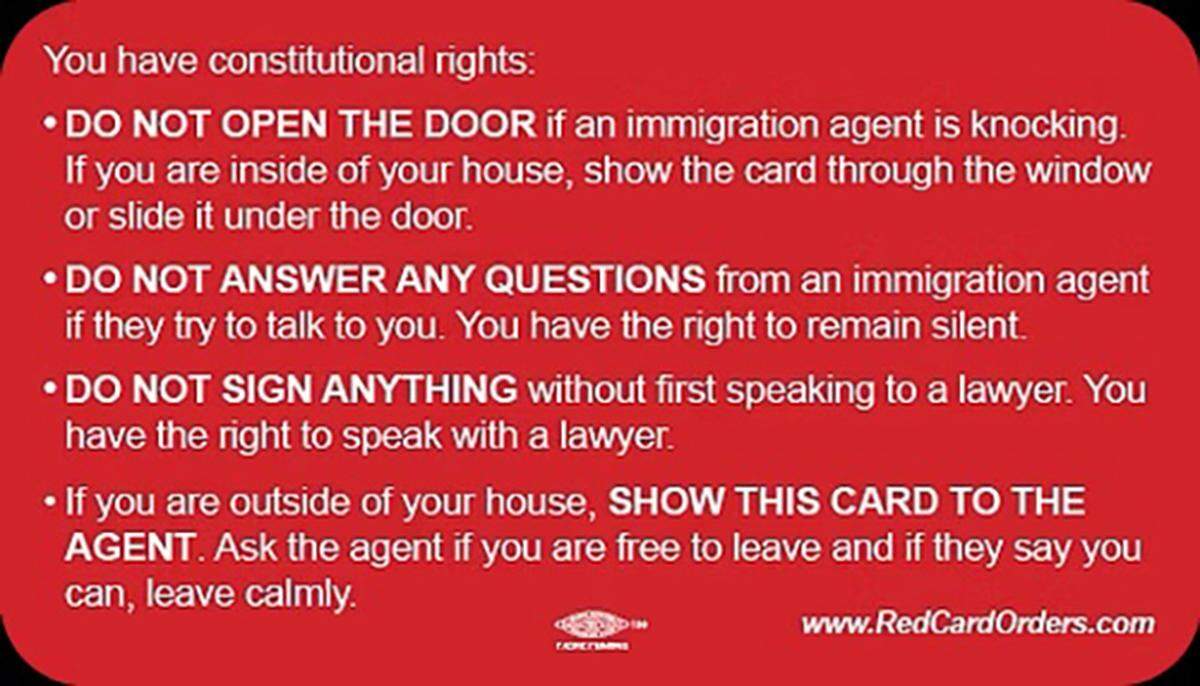
Employers can also distribute “Know Your Rights” red cards to their employees and patrons.
Created by the Immigrant Legal Resource Center, the cards list the constitutional rights all people have regardless of their citizenship status when speaking to immigration agents.
Those rights include:
- That people do not have to open the door of their home to an immigration agent
- The right to remain silent when approached by an immigration agent
- The right to speak to a lawyer before signing any documents
The cards also include a message to inform immigration agents of those rights. People can give the card to an agent who is trying to question them.
The center also offers translated versions of the red cards to support monolingual immigrants.
Download the artwork to print the cards at www.ilrc.org/red-cards-tarjetas-rojas.
This story was originally published June 11, 2025 at 3:38 PM.