How to support undocumented immigrants in SLO County as Trump pushes deportation plan
Fear has rippled through San Luis Obispo County’s immigrant community in the wake of President Donald Trump’s executive orders supporting plans for mass deportation.
Undocumented immigrants and members of mixed-status families have reported a reluctance to go to work, to the doctor or to send their children to school since Trump’s inauguration, SLO County Diversity Coalition executive director Rita Casaverde told The Tribune.
“Deportations and ICE raids are not new to the community. We have seen it for decades over different administrations,” Casaverde said. “But there’s an added layer of fear. It’s definitely affecting the community.”
Between 6,900 and 8,000 undocumented immigrants call San Luis Obispo County home, according to a recent local study. About 70% of them have lived in the United States for 10 years, the study said.
Numerous local organizations are working hard to offer resources to undocumented immigrants and their families during this time — and there’s plenty of ways for The Tribune’s readers to support those efforts.
Manuel Barba, owner of Traffic Records in Atascadero, encouraged people to speak out against Trump’s deportation plan and support their neighbors.
“We should really use all of our voices and platforms to talk about what’s right and protect people,” he said.
Here’s a guide to ways you can support the local immigrant community.
Where to volunteer and donate
The 805 UndocuFund Rapid Response Network is seeking volunteers to report ICE activity and support those impacted by immigration enforcement actions.
The network is seeking three types of volunteers:
- Legal observers, who “monitor and document ICE activity to ensure transparency and accountability,” the website said.
- Dispatchers, who “answer hotline calls, document reports and coordinate responses with the appropriate teams,” the website said. Bilingual volunteers who speak Spanish and English are especially helpful.
- People who “provide emotional and logistical support to individuals facing immigration-related challenges, such as attending court hearings or legal appointments.”
Volunteers will be screened and trained by 805 UndocuFund. Sign up online at bit.ly/3WEmSbs.
Additionally, people can report ICE activity, immigration raids, checkpoints, detentions and arrests of undocumented individuals to the organization’s Rapid Response Hotline at 805-870-8855. The network will then text those enrolled in their service about confirmed ICE sightings.
During its first week of operation, the organization said the hotline has been:
- Providing accurate information about confirmed ICE arrests here
- Responding to and verifying reports of ICE activity to prevent misinformation and panic
- Sending alerts through social media platforms and the group’s internal alert system
- Offering phone support through trained operators, ensuring that impacted individuals receive guidance and resources in real-time
“Our Rapid Response Network exists to combat misinformation, provide immediate support and ensure our communities are prepared, not panicked. We are not just responding to enforcement actions — we are building a stronger, more informed community that stands together in solidarity,” 805 UndocuFund executive director Primitiva Hernandez said in a statement.
People can also report ICE sightings to the community group 805 La Voz, which will then announce ICE and Border Patrol activity on its Facebook page.
“Over the next four years, it’s essential that we come together to create a safe space for our community that we can trust,” the Facebook group’s administrator posted on Jan. 31. “If you know of something going on or have information to report, don’t hesitate to contact us.”
Finally, people can donate to multiple organizations that support local immigrants.
Donate to 805 UndocuFund online at www.805undocufund.org/donate. Those donations will fund the cost of sending text messages for the Rapid Response Network as well as direct assistance to undocumented immigrants.
SLO County Undocusupport offers resources and advocacy to immigrant families. Donate to them through The Community Foundation at www.sloundocusupport.org/donate.
Donate to the Diversity Coalition SLO County at www.diversityslo.org/donate to support the distribution of “know your rights” information and to Mujeres de Acción to support 805 La Voz.
What can businesses do?
The National Immigration Law Center created a guide for employers called “What to Do If Immigration Comes to Your Workplace,” accessible online at bit.ly/4aMrxhf.
ICE agents can enter public areas of a business without the owner’s permission, including parking lots, a restaurant’s dining area or a lobby. However, ICE agents can only enter the private area of a business with a judicial warrant or the employer’s permission.
“A judicial warrant must be signed by a judge and say ‘U.S. District Court’ or a state court at the top,” the guide said.
ICE agents might instead present an administrative warrant issued by federal immigration authorities, which “does not allow agents to enter private areas without your permission,” the guide said.
If the federal agent does not have a judicial warrant, the employer can prevent them from entering private areas of the business and speaking to employees there.
To indicate that an area is private, use signs to label it as such and keep the doors closed or locked, the guide said.
The guide recommended that employers make a plan for when ICE shows up at their workplace, inform employees of that plan and practice for ICE raids in a similar fashion to a fire drill.
Employers can also distribute “know your rights” red cards to their employees and patrons.
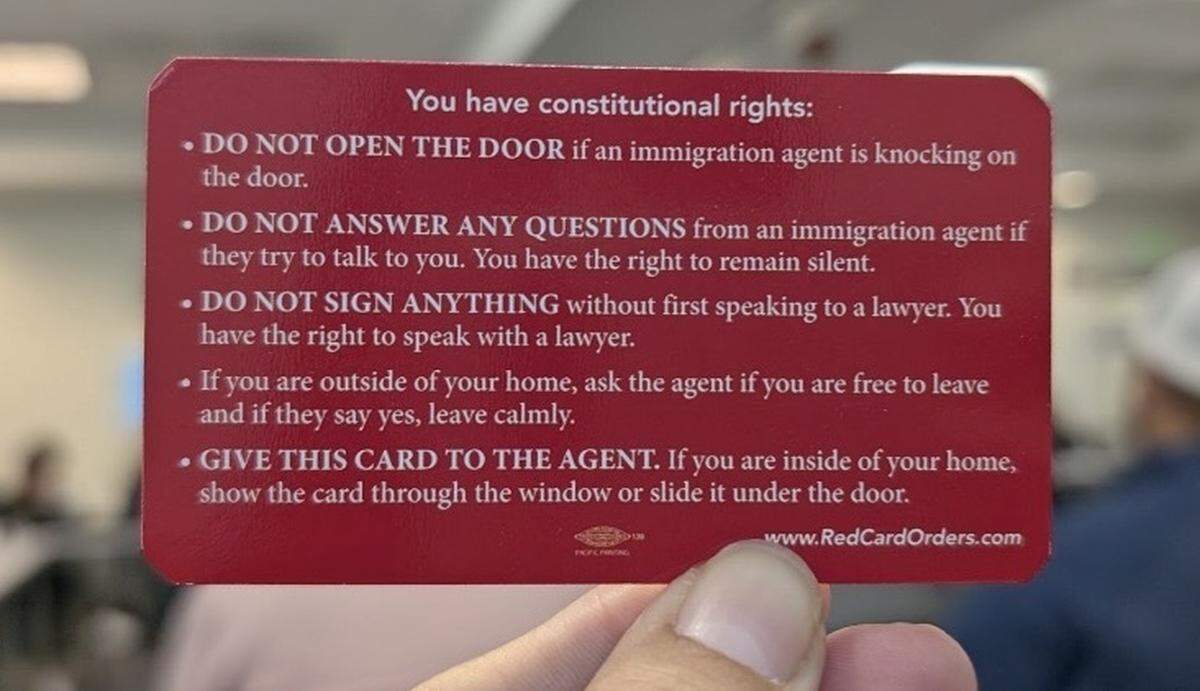
Created by the Immigrant Legal Resource Center, the cards list the constitutional rights all people have regardless of their citizenship status when speaking to immigration agents.
Those rights include:
- That people do not have to open the door of their home to an immigration agent
- The right to remain silent when approached by an immigration agent
- The right to speak to a lawyer before signing any documents
The cards also include a message to inform immigration agents of those rights. People can give the card to an agent who is trying to question them.
“Translated versions are designed to support monolingual immigrants translate their rights with immigration officers,” the website said.
Download the artwork to print the cards at www.ilrc.org/red-cards-tarjetas-rojas.
Since Trump’s inauguration, the Diversity Coalition SLO County had distributed 1,000 red cards and another 1,000 fliers with the same information and placed an order to print 1,000 more red cards, Casaverde said last week.
The American Civil Liberties Union also offers other guidelines for undocumented immigrants if they encounter ICE agents.
“Stay calm. Don’t run, argue, resist, or obstruct the officer, even if you believe your rights are being violated. Keep your hands where police can see them,” the group said on its website. “Don’t lie about your status or provide false documents.”
The ACLU also says agents don’t have the right to search someone without probable cause, but if an agent asks to see immigration papers, the person must present it if they have it.
Traffic Records store speaks out
Traffic Records in Atascadero aims to support all communities targeted by the Trump Administration — especially undocumented immigrants, Barba said.
That starts with preventing ICE from entering his establishment.
“I would tell them to get out of my store,” Barba said. “My business is private property and we have the right to refuse service to anyone.”
He encouraged other businesses to do the same — and to speak out against Trump’s mass deportation plan.
“A lot of business owners are fearful to speak out, fearful to disrupt their customer base,” Barba said. “But I would just encourage all businesses, especially the ones that push the art, to really speak out, because things are gonna get worse before they get better.”
As the son of an immigrant family, the issue is close to Barba’s heart.
His mother immigrated to the United States from a village outside of Michoacán, Mexico, when she was 15 without the proper documentation. She didn’t speak English when she arrived. Now, she serves as an appointed commissioner on an appellate board in Los Angeles, he said.
“She is the American dream. She is what this country was founded on. And I’m really proud to be her son,” Barba said. “I wouldn’t be here if it weren’t for illegal crossing of borders, and same with so many people who are doing such wonderful work in our community.”
Politicians like Trump push a false narrative that Mexican immigrants “are overwhelmingly violent and overwhelmingly dangerous to our community,” Barba said, but these statements are not supported by data.
In reality, those immigrants are just like other people in San Luis Obispo County — working to support their families and their dreams of a better life, Barba said.
“People just need to get out and meet their neighbors and understand their struggles,” Barba said. “That’s what I’d like to see change, is a more realistic and understanding view of these populations that are now being targeted.”