Who are SLO County’s immigrants? Report examines diverse population — and challenges they face
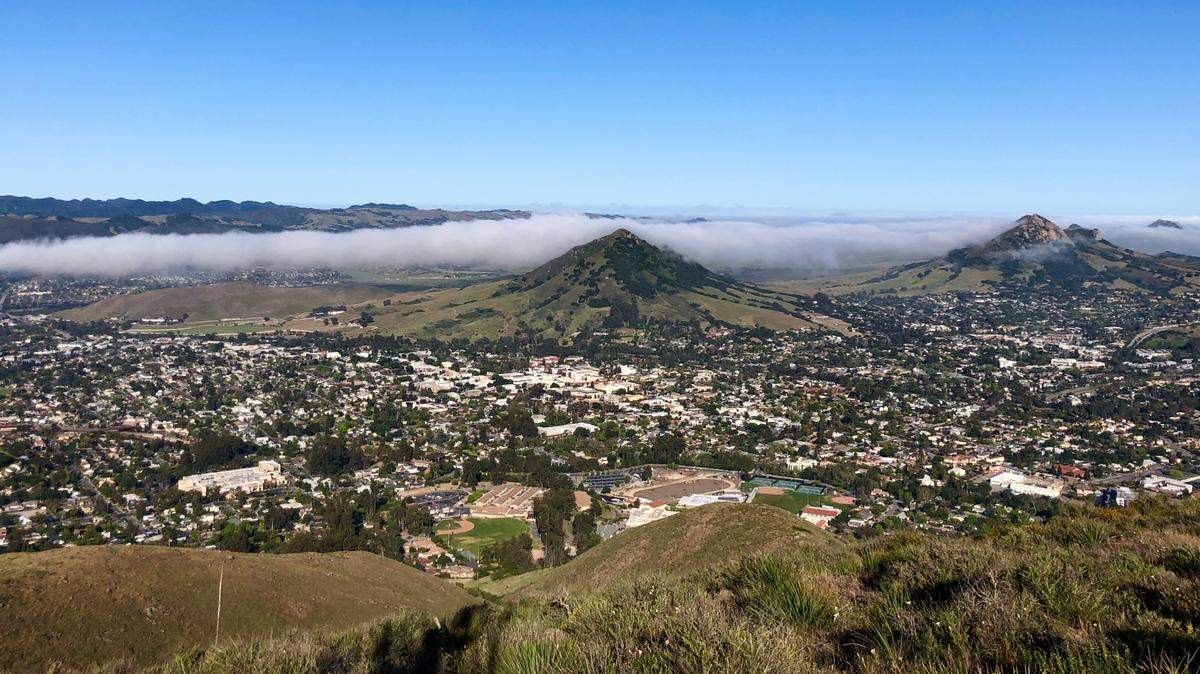
San Luis Obispo County is home to a diverse immigrant community — but language differences and citizenship status can act as barriers to accessing local services, according to a study released Wednesday.
Just more than half of the county’s immigrant population is from Latin America, with the remainder hailing from Asia, Europe, Africa and Oceania, the study said.
The study shared demographic data for the local immigrant community, where they live and work and what barriers they encounter when attempting to access healthcare and social services.
“We’re being faced with a deluge of media about ‘the immigrant,’ and what we really wanted to do is parse out who immigrants really are,” report author Joel Diringer told The Tribune.
Diringer said he hopes the report will combat common misconceptions about immigrants.
“There really are a lot smaller individual groups in the immigrant population,” Diringer said. “There’s quite a diversity of countries or regions of origin.”
The study compiled data from multiple sources, including the U.S. Census Bureau’s 2022 American Community Survey, UC Santa Barbara’s Central Coast Regional Equity Initiative and local reports like the 2024 San Luis Obispo Mexican Indigenous Community Study.
It was commissioned by multiple local organizations, including Community Foundation San Luis Obispo County, the SLO County Board of Supervisors, the Diversity Coalition San Luis Obispo County, First 5 San Luis Obispo County and MUST! Charities.
“The immigrant communities in San Luis Obispo County are an integral part of our social and economic fabric,” CEO of the Community Foundation Heidi McPherson said in a news release. “The agricultural, construction, and hospitality industries are strengthened by the vital contributions of immigrant workers, whose skills and labor are integral to these sectors’ success. Yet, these families face numerous barriers — from language challenges to lack of access to healthcare and housing. Our hope is that this report will provide policymakers, service providers and community leaders with the data they need to make informed decisions to support these communities.”
Demographics of SLO County’s immigrant population
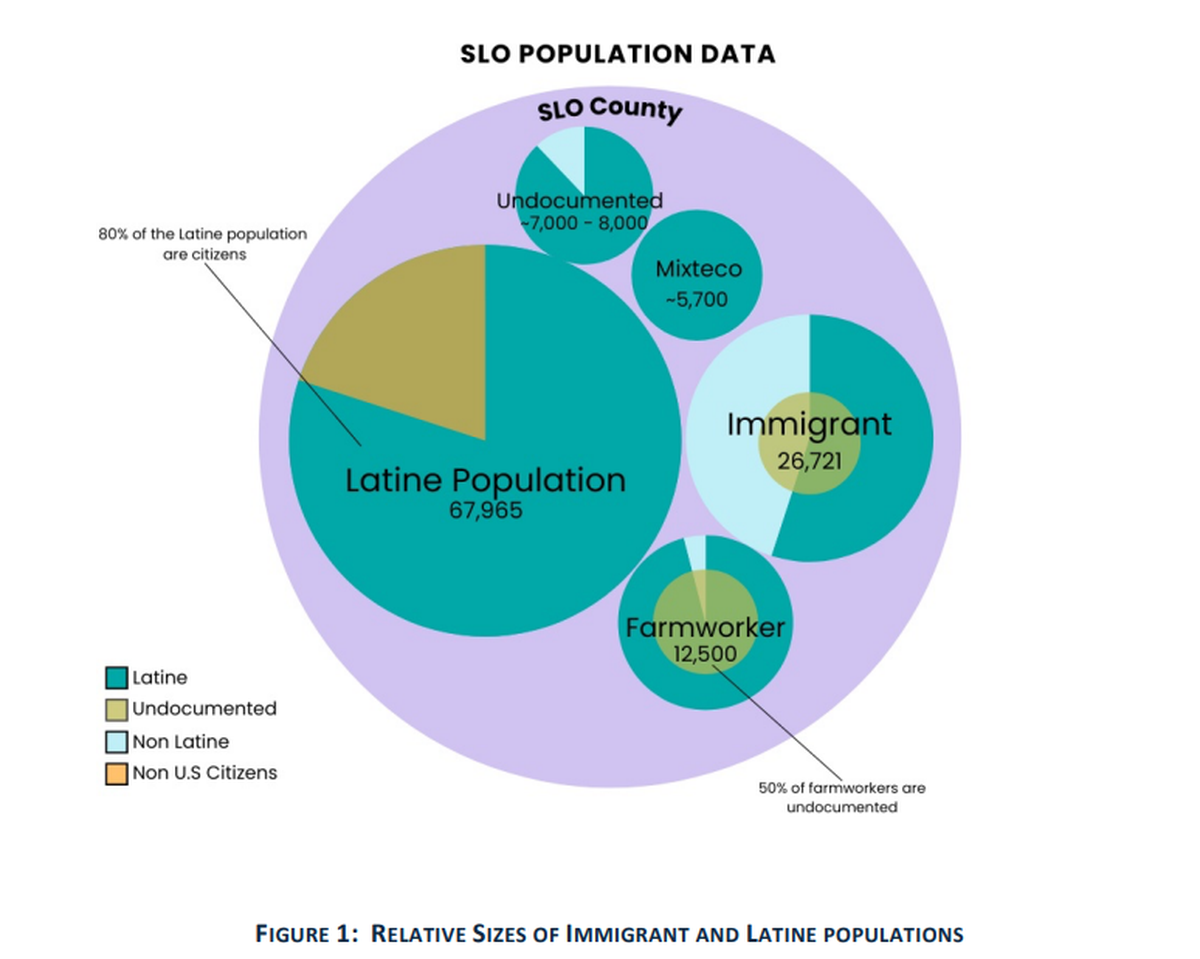
About 26,000 immigrants live in San Luis Obispo County, which is 10% of the total population, the study said.
Within the local immigrant population, about 56% are from Latin America, 20% from Asia, 16% from Europe, 2% from Africa and less than 1% from Oceania.
Though Latines represent a large portion of the county’s immigrant community, the majority of the local Latine population was born in the United States.
In fact, 80% of San Luis Obispo County’s Latine population, or 66,000 people, were born in the United States.
“Immigrants are not to be equated with the overall Latine population,” the study said.
About 52% of the county’s immigrant population, or 13,915 people, were U.S. citizens, while 48%, or 12,805 people, were not.
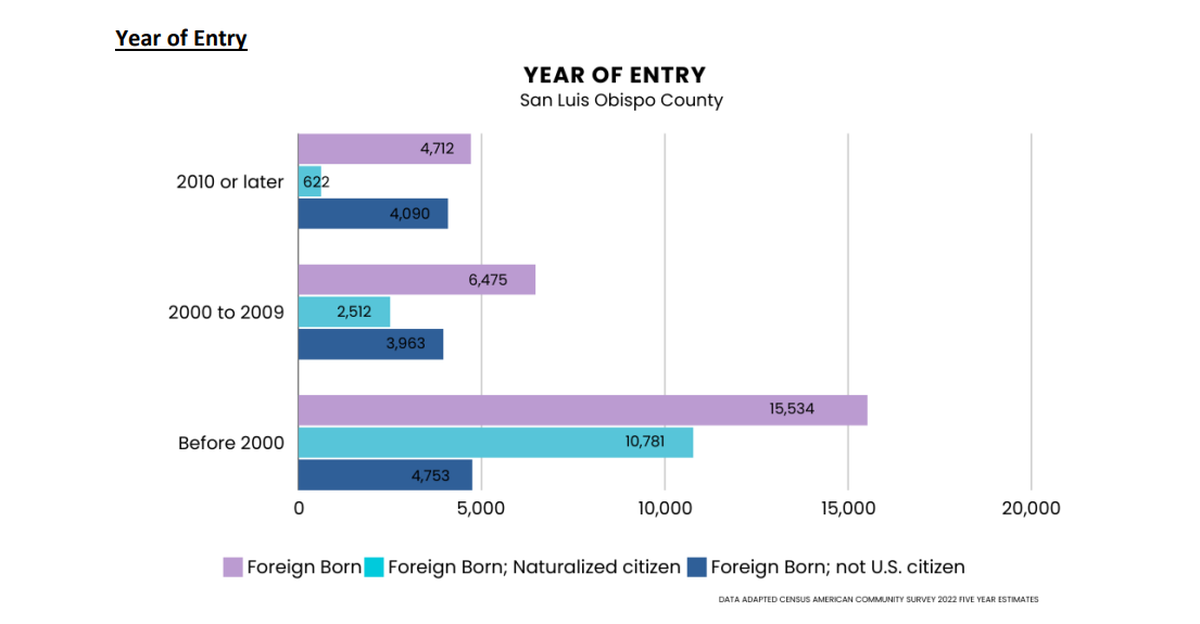
About 80% of immigrants in the United States have lived in the country for more than 15 years. Of those, 58% arrived before 2000 and 24% arrived between 2000 and 2009, the study said.
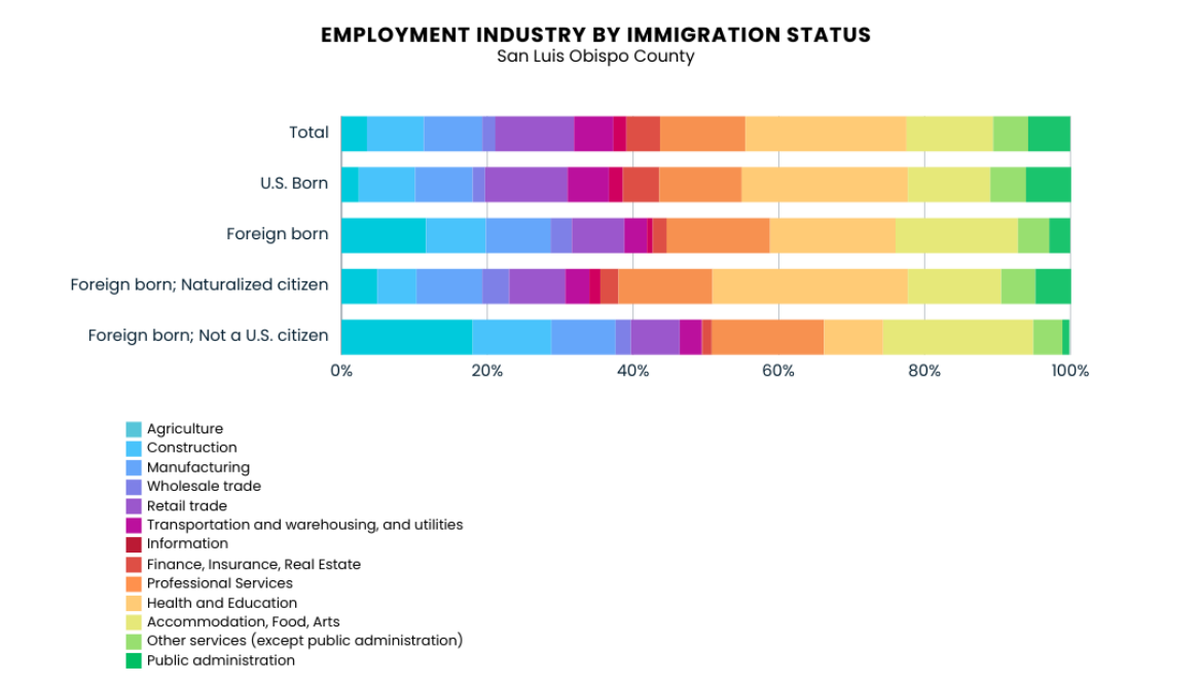
Meanwhile, about 55% of California workers are immigrants or children of immigrants, the study said.
“Immigrant communities, including those without documentation, contribute significantly to the local and state economy through taxes and labor,” the report said.
On the Central Coast, Latine immigrants make up 92% of farmworkers, 54% of cooks, 54% of construction workers, 49% of food preparation workers, 48% of janitors, 38% of truck drivers and 32% of childcare workers, the study said.
However, they often earn less money than the general population.
“The median hourly wage for immigrants is $18, compared to $28 for all full-time workers in the county,” the study said.
SLO County undocumented immigrants face barriers to healthcare, social services
Between 6,900 and 8,000 undocumented immigrants call San Luis Obispo County home, the study said.
The U.S. Census does not gather data on undocumented immigrants, so Diringer’s study compiled 2021 data from USC Immigration Data Portal and 2019 data from the Migration Policy Institute to make these estimations.
The study defined an undocumented immigrant as “someone living in a country without legal authorization.” This includes individuals who “entered the country without proper documentation, overstayed a valid visa, lost legal status due to factors like a denied asylum claim or expired work permits.”
About 70% of undocumented immigrants in San Luis Obispo County have lived in the United States for more than 10 years, the study said.
Additionally, about 9,700 “U.S. citizens and lawful residents in the county live in households with undocumented family members,” while about 24% of Latine children in San Luis Obispo County have at least one undocumented parent, the study found.
Non-citizen families are also more likely to experience financial hardship, according to the study.
“Approximately 21% of non-citizen families with children under 18 live below the poverty level, compared to 9% of all families in the county,” the study said.
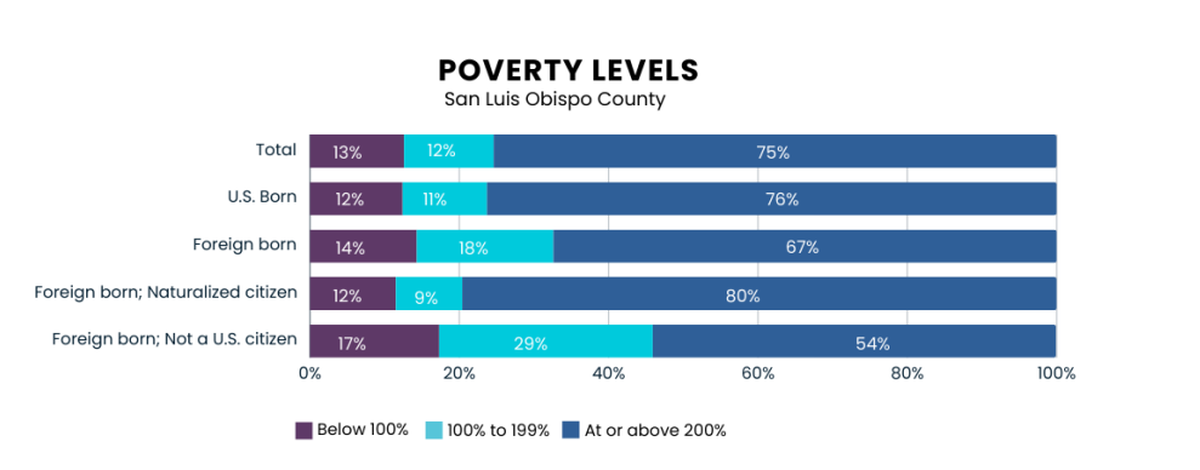
An individual’s immigration status also has a strong impact on their access to healthcare and social services.
“Undocumented Californians paid nearly $8.5 billion in state and local taxes in 2022, according to estimates from the Institute on Taxation and Economic Policy. This includes the sales and excise taxes paid on purchases, the property taxes paid on homes or indirectly through rents, individual and business income taxes, unemployment taxes and other types of taxes,” the study said.
Meanwhile, undocumented immigrants are excluded from accessing Social Security, unemployment insurance, CalFresh and Medicaid because of their immigration status.
In recent years, Medi-Cal updated its policies to allow low-income undocumented immigrants to apply for coverage.
This allowed more undocumented residents to apply for insurance, the study said. As of January 2024, 2,337 undocumented residents in San Luis Obispo County between the ages of 26 and 49 received Medi-Cal benefits through CenCal Health, the study said.
“However, gaps remain,” the study said. “A UC Berkeley Labor Center report estimates that 520,000 undocumented Californians will remain uninsured, either because they earn too much to qualify for Medi-Cal or lack access to employer-based insurance.”
Additionally, undocumented individuals may not apply to programs they are eligible for because they fear deportation or discrimination, the report said.
When people apply for permanent resident status, immigration authorities evaluate whether or not the applicant would become a “public charge,” which is an individual who is likely to rely on the government for extended support, Diringer said. Those deemed a public charge are less likely to be granted citizenship, he said.
Originally, applicants who accessed cash aid or long-term nursing care would be considered a public charge.
In 2019, the Trump administration proposed expanding the definition of public charge to individuals who accessed Medi-Cal, public health services or food stamps. The policy was not implemented, but undocumented immigrants still avoid these services out of concern that it could harm their ability to become a permanent resident, Diringer said.
In fact, a study published by the Urban Institute revealed that almost 24% of adults in mixed-status families “avoided safety net programs ... due to concerns about green card status,” the study said.
“The fear and anxiety over it was the most alarming piece,” Diringer said. “Just proposing these changes really accomplished its purpose of intimidation.”
Immigrant farmworkers support SLO County agricultural industry
Trump threatened to initiate “mass deportations” of undocumented immigrants when he enters the White House for the second time — a move that would not only threaten the health and well-being of immigrant families, but would also remove valuable employees from the San Luis Obispo County agricultural industry, Diringer said.
“If there’s a crackdown on immigration, it’s going to severely impact food supply,” he said.
The $1.1 billion agricultural industry is supported by about 9,000 to 15,000 farmworkers who live in San Luis Obispo County. About half of them are undocumented, the study said.
A migrant farmworker “moves regionally or cross borders for seasonal work,” and they make up about 13% of California’s agricultural work force, the study said.
Meanwhile, a seasonal farmworker “engages in agricultural labor during particular seasons but stays within a local area,” the study said.
About 49% of California farmworkers have a work authorization, while the rest are undocumented, the study said.
The Central Coast has experienced an increase in workers with H-2A temporary work visas, with 1,185 of those visas approved for San Luis Obispo County, the study said.
San Luis Obispo County is home to about 3,430 to 8,000 Mexican Indigenous immigrants from areas of Southern Mexico like Oaxaca and Guerrero, most of who work in agriculture and speak only Mixteco.