70 years of finding forever homes? How Woods Humane Society helps thousands of pets get adopted
Few organizations can boast that they’ve been in the business of providing love for 70 years.
That’s exactly what the privately funded Woods Humane Society in San Luis Obispo County and its predecessor have done, changing many lives in the process.
Since July 1955, staff and volunteers have given that love to abandoned, injured and relinquished dogs and cats, as well as food, medical treatment, shelter and fervent hopes that each the pet will find its forever home.
In turn, the nonprofit’s adopted pets can lavish emotional support, companionship and unconditional love on the adopters who just couldn’t leave the shelter without taking their new friends home with them.
There are two stories behind every adoption: The human one and the four-legged tale. They’re nearly always poignantly emotional.
When a human and a pet make the perfect match, it can be life-changing magic for both of them.
Just ask the San Luis Obispo County residents who’ve adopted family members from Woods in the past 70 years.
Kara Woodruff, who adopted dogs from Woods in 2004 and 2024, told The Tribune all of her dogs “have totally changed my life — mostly for the way better (but I lost some slippers, hats, furniture, etc., during the puppy stages.)”
And at least a part of that is thanks to the volunteers at Woods Humane Society, she said.
“Woods is fantastic — the staff is so caring and dedicated,” she said. “We’re grateful for all the lives that Woods has saved.”
Kids love Woods as well.
Young Audrey Rowe, of Atascadero, used a gift certificate to pick out a kitten, Kona, from a litter that had been brought to the Atascadero shelter.
She and her mom, Rachel Hopson, had just moved into a house in Atascadero, and it had a bedroom just for Audrey. Having the kitten helped the child adapt to the changes, Hopson said.
“Kona is the sweetest, most talkative kitty and definitely one of the family,” Hopson said. “We love Woods Humane Society.”
Cherie Gibson’s family tale about Woods meanwhile is paved with coincidences.
She saw a picture of a golden cocker spaniel named Jo Jo in 2011, with the request, “Save me!” under the photo.
Gibson’s parents had several cockers during their 50 years of marriage. Her dad died in 2004, and Gibson’s mom hadn’t had a dog since.
Was it time?
Other coincidences surfaced: The photo was published on Gibson’s parents’ anniversary date; Jo Jo was seven years old (Gibson’s dad had died seven years earlier); and when Gibson met Jo Jo, he was playing with a dog named Herman (the name of Gibson’s maternal grandfather).
While she was completing Jo Jo’s adoption paperwork, a large black cat was nearby. The big medallion he wore around his neck carried the name Joe.
That was the name of Gibson’s father.
“Jo Jo was the perfect dog. He loved and protected my mom like no other,” Gibson said. “I believe my dad sent him to her. Jo Jo passed about four years before my mom did. I’m sure they are all together now.”
How did Woods Humane Society get its start?
So how did this local institution that’s been the source of so much joy get its start?
The nonprofit’s namesake, Frances Newhall Woods, donated her Nipomo property to the “Bark and Purr Club” in 1955 to provide shelter for local pets in need.
According to records current Woods CEO Emily L’Heureux tracked down, Bark and Purr became Woods Humane Society in about 1959, though much of its earliest history is still somewhat of a mystery.
What is known is that two of Frances Woods’ children later honored their mother by giving significant donations to the nonprofit that bears her name, as have her grandchildren and great-grandchildren.
“This family tradition of generosity has allowed us to care for countless homeless pets as we developed a full range of services (for) a future where every animal has a home where it is cherished,” the organization’s website said.
L’Heureux estimated that since 1959, Woods Humane Society has found loving homes for up to 3,000 dogs and cats per year, enriching the lives of tens of thousands of local adoptive families.
She’s a Woods adopter, too, having acquired two pets from there before she became the shelter’s CEO in 2023.
During its 70 years of operation, Woods Humane has seen a number of changes.
From 1959 to 1974, it served as the official humane officer for San Luis Obispo County.
In 1960, it relocated to near the airport in San Luis Obispo.
In 1993, to help address the issue of pet overpopulation, the shelter began requiring that every adoptable pet be spayed or neutered.
The organization moved to its current location— a 25,000 square-foot campus on 5 acres of SLO County land at 875 Oklahoma Ave. — in 2005.
There, Woods includes a state-of-the-art cattery, two canine pods, 13 canine exercise yards, a well-appointed surgery center, a training-and-behavior center and a 1,300-square-foot community room.
In 2017, Woods Humane Society merged with North County Humane Society, now called Woods Humane Society/North County, at 2300 Ramona Drive in Atascadero.
That site provides shelter and adoption opportunities for cats and kittens, and includes the county’s first public spay/neuter clinic, opened in 2018.
SLO County nonprofit is more than just a shelter
Woods does more than just shelter, treat, foster and adopt out pets.
In 2024 alone, Woods performed 5,471 spay and neuter surgeries along with 2,884 adoptions, L’Heureux said.
That year, cats and kittens accounted for 61% of adoptions and dogs for 39%, she said, with 700 animals sent temporarily to foster homes. (Fosters take animals into their own homes for a limited time until the right adopter comes along.)
Since it opened in 2007, the Woods-Cashin Surgery Center at its SLO campus has done nearly 40,000 spay/neuter surgeries, L’Heureux said.
As part of its lease agreement with the county, Woods also takes in more than 300 cats and dogs from the county’s Animal Services Division annually.
The society cares for some “community cats,” too — formerly labeled feral — but someone else has to find, trap and bring them to Woods. Those felines will be treated, spayed or neutered and any that would adapt well to being a pet are fostered out or adopted.
Woods helps other communities, too.
So far this year, the nonprofit has taken in 39 animals from Southern California shelters to free up kennels in those facilities to house refugee pets from fire-ravaged areas.
Though it doesn’t identify as a “no-kill shelter,” Woods Humane’s website says its live-release rate “typically hovers around 99%.”
“Animals stay in our adoption program as long as it takes to find them a loving home,” the website said. “While the euthanasia of animals is rare, there are times when it is appropriate to end suffering from severe medical issues, or to prevent the release of a truly dangerous animal into the community.”
How does adoption from Woods Humane Society work?
Eric Stockam, adoptions program supervisor, and his staff work with each person who comes into Woods looking for a pet, striving to help make the perfect human/pet connection easier to achieve.
The process can be quick or a bit time consuming, depending on circumstances.
“We have a very customized, specific approach to match the right animal with the right people,” Stockam said. “We help to create families every day, and we want it to be a pleasant experience.”
He knows all that from experience, too: He has three cats and a dog, all adopted through Woods.
Sometimes, folks just want to spend time with an animal, petting it, tossing a toy for it, giving it treats, talking to it, sitting with it. That’s OK, too, he said.
There are two kiosks in the San Luis Obispo lobby from which visitors can get initial information on the process and see photos of and bios for the available dogs. The potential adopters can also go online at woodshumanesociety.org/adoptions for details about dogs and cats.
The two shelters are open for adoptions seven days a week from noon to 4 p.m.
Average cost to adopt a pet is $150, she said, although Woods sponsors various lower-cost adoption events throughout the year.
For instance, a recent Valentine’s Day-oriented “Bachelor Pet Adoption” campaign offered $14 adoptions at both locations (not including a county dog license).
During the promotion, 69 animals found new homes.
In the same time frame in 2024, 48 adoptions happened at Woods, L’Heureux said.
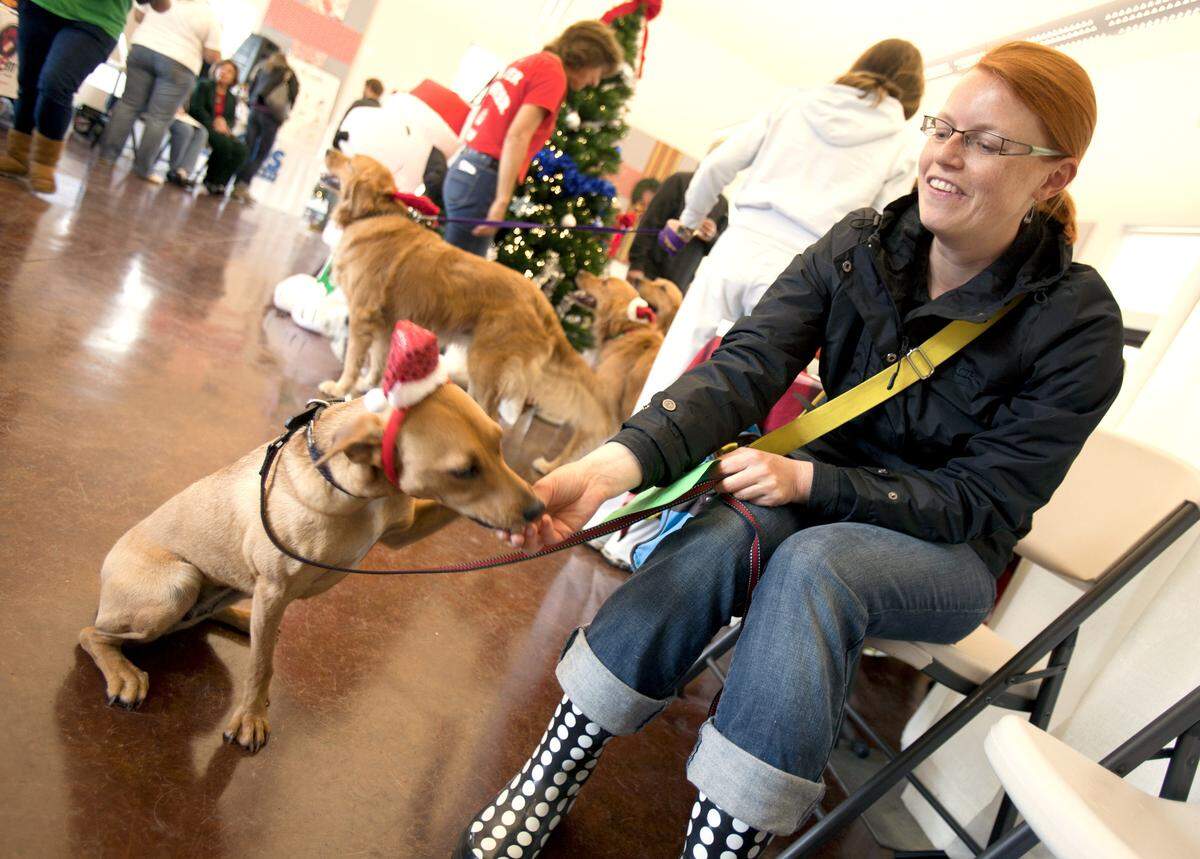
Volunteers make Woods the success it is, CEO says
What makes the adoption process — and the entire operation — work so seamlessly is Woods’ sizeable cadre of volunteers and fosters.
“On average, we have about 200 active volunteers, each spending two hours or more a week helping Woods,” L’Heureux estimated.
Occasionally, adopting a new pet from Woods can lead to becoming an important volunteer there.
About a dozen years ago, Mimi Ditchie was grieving deeply about the death of her father. She said at the time she thought she “should go do something helpful to the world” to pull herself out of the funk.
“I love animals, so why not animals?” she asked herself.
At the time, the shelter needed someone to take pictures of dogs and cats that needed forever homes and families, Ditchie said — and she’s been a Woods photographer ever since.
In the ensuing years, Ditchie adopted several animals from Woods: a dog named Cammie who sat at her feet while she spoke with The Tribune, a cat named Buddy and a big “muttweiler” she named Diesel.
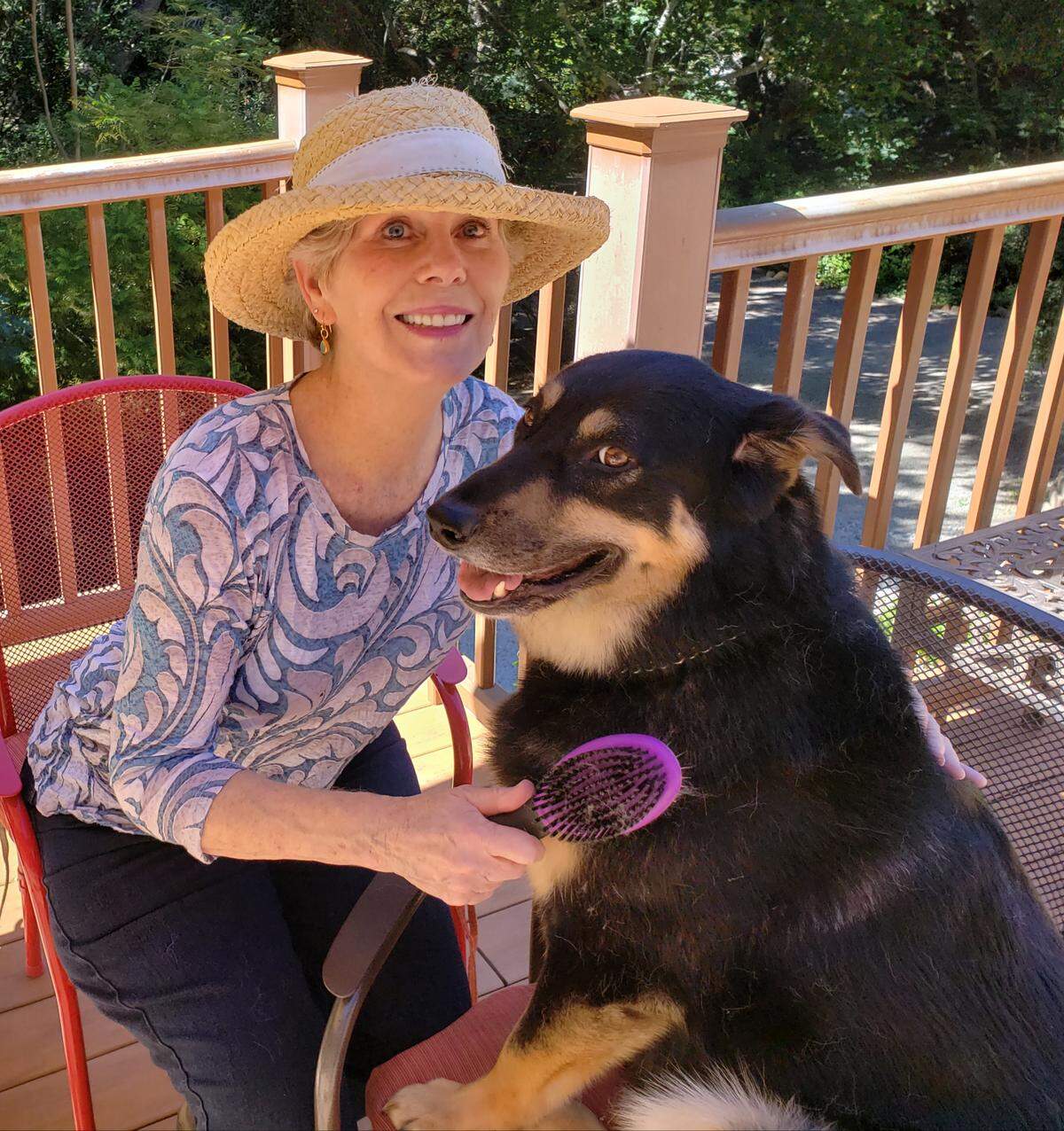
Currently Ditchie is training fellow volunteer George Drastal to also capture images of the shelter’s four-legged charmers.
Woods uses the pictures to show people — via publicity and regular social media postings by volunteers like Holly Ludwigson — what wonderful pets the animals can be.
Volunteers also fill a plethora of roles performing necessary chores.
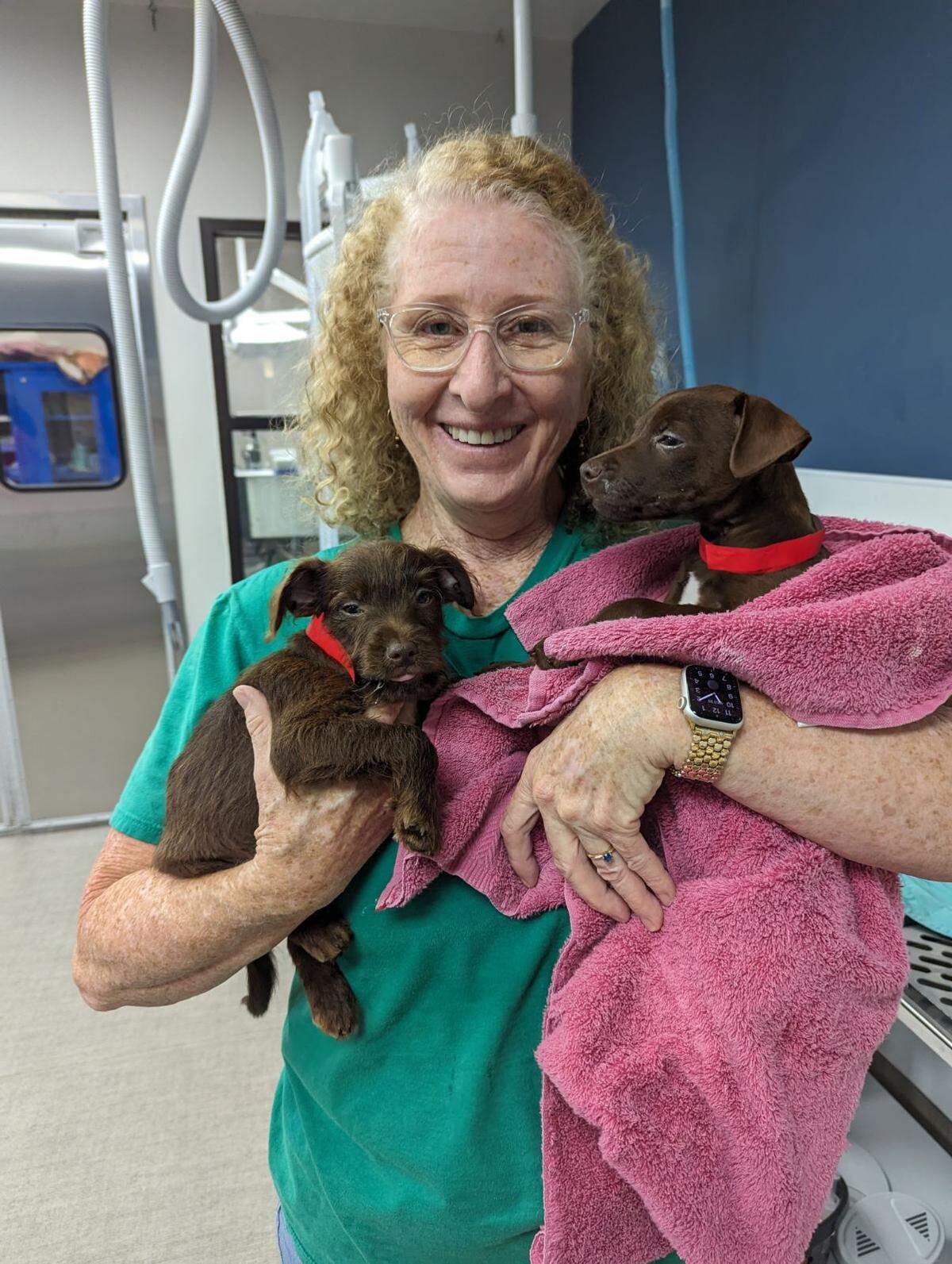
Sue Hefner said she is at the surgery center from 9 a.m. to noon every Wednesday to wash and autoclave-sanitize surgical tools, wash and dry surgical linens and cloths and perform other errands during surgeries.
“I jokingly say ‘I do dishes and laundry at Woods,’” she told The Tribune.
Hefner also fosters dogs at a rate of “about one every two months,” she said. So far, she’s fostered a total of eight dogs “without ever becoming a ‘foster failure’” — or someone who winds up keeping the animals they foster.
At first, she wasn’t sure if she could foster, but the satisfaction of seeing the animal heading for its new home and family is worth it, Hefner said.
“I knew I’d get attached to them,” she said. “It’s a great thing to do. They get adopted so quickly from a foster, and I know they’re going to a good home.”
Hefner’s done a lot of volunteering in her life, but the 63-year-old retired electrical engineer told The Tribune she has “never experienced anything else like Woods.”
“It sounds trite, but it really is the people who are working and volunteering here that make the difference,” she said.
According to L’Heureux, there are other ways to make a difference through Woods as well.
“There are so many ways people can help homeless animals in this county,” L’Heureux said. “Adopt, spread the word, donate, volunteer. We’re so grateful for all of those.”
She concluded: “We are immensely grateful to the SLO County community of volunteers, supporters and adopters that makes our mission a true society of passionate individuals. That will enable us not only to save more lives, but to continue shaping the future of animal care in our community for 70 more years.”
For more information
Woods Humane Society is located at 875 Oklahoma Ave. in San Luis Obispo and 2300 Ramona Road in Atascader. Both are open to the public from noon to 5 p.m. daily.
To contact the San Luis Obispo shelter, call 805-543-9316; to contact the Atascadero shelter call 805-466-5403.
To learn more about donating, volunteering, adopting, dog training, youth programs, spay/neutering program and more visit its website at woodshumane.org. Woods is also available on Facebook and Instagram.
This story was originally published February 22, 2025 at 5:00 AM.