
Cal Poly grad says cohousing could help solve homelessness. ‘The era of excuses is over’
Architect and developer Charles Durrett said he sees people enter housing with nothing but a wet sleeping bag or broken tent.
Right after moving in, those people have adorned their homes with plants, invited their grandchildren to visit and talked with neighbors on their front porches.
One man moved into one of Durrett’s projects after sleeping under a highway for six years. At the project’s opening, the man said, “I thought I had died and gone to heaven — and I plan on staying here until I do go to heaven.” The man was a Vietnam War veteran.
Durrett, a Cal Poly architecture graduate and co-founder of the Cohousing Company, designs cohousing projects that put community first through tiny home villages and communal spaces.
Durrett presented at the Mountainbrook Church Saturday evening to help bring his community-first approach to San Luis Obispo County.
About 200 to 250 people, including local government leaders and homeless advocates, attended the event, according to the nonprofit Hope’s Village of SLO.
Hope’s Village founder Becky Jorgeson invited Durrett to give his free presentation, “A Solution to Homelessness in Your Town,” titled after his book.
After the presentation, County Supervisor Dawn Ortiz-Legg said it was important to get a “voice from the outside” to push the county into more action.
She says they’ve known what they need to do, but a lack of leadership, coordination and action-oriented goals has gotten in the way.
“We need to get a little bit bolder,” Ortiz-Legg said.
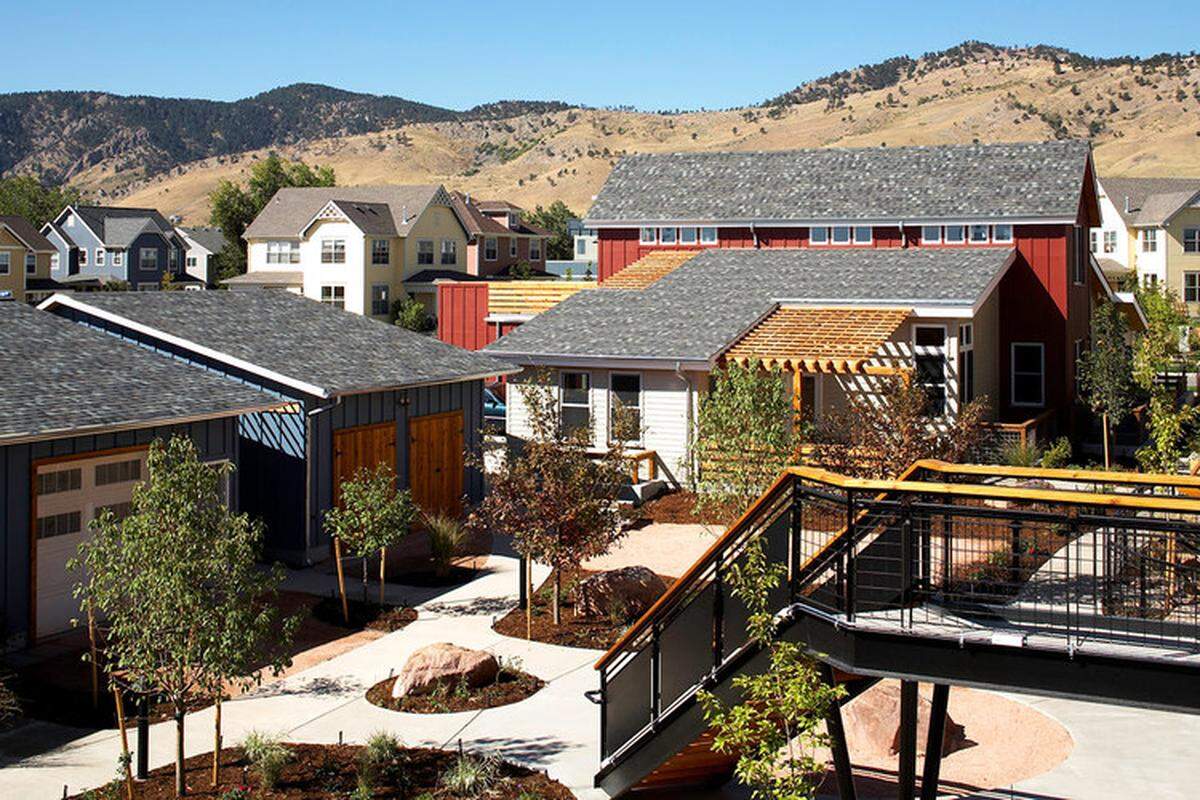
What is cohousing?
Durrett said he has built more than 50 affordable and supportive housing projects across the nation, including affordable, multi-family housing in Oceano and Paso Robles.
Cohousing is modeled after Danish architecture that centers housing around communal spaces and social support systems.
Durrett said his projects have also been influenced by Chinese architecture, which marries the structures with the typography and social environments, “stitching a community together.”
Durrett himself lives in a cohousing community of 55 adults and 25 kids in Nevada City, a small town of 325 people that has shown him what a “village” support system is like.
He says low-income housing should be made with a social focus — providing residents with a community support system. These communities can be self-built and self-managed.
“It’s making it easier for the architecture to constantly facilitate community and privacy,” Durrett said during his presentation.
Durrett said cohousing is a wise and feasible housing solution, noting how much funding and resources are put toward police to help manage homelessness issues.
The U.S Interagency Council on Homelessness estimates that it costs taxpayers between $30,000 and $50,000 annually for each unhoused person, including hospitalizations, detox programs, psychiatric institutions and jail services.
“Not to mention the emotional drain,” Durrett said.
Durrett said his favorite project was a tiny home village in Eugene, Oregon that costs $8,000 per unit. It was built by 150 volunteers, including people experiencing homelessness themselves.
His presentation also highlighted Valley View Senior Homes — a cohousing neighborhood of 70 affordable cottages built in Napa County in 2019.
The project had 16 donors, including local governments, corporations like Home Depot and “people you would never expect to donate.”
Durrett said they had continuous support from the donors, because all of them “felt like they had played a role in the solution.”
Durrett said he’s most proud of how many volunteers show up to help build cohousing, saying donated labor and self-built housing on behalf of future residents are ways to “get the job done” with less regulations.
How cohousing could help end homelessness
Durrett advocated for both social justice and economic approaches to solving homelessness.
“They have so much talent, so much ability, when we set them up for success,” Durrett said during the presentation.
Often, roadblocks are said to be a lack of money or land.
Durrett says all of the resources are there, but they’re being misallocated. And willpower is the most needed resource, he said.
“As far as I’m concerned, the era of excuses is over,” Durrett said. “We can do better than this as a society.”
He said people get caught up in long-term ideas to end homelessness and get bogged down with focusing on services— and it’s “not that complicated.”
Durrett called on the town to make a “dead-clear plan” and be proactive in presenting lease agreements to the city for unused land.
Architect weighs in on SLO County tiny homes projects
Prior to his presentation, Durrett drove around the county with Jorgeson, the founder of Hope’s Village, to pinpoint vacant land that could be transformed into tiny home villages.
Jorgeson said at the event that she’s eyeing at least four to five sites, a mix of county- and private-owned land, for a tiny home village.
These homes would have program fees with 20-35% of a resident’s income, rather than a landlord-renter relationship.
Each home would include a bed and closet, while the communal building, where people share chores, offers food and bathrooms.
Aurora William, who provides services through the Lags Recovery Center, praised the presentation on cohousing and tiny home solutions Saturday night.
She added that multiple villages would be needed for different “levels,” as not everyone has the same mental health capacity to live in certain community structures.
Hope’s Village collected monetary donations and sold shirts to raise funding at the presentation. In total, they received $350 in donations.
Jorgeson said people will have an opportunity to pledge funds to the tiny homes projects once they’re in escrow.
This story was originally published March 21, 2022 at 2:16 PM.