
Mission San Luis Obispo de Tolosa turns 250 this year. Here’s a look back at its legacy
A historical San Luis Obispo landmark reaches a milestone this year — its 250th anniversary.
The fifth of 21 California missions, Mission San Luis Obispo de Tolosa represents a long and storied history with deep ties to the region’s history, as well as controversy as it relates to Native American life and culture.
“The Mission took many years to put together,” Docent Connie Pillsbury told The Tribune in a recent interview. “Lasting through three different governing countries, it’s amazing it’s still standing. This is an active parish church, but also a historical site.”
Often considered a linchpin of SLO’s cultural center, the adobe church is where masses, choir performances, weddings, religious events and regular tours attract thousands of people every year. Baptisms, confirmations, quinceañeras and funerals continue to bring people together regularly at the centuries-old building that overlooks the city.
“Every year, school children who are studying California history come here to visit and learn about the mission,” said Father Russell Brown, a pastor from 2006 to 2019 who still lives on church grounds. “It’s humbling to be here with roots as deep as the Mission.”
To celebrate its 250 years, the Mission is hosting a large, free event full of music, dancing and demonstrations of early California life on Feb. 20.
SLO’s Mission founded 250 years ago
Mission San Luis Obispo de Tolosa was founded on Sept. 1, 1772 when Serra and Father Jose Cavaller set up the first modest Alta California church site.
They erected a cross near Stenner and San Luis Obispo creeks, but flooding relocated the early Mission upstream, according to a historical timeline documented by Mission San Luis Obispo Docents.
A 1776 fire — caused after Yokuts shot flaming arrows as a diversion to steal horses — ignited the thatch roof and supplies of wine, candles and farming tools went up in flames.
After that incident, Serra decided the Mission needed to be established at the highest grounds along the creek and instructed that the roof be made of fire-resistant tile. The third and final location is where the adobe building stands now, finally completed in 1793, nine years after Serra’s death.
Franciscan priests serving under the Spanish government proselytized and converted Native Americans who helped build the Mission — a controversial facet of the landmark’s legacy when looking back today.
The treatment of Native Americans by the Mission’s priests and founders is characterized by local docents as better than the treatment of indigenous peoples in other regions colonized by Europeans.
“Those people in 1772 were doing the very best they thought they could do with the information that was available to them at the time,” Pillsbury said. “We can’t lay our value system over a historical era.”
While disease introduced by Europeans killed many Native Americans throughout the region, Pillsbury said those on the Central Coast “were not slaves and there was no genocide.”
Some even assimilated, she said.
“Many became Catholics,” Pillsbury said. “They married. They raised their kids there and became singers. They served as foremen on the work crews.”
The building itself also features some homages to the culture of those who literally helped to build the structure. Stars painted on the ceiling of the Mission represent the spiritual connection to the universe that was reflected in Native American culture, Pillsbury added.
Those who lived at the Mission grew their own food and wine, and worked on art and crafts in the Mission courtyard, Pillsbury said.
How Mission’s founding impacted Central Coast indigenous peoples
The impact of the Mission’s founding on Native American lives is more complex to many of indigenous descent.
“When the missionaries arrived 250 years ago, that wasn’t even a blink of an eye compared to how long the (Native American communities) had been here, which was for more than 13,000 years,” said Mona Tucker, chair of the yak tityu tityu yak tiłhini Northern Chumash Tribe.
“They were able to stay in a place for thousands of years and you can’t do that unless you’re pretty darn smart and know how to take care of yourself,” Tucker said.
Tucker, who emphasized she’s speaking on her own behalf and not the Tribe’s, said when they arrived, European colonizers disregarded the complex and rich culture of Native American peoples. The people the Spanish found living on the Central Coast had government, commerce and environmental management, to name a few, she said.
“The missionaries came upon people who they disregarded,” Tucker said. “They did not honor them or treat them in a way that they deserved.”
Tucker believes the influence of the missionaries, despite the religious nature, had “a lot of conquest in mind” and notes many died through disease they were not warned about and subjected to a diet that wasn’t healthy for them.
“The evangelism was harsh and cruel,” Tucker said. “The missionaries were sent here to proselytize and baptize, but they were also sent here by the Spanish government that was trying very hard to lay claim of Mexico going north.”
Tucker said she doesn’t think she can comment on other people’s relationship with religion, but the missions themselves are “highly regarded as icons of California.” Tucker considers the missions tools of genocide through Spanish colonization.
“It was such a massive taking away from us,” Tucker said. “I have had a couple of people say to me recently that the missions are ours, too, that they belong to us too. But they don’t. They belong to the Catholic church.”
Tucker said that she hopes as much information as possible that hasn’t been shared by the church yet can be disclosed through records on the lives of Serra and other missionaries.
“I’ve been to the Mission for many events, weddings and funerals and other events, but we do know the cost it took for the missions to exists here in California,” Tucker said. “It took our land, it took our children, separated families and ran havoc on our ability to even survive. And we still feel the impact today with the loss of homeland. Nobody has returned out homeland to us and we’re landless people by in large.”
Legacy of Father Serra, California missions is complex
The legacy of Serra remains complex, according to Cal Poly professor emeritus Dan Krieger.
“Where Serra’s critics see the missions as slave camps, others see a pre-capitalist society where both the (Native Americans) and the padres shared in the work and the benefits of food, shelter and community,” Krieger wrote in July 2020 in a Tribune column. “Most mission scholars agree that these benefits were major factors in attracting Native American converts.”
Krieger wrote that missionaries did, in most instances, try to “Europeanize converts in terms of their clothing, food and lifestyles.”
“Unmarried girls were obliged to live in monjeríos, or, monasteries, watched over by a matron who instructed them in cooking, weaving, laundering and other skills,” he wrote. “The men were converted from a hunting-and-gathering culture to agriculture reliant on the spread of narrow-bladed grass seeds for feeding flourishing herds of non-native cattle.”
He added: “Within less than 30 years, the ecosystem of coastal California was transformed. Most Native Americans could not go back to their original way of life if they wanted to.”
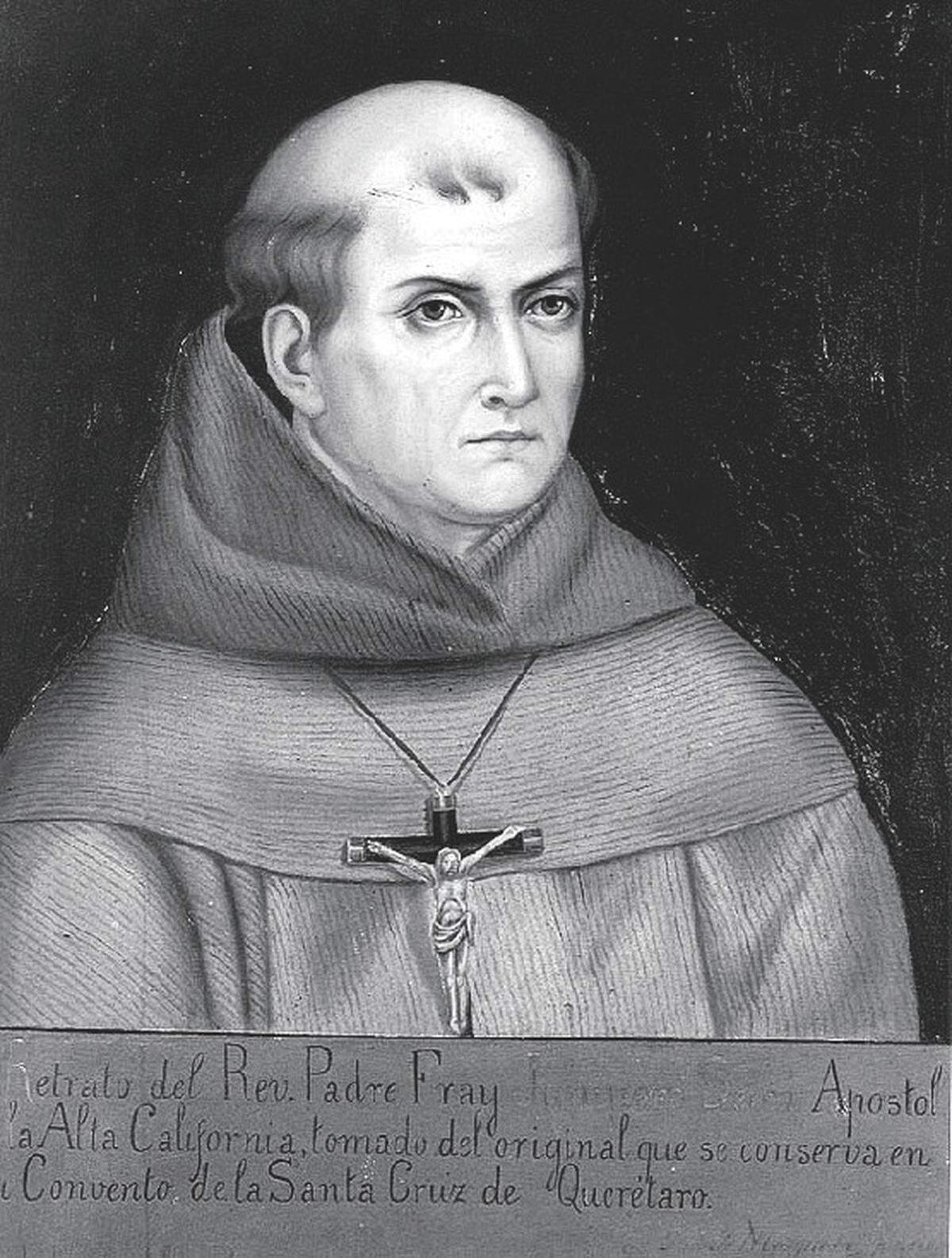
During the 1740s, José de Escandón, the Spanish colonizer of northeastern Mexico, “brutally occupied the Sierra Gorda,” Krieger wrote.
Serra arrived in 1751 and tried, apparently with some success, to heal the damage that Escandón had done.
“Today, the Mexican people of Querétaro cannot understand the protests against Serra in California.” Krieger noted. “To them, he will always be a santo, or, saint, known for his kindness and efforts at restraining the military, centuries prior to his actual canonization by Pope Francis in 2015.”
Father Brown wrote in a July 2020 Tribune opinion column that Serra’s arrival was founded on religious devotion and a commitment to preach and teach — and it’s difficult to reconcile with a conclusive verdict of his legacy.
“There is a romanticized view of Father Serra that portrays him without blemish and neglects the profound impact the European empire was certain to have on the function and psyche of pre-modern culture,” Brown wrote. “Awareness of such impact is part of a global awakening that has only been critically embraced over the past century.
“In terms of raw mortality, it is undisputed that all indigenous people, from coast to coast, suffered deeply from European diseases to which they had no immunity. Given the lack of knowledge of epidemiology in the early 18th century, it is fair to assign historical responsibility for these pandemics, but more difficult to attach moral blame.”
In conclusion, Brown said if Serra had been able to foresee the suffering indigenous peoples, “he would have assigned to himself an unwarranted measure of responsibility and taken on a grave penance in accord with his character and spirituality.”
“For his humility, and for his devoted and conflicted life, he is still more worth remembering than forgetting, and the missions themselves remain his lasting monuments,” Brown wrote.

What was the Mission like under Mexican rule?
The Spanish governance lasted until Mexico gained independence and took over the region in 1822.
Soon after in 1830, an earthquake damaged the San Luis Obispo Mission. Then the Mexican government decreed secularization of the Alta California Missions in 1834.
“The Mexican government didn’t like the Spanish and thus they didn’t like the Mission,” Pillsbury said. “They sold many of the missions, including ours.”
In 1845, Mexican Governor Pío Pico sold Mission lands and the San Luis Obispo Mission for $512 to retired sea captain John Wilson and two partners, James C. Scott and James McKinley. Lawsuits over who owns what part of the Mission and its lands went on for years.
The Mexican-American War resulted in American jurisdiction — the third country to govern the land that the Mission stands on — when California became the 31st state in 1850.
Modern Mission still a destination for families, visitors
In 1947, William Randolph Hearst awarded a grant of $50,000 to help restore the Mission that by that time had fallen into disrepair.
“Hearst played a very important role in restoring the Mission at a time when it was starting to deteriorate,” Pillsbury said. “$50,000 was a lot back then.”
In the following years, a rectory was built and a museum moved downstairs to its present location.
The Mission weathered the 2003 San Simeon earthquake and in 2011, the building was seismically retrofitted.
Today the Mission is a fascinating combination of old and new. Its bells still chime, a tradition dating back centuries, while mass is held daily and Sunday services are also still held in Spanish.
Though the annex is the same, with the priest addressing the congregation by speaking to two wings, the building today features administrative offices, storage, a museum and living quarters.
Meanwhile, because vandalism of Serra statues has taken place elsewhere in the state, SLO’s monument has been removed for safe keeping.
“While many missions have an admission fee, ours does not,” Brown said. “It’s hard to know exactly how many people come through these doors, but many families and visitors do every day to see the Mission.”
Celebration will feature food, music and demonstrations
A free public celebration of the Mission’s history will be held Feb. 20 from 11 a.m. to 3 p.m. in the Mission Courtyard, complete with food, music and demonstrations of early California life.
Other activities will include crafts, building and bell tower tours and a demonstration of life in the Mission’s early days.
Events include audience participation dancing featuring the Baile de Californio Dance Troupe, showcasing the steps of the 1840s; live 1830s music from Rancho-era guitarist and singer Richard Moreno with Mike Mullins on mandolin; meals that date back to the Mission’s early days; and historical lectures from Cal Poly professors emeriti Craig Russell and Kreiger.
“This festive jubilee event will provide both entertainment and education for adults and children as they see, taste, listen and experience a sample of early California life,” an event flyer noted.
This story was originally published February 15, 2022 at 2:22 PM.
%20Cropped.jpg)