Mission San Luis Obispo’s bells went silent for a decade. But their secrets weren’t lost
In 2020, large gatherings for Easter and Passover are suspended to prevent the spread of coronavirus.
Some communities are ringing bells during this period of forced isolation to express solidarity — and say thanks to the doctors, nurses and first responders on the front lines of COVID-19.
The following is a story of how traditions can be kept alive even when temporarily interrupted.
Mission bells are an iconic symbol, featured in everything from the city of San Luis Obispo’s flag to the lyrics of hit Eagles son “Hotel California.”
San Luis Obispo’s most famous bell ringer was Gregorio Silverio.
According to an undated article by Pauline Bradley Dubin, a 90-year-old Indian man, Florentine Naja taught the 13-year-old Silverio to ring the bells.
It was July 24, 1891 at noon. Cues were provided by whipping the loose bell ropes across the boy’s calves.
“Go slow or you’ll crack the bells. Don’t make a ding-dong like a cow bell. Make a mellow tone that sings,” Naja reportedly told the boy.
Two years later, Naja had died and teenage Silverio carried the secrets of the bells with him for the next six decades.
Silverio knew how to ring the 800-pound Joyus bell, the 1,000-pound Angelus bell and the 850-pound Sorrowful bell. He knew the patterns for weddings and funerals, even the “De Profundis” toll rung at sunset for souls in purgatory.
Worship bells called the faithful to mass. Joyful bells rang out for the funerals of infants without sin and rejoiced upon their entry to heaven.
SLO man rang mission bells for six decades
Silverio had celebrated 62 years of bell ringing when he was profiled by Kevin Wallace in a San Francisco Chronicle article published July 24, 1953.
Wallace wrote Gregorio Silverio was the oldest of 10 boys, His father, Frank, had come to San Luis Obispo from the Azores in 1870.
Frank Silverio helped build a retaining wall along San Luis Obispo Creek through town. But he died of pneumonia at the age of 49, leaving his son Gregorio to be sent away to the mission.
The boy was homesick his first night.
“I was sad the first night away from home, in the mission,” Gregorio Silverio recalled in the Chronicle story. “But the bells woke me up in the morning and it was as though I had never heard them before. They made me very glad.”
Silverio was the oldest practicing master of bells, and a school district apparently recorded his ringing on tape and in a movie.
When Silverio died on March 18, 1954, at the age of 76, the mission bells went silent.
But the secrets of the bells weren’t lost.
Walt Beesley wrote in the Telegram-Tribune on Dec. 31, 1965, about how the tradition was revived over a decade after Silverio died.
Beesley Americanizes Silverio’s first name, and the relationship between Father Junípero Serra and the Native Americans is more complicated than the following article states.
Virginia carries on Mission tradition
Bells of Old Mission San Luis Obispo have a veteran at the controls once more and, if everything goes as planned, all the old Franciscan bell “patterns” will ring out soon again at the historic church.
The long and colorful story of the bells is a familiar one to many long-time San Luis Obispo residents. But to newcomers their history is obscure but nonetheless a vibrant par of the Old Mission’s past.
There are none around who remember the first bell ringers, the Indians who helped the indomitable Fr. Junipero Serra erect the church and hoist the Peruvian-cast bells into their original, rickety belfry.
But there are, perhaps, many who recall the most noted of all the ringers, Gregory [Gregorio in other stories] Silverio, who died in 1954 after serving more than half a century tolling and chiming the great bells.
With Gregory’s death the bells fell silent because there apparently was no one who knew the patterns as he did.
But Gregory did NOT depart from this world without leaving a heritage. He had spent years teaching his granddaughter, Virginia Lee White, the patterns and the “touch” of the ropes. He even preserved the sounds on a record.
Virginia’s friendship with the bells, for all practical purposes, ended with Gregory’s death, and for nearly 13 years the chimes were not heard.
Their bongs were brought to life again when Fr. Joseph P. Stieger became pastor of Old Mission parish and decided to activate the bells. He was faced with the problem, however, of finding someone to ring them, someone who knew the intricate operation.
The name of Judge Paul K. Jackson was suggested and San Luis Obispo’s justice court judge stepped into the breech to help. He had rung the bells as a young man but admitted he never was an expert. He did teach a small group of parishioners the rudiments of the ringing operation and so the bells have rung intermittently for Sunday masses and at times for other special occasions such as weddings and funerals.
It was a coincidence that Gregory Silverio’s granddaughter entered the picture. At a dinner in Virginia’s home, Dr. Charles Moore chanced to learn of Virginia’s knowledge of the bells, gained through her grandfather’s instructions. He immediately put the wheels in motion to take advantage of Virginia’s knowledge.
Now, after a few weeks of pulling the ropes, Virginia again is gaining the touch and the timing so necessary to a smooth operation.
“I believe I’m the only person in town who knows all the patterns,” she said.
“My grandfather spent a long time teaching me and I haven’t forgotten. I’m just rusty, but I’ll get over that. I’m solid in the fundamentals, and that’s what counts.”
Virginia is grooming another woman to share her job and plans to enlist all the men who wish to fit into the picture and join the Mission bell ringers.
“I believe there are a few things I can show those who have been doing it, such as the proper place to stand. There is only one proper spot from which to pull the ropes. Standing any other place throws a person ‘out of balance.’ And some of the bellringers have been hitting the bells too hard. Tat isn’t necessary. A rhythm and light touch are all that are required in that respect.”
There is no question about Virginia’s liking her new assignment. She is steeped in Mission history and can recite much of it which she acquired not only from her grandfather but from reading.
The bells, she recalls, were cast in Peru in 1818 by Manuel Vargas and shipped to San Luis Obispo by boat on a two-year journey.
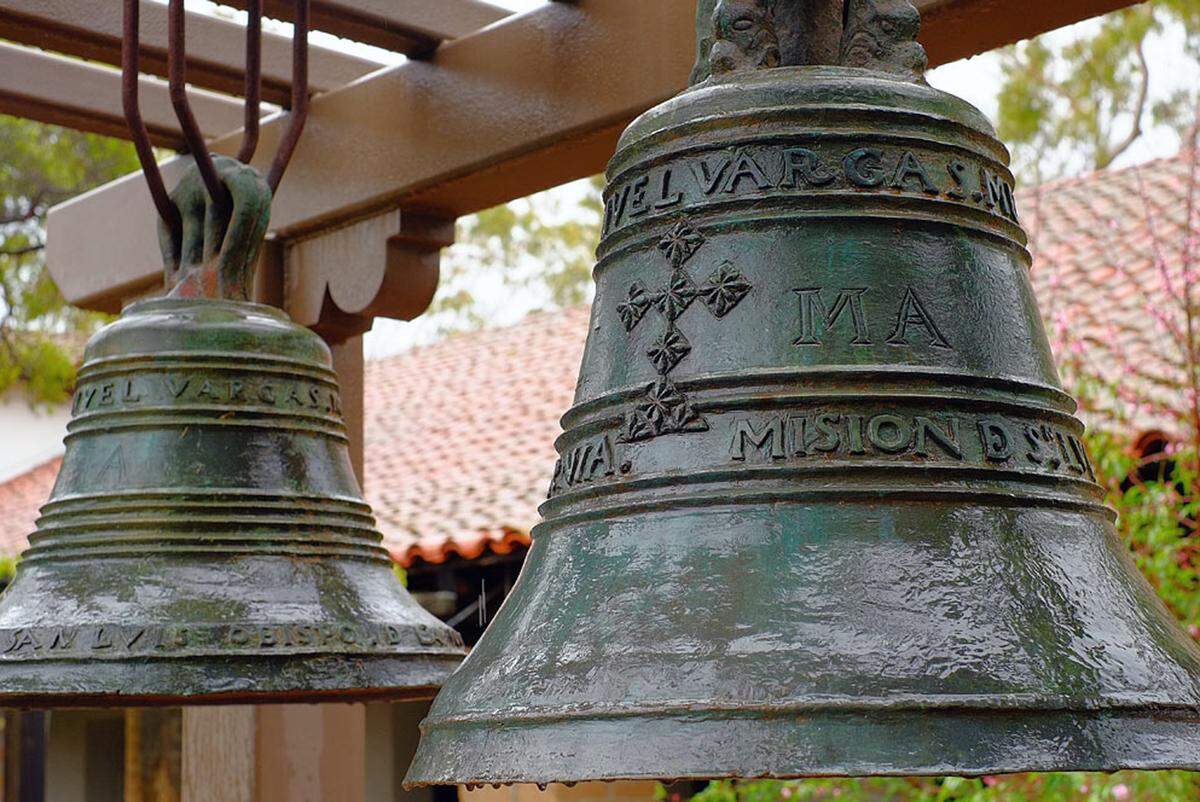
There were five bells at the start but two developed cracks and were sent to San Francisco for repairs. Instead, they were melted down and one new bell was returned. One other bell “disappeared” and is now believed to be in either San Miguel or Santa Barbara.
Two of the present bells are inscribed as they were originally. All three bells are named. Looking at the front of the mission, the bells are the Sorrowful, the Angelus and the Joyful weighing 1,000, 800 and 850 pounds, respectively.
The patterns which Virginia knows and will teach others are: (1) the Worship, for the Mass; (2) the Joyous, for use at infant funerals; (3) the Funeral, for adults; (4) the Angelus, rung at 6 a.m., noon and 6 p.m.; (5) the Wedding pattern; (6) De Profundus, rung at 8 p.m. and (7) the Elevation, rung at the elevation of the mass.
“My grandfather used to call me whenever there was a special occasion at the Mission,” Virginia recalls.
“But he wanted me to learn the funeral pattern in particular. I found out later why. When my grandfather got married, there was no one to ring the bells for him. He had performed for everyone else who had been married through the years. But when his own wedding came along, he had to do without the bells.
“He drilled me on the funeral pattern and I rang the bells at this funeral.”
Gregory Silverio went to live at the mission in 1891 and was taught to ring the bells by Florentino Najar [different spelling in this article], who also learned the art at an early age. When Florentino died at the age of 90 plus, Gregory took over the task before the turn of the [20th] Century and continued as the Mission’s bellringer until his death.
But his work and his love of the bells will be perpetuated by his granddaughter, whose enthusiasm appears to be as great as that of Gregory Silverio.
***
In addition to the articles quoted above, a Sept. 1, 1947 Telegram-Tribune story about the bell ringer by Celia Jenson is available online.
Matthew D. Herrera has written a detailed monograph on Gregorio Silverio that includes many additional sources.
This story was originally published April 11, 2020 at 5:00 AM.