Q&A with Paso Robles’ new city manager: On leaving the police, building trust and more
After more than 20 years in law enforcement, Paso Robles’ former top cop recently accepted a new challenge — transitioning out of police work to become the city’s top administrator.
Ty Lewis, who’s served as police chief since 2018, recently became city manager after a months-long search following Tom Frutchey’s retirement in April.
City Council members officially appointed Lewis to the position at their Aug. 17 meeting.
Lewis is excited for the career shift and said he’s “always one for a challenge.” His desire to move into administration comes from his love for the Paso Robles community and wanting to reinvest all the city’s given him during his time in law enforcement.
“I’ve been here for 20 years,” Lewis said. “And so I’ve seen this city grow. I’ve been here through tough times. I’ve been here through the good times, the golden years. And I built a lot of relationships over that time with community members, with our elected officials. And of course, not only within the Police Department, but throughout the city.”
“I have this sense of responsibility, the sense of ownership,” he added. “... The same thing that drove me to be the police chief is driving me to be the city manager. And that’s care for the community that’s cared for me.”
Just before starting his new job, Lewis sat down with The Tribune to talk about leaving the Police Department, city priorities and building trust in the Paso Robles community.
Moving from police work to city planning
Lewis has loved his time in law enforcement, but he admitted it “ages you and takes a toll on you.”
“To be quite candid with you, I could go the rest of my career without seeing another dead person,” Lewis said, referring to a July incident in which the San Luis Obispo Regional SWAT team shot and killed an armed man who’d barricaded himself in a Paso Robles apartment.
But Lewis isn’t yet ready for retirement, which led him to consider the city manager role.
“I chose a different path that would still hopefully give me the same satisfaction of serving and protecting my community, just in a different role,” he said.
Although Lewis doesn’t have much of a background in city planning, he feels his time managing one of Paso Robles’ biggest departments has given him the skills he needs to take on the city manager job — especially the ability to make “good decisions and informed decisions” on the fly.
“Police chiefs and the sheriff and law enforcement, in general, we’re often confronted with big decisions that require quick processing and sometimes taking incomplete information and making quality decisions,” Lewis said. “And so that’s one of the things that I think that I bring to the table, part and parcel of what I’ve done here at the Police Department.”
Handling city emergencies, ‘thin blue line’ flag removal
Lewis’ top goal, both as police chief and now as city manager, is to build trust with Paso Robles community members.
He cited how he’s dealt with intense city situations during the past few years, including the racial justice protests last summer, an active shooter who killed a homeless man and traded gunfire with police for two days and the COVID-19 pandemic.
“Understanding what’s important to everybody and trying to find a path that best serves the community is what a good police chief is all about,” Lewis said. “And so those same qualities directly apply to (city manager). You’re just doing it in a different way.”
Recently, Lewis also drew ire from some residents after he ordered the removal of a ‘thin blue line flag’ that community members had hung outside the Public Safety Center.
To some people, the flag is a sign of support for law enforcement. For people fighting for racial justice, it’s a sign of opposition to the Black Lives Matter movement.
Lewis said he had to put aside his own feelings about the flag and realize how other people interpret it.
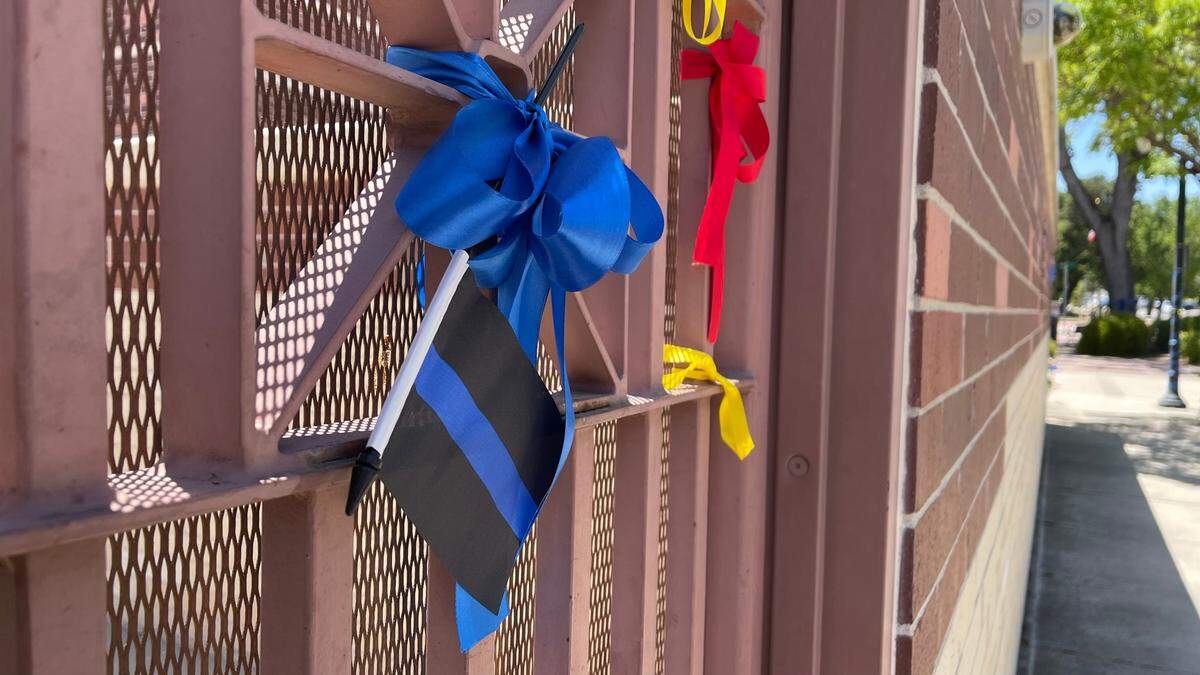
“My decision to do that wasn’t to cater to any particular group,” Lewis said. “It was to create a neutral appearance for the Police Department, period. It wasn’t a political statement. It wasn’t to impress anybody. It was simply to build trust within the community with everybody. And it was unfortunate that some people took it any other way than that — that it somehow was a slight against my love for my profession or their love for the Police Department.”
Lewis said there were even those within the Police Department who were upset about his decision to remove the flag and “let me know they felt that way.”
He said he respects and understands those opinions, but it doesn’t “change the responsibility that I have to the community as a whole.”
“The thin blue line flag is not the United States flag,” Lewis said. “It’s not the badge that we put on our shirt. It’s not the patch that we put on the shirt. That flag means various things to different people. And so I can have my own belief. They can have their own belief. But it was never intended to be an insult. It was simply a matter of understanding that that particular symbol is offensive to some people.”
Addressing city’s homelessness crisis
Lewis cited Paso Robles’ homelessness crisis, affordable housing and several economic development projects as his top priorities in his new job.
In regard to homelessness, there needs to be more cohesion among San Luis Obispo County officials to find strategies to address the plight of the unhoused, he said.
“There’s so much overlap when it comes to our unhoused populations,” Lewis said. “I’d love to see the North County get more dedicated resources to addressing it. One of the challenges is that we’re just displacing a lot of these folks, but we’re not finding long-term solutions right now to get them out of that.”
“One thing I do know about this county — and Paso Robles is a big part of that — is that because we’re all relatively small communities, we really work well together,” he added. “There’s a lot of collaboration — the police chiefs and the sheriff do it. I know the city manager groups do it. And there’s a lot of smart people.”
He also said it’s important to “bring more resources to address our local problems,” including services to help those struggling with drug and alcohol addiction and mental health issues.
“A lot of my focus in the past has obviously been on the enforcement side of things,” Lewis said. “But there’s also big components when it comes to education, and outreach and prevention. Those are some of the things that I think that we can really make some strides in. And I hope that I can make an impact.”
Lewis thinks a lot of the anger community members have expressed toward unhoused residents is caused by a fear of losing the community’s quality of life in Paso Robles.
“I think that that’s really what it comes down to is creating a sense of, ‘Hey, we can create a sense of safety for our community, and address the challenges that are contributing to that,’” he said.