Energy company destroys Morro Bay homeless camp, displacing up to 30 residents
A large section of an illegal homeless encampment in Morro Bay was destroyed May 24 by Vistra Energy Corp., a Texas-based company that owns the plot of land containing the old Morro Bay Power Plant.
The work began at around 11 a.m. May 24. Residents described scrambling to gather whatever belongings they could before a front-end loader tore through areas of the encampment.
Trash, clothing, bedding, tents, needles and other paraphernalia at the site were plowed over and mixed into the topsoil while the front-end loader cut through thick underbrush in the area around Morro Creek.
Vistra was expected to continue the clearing on May 25.
Those living on the private property had been there for several years, and other cleanups had been conducted in the past. None of those previous efforts had ever used heavy machinery to clear out the camp.
Lisamarie Abbattista, who had lived on the Vistra property, said the Morro Bay Police Department had come out many times before to say they would be removed from the property — but the threats usually weren’t carried out.
“We would clean everything up, be prepared to leave, and then nobody would ever come,” she said. “But this time is different. We weren’t given basically any time to figure things out and find another place to live before Vistra came with the bulldozers. Now they (Morro Bay police) are arresting us if we go back down there, and Vistra is just bulldozing everyone’s homes down there, too.”
Abbattista noted that it’s difficult to get a space in a local homeless shelter, especially because she has a job. She said she plans to go to a nearby fee campground and spend as much time as she can there with a group of other folks who were living on the Vistra property.
The 20 to 30 residents of the area were given seven days’ notice to move out of the encampment by Monday morning, according to Vistra spokeswoman Meranda Cohn.
None of the residents were provided any services from the county or city Monday and were instead left to sleep on the streets or find another encampment, according to Lois Petty, a site manager for SLO Bangers, a syringe exchange and overdose prevention program.
Representatives from the Salvation Army and Community Action Partnership of San Luis Obispo were on site May 24 and 25 to help provide some services.
Morro Bay Police Sgt. Gene Spuart said the clearing of the property was done so the company could “cut back the greenery and clean up the area.”
Cohn told The Tribune in an emailed statement that the cleanup will continue through the end of the week, at a cost to Vistra of about $20,000.
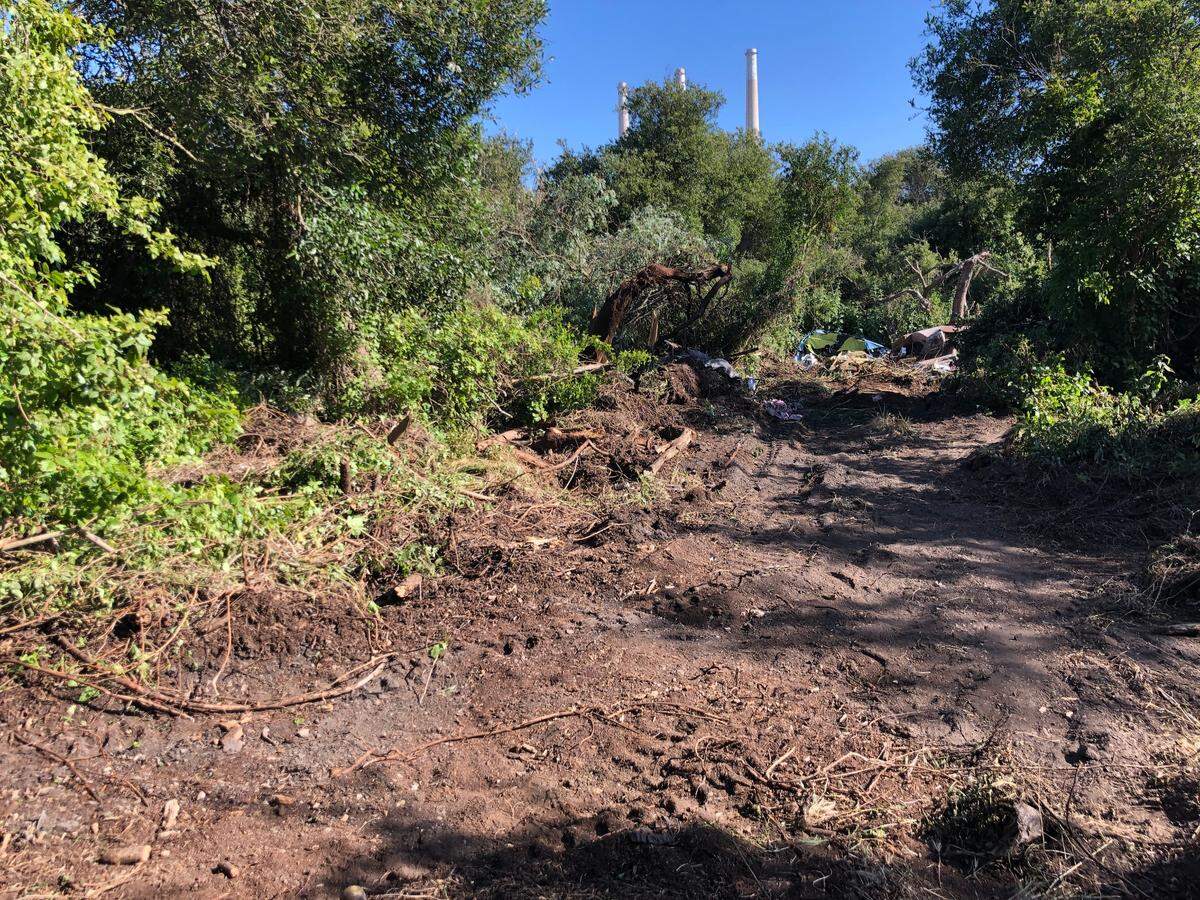
“We are not clearing trees around these encampments — but are clearing some vegetation as needed to give our crews better access to the areas that need to be cleaned,” she wrote.
Cohn told The Tribune that all hazardous materials and any trash or materials left on the property were later removed.
Petty said it was hard to see how destroying the camp site was considered a cleanup, given the environmental damage done by destroying animal habitats and tearing down dense underbrush in the creek area.
Instead, she said it was likely “to create some sort of terror” among the houseless folks who lived in the forested area along the creek and scare them out from the property.
“These are human beings, and we criminalize the houseless as if it’s a crime to be houseless,” Petty said. “It’s really disgusting what (Vistra) has done out here.”
Petty confirmed that the folks who lived on the property had about a week to relocate. During that time, none was able to find other living situations aside from out on the streets or in other parks, she said.
“There are people here who work, but they can’t afford to live anywhere here,” Petty said about Morro Bay and surrounding San Luis Obispo County communities.
Environmental impacts of bulldozing work
In its application for the battery power plant, Vistra notes that “the project will take advantage of existing infrastructure and not create impacts to undisturbed areas of the City of Morro Bay.”
The plan also says that “a few trees may need to be removed,” but these trees are located at the west end of the property, not around Morro Creek.
Nowhere in the document does Vistra announce plans to clear sections of the forested area around Morro Creek.
“For Vistra, this is an issue of employee safety,” Cohn wrote to The Tribune. “We initiated the cleanup because of the growing size of these camps and the long list of health and safety hazards and security issues that come along with them.”
Matt Gil, a lieutenant with the California Department of Fish and Wildlife located on the Central Coast, said his office was more concerned with the several batteries, propane tanks and other paraphernalia found around the encampment. The cleanup done by Vistra will hopefully improve conditions in the area, he said.
“As long as they (Vistra) don’t cut down and remove large trees or move dirt in a way that could impact the streambed or bank, then that’s fine on our end,” he said.
Gil noted that Vistra did not need to obtain any sort of permit from his office to conduct the clearing work unless they intended to disturb the creek or area surrounding it.
California Coastal Commission spokesperson Noaki Schwartz noted that most, if not all, of the property where Vistra was conducting the work is within the city’s jurisdiction.
When asked whether the city was aware of the work done at the property, Morro Bay Community Development Director Scot Graham told The Tribune he was “aware they were planning on doing some cleanup on site in the creek area,” but didn’t have any information beyond that.
This story was originally published May 25, 2021 at 3:39 PM.
CORRECTION: This story was updated to indicate that a front-end loader was used to clear areas of the forested area and homeless encampment, not a bulldozer. Additionally, the article was further corrected to note the correct time the work began on Monday, which was 11 a.m., that Vistra crews cleaned up any remaining trash and hazardous materials left on the site, and that the items described mixed into the soil were mixed only into the topmost layer of the soil.