Paso Robles approves large 5-year sewer rate hike — over hundreds of protesting residents
Paso Robles residents will see a substantial increase in their wastewater bills starting in July and for the next four years — over objections from hundreds of residents.
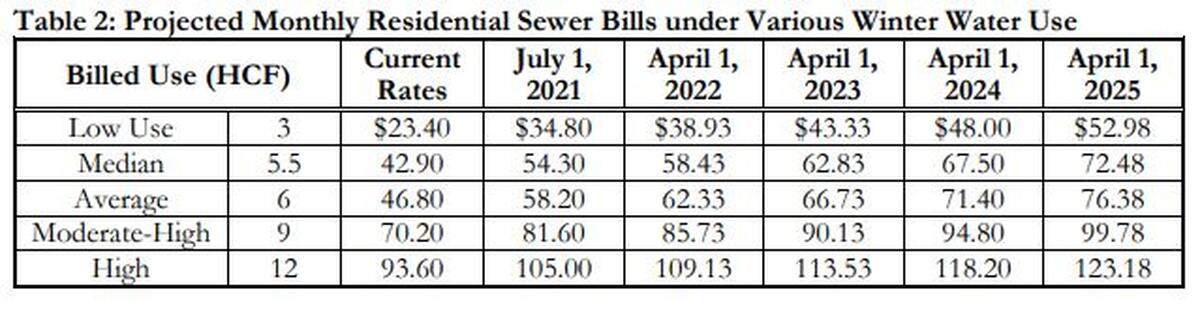
The City Council on Tuesday voted 5-0 to approve the recommended sewer rate increase, which will ultimately result in a 63% hike for typical users by 2025.
Residents who use an average amount of wastewater — 5.5 hundred cubic feet (HCF), or about 4,100 gallons a month — will see a 24% increase starting on July 1, when the rate hike will take effect. Average rate payers will then see increases of about 7% in April 2022 through 2025.
City staff said the increases are needed to help stabilize Paso Robles’ wastewater fund, which is currently operating at a loss and draining its reserves.
The rate hikes will help pay for three major infrastructure projects the city has completed or will be starting soon — a $47.2 million wastewater treatment plant upgrade, a $14.4 million tertiary treatment facilities project to produce recycled water and $9.7 million in sewer system upgrades during the next five years.
The city also recently lost one of its biggest customers, the Templeton Community Services District, which completed its own wastewater plant in 2019. The CSD previously paid Paso Robles about $700,000 per year to treat a portion of its wastewater.
Hundreds of residents protest sewer rate hikes
The City Council on Tuesday held a hearing to allow residents to protest the sewer rate increases.
If more than half of residents protested the rate hikes, council members would have been be obligated to reject the rate hikes.
The city received 448 protests, and 5,174 protests were required to overturn the increase, City Clerk Melissa Boyer said during the meeting.
Some residents called into the meeting to express their concern about how the rate hikes will impact residents already having trouble paying their bills.
Jan Albin criticized the city for failing to “jump on the problem when it began its deficit free-fall and while it was still manageable.”
She suggested the council use money from the city’s 2020 special sales tax, CARES Act dollars or funds from the $6 million the city is slated to received as part of the federal American Rescue Plan to help “support the revenue of the sewer fund and maybe reduce the proposed increases to something much less.”
“Behind the scenes, this is a community of people struggling to pay their bills, struggling to put food on the table and pay the rent,” Albin said. “It was like that before COVID, but it’s doubly hard now. These are ordinary people who, year after year, have to make hard choices about staying in the town they love or moving away to somewhere more affordable. Our school enrollment is declining because these ordinary people in ordinary jobs can no longer afford to live here. The cost of living in this town is more than the average person can bear.”
City delayed sewer rate increases for years
City Council members presented the expensive rate increases as an absolute necessity to ensure the financial health of the wastewater fund.
“I’m concerned as a citizen, and I’m a senior, as well,” Councilman Steve Gregory said. “But I’ll tell you what, I’m going to support a good quality system with good reasonable requests at a fair rate. We have to do this — it’s the only thing that’s good for our city right now. There’s nothing else we can do. It is what it is.”
Water Resources Manager Christopher Alakel and Wastewater Resources Manager Matt Thompson emphasized the city’s efforts to secure grants and low-interest loans to finance the infrastructure projects.
“The city did everything in its power to minimize the up-front cost of the expensive upgrade projects by pursuing the best financing available,” Thompson said. “And, in our case, we were able to secure for one of those loans a $4 million grant in conjunction with that low-interest loan. So I think we’ve done a good job for the rate-payers to put together a really good wastewater system at a good value and at minimal cost to our sewer rate customers.”
However, a wastewater analysis the City Council received in October 2015 suggests leaders could have prevented the need for more expensive increases by raising rates sooner.
Paso Robles last approved five-year wastewater increases in 2011, and 2016 was the last year rates went up.
The analysis suggested the city consider enacting a “series of modest increases of approximately 5.5% per year” starting in July 2017. The report took into account the wastewater treatment upgrade and tertiary treatment facility project, which were underway at the time.
COVID-19 relief funds for lower sewer bills?
The City Council did not rule out using COVID-19 relief funds to lower wastewater rates in the future. City staff suggested sales tax funds likely wouldn’t be considered for this purpose, as leaders previously committed to using that money for law enforcement, fire and emergency services and street repairs.
“When we set all these, we didn’t know what was going to happen with the federal government or the state government and with grants and COVID-19 relief projects,” Councilman Fred Strong said. “.... It looks like there may be some money coming that we could choose to use for this purpose. And that’s going to be a decision we’re going to have to make, which could allow us to reduce these rates somewhat from what they are.”
But Mayor Steve Martin said that money could only help temporarily, and rate increases would likely still be needed.
“That’s not money that would defray any rates for any service in the city ad infinitum, on forever,” Martin said. “You might do a temporary relief, but eventually, you would still have to come back to this rate increase.”