Paso Robles residents are facing a big increase in their sewer bills. Here’s why
By 2025, Paso Robles residents could be paying 50% more for their sewer bills — thanks mostly to water treatment upgrades and the city’s biggest customer shifting to its own system.
City leaders are considering the significant rate hike to help fund a series of upgrades to the city’s sewer system and to pay off state loans taken out to pay for a new recycled water plant.
Under the plan City Council members tentatively approved in February, customers would get a 24% increase in July, followed by an 8% hike each year for the next four years.
The rate hike still must go through the Proposition 218 process, which will allow residents to protest the increase. The council will formally consider it at a hearing on April 20.
The increase would also help stem the loss of income from the Templeton Community Services District (CSD), which was sending about two-thirds of its water to be treated in Paso Robles until June 2019.
That’s when the community disconnected from Paso Robles’ sewer system after completing a project that allows the CSD to treat all of its own wastewater and later recapture it from the Salinas River.
“We’re asking our customers, as the owners of this system, to allow the city to generate enough revenue to properly take care of the system, so future generations don’t have to make expensive improvements,” said Matt Thompson, Paso Robles wastewater resource manager.
Proposed Paso Robles sewer rate increases
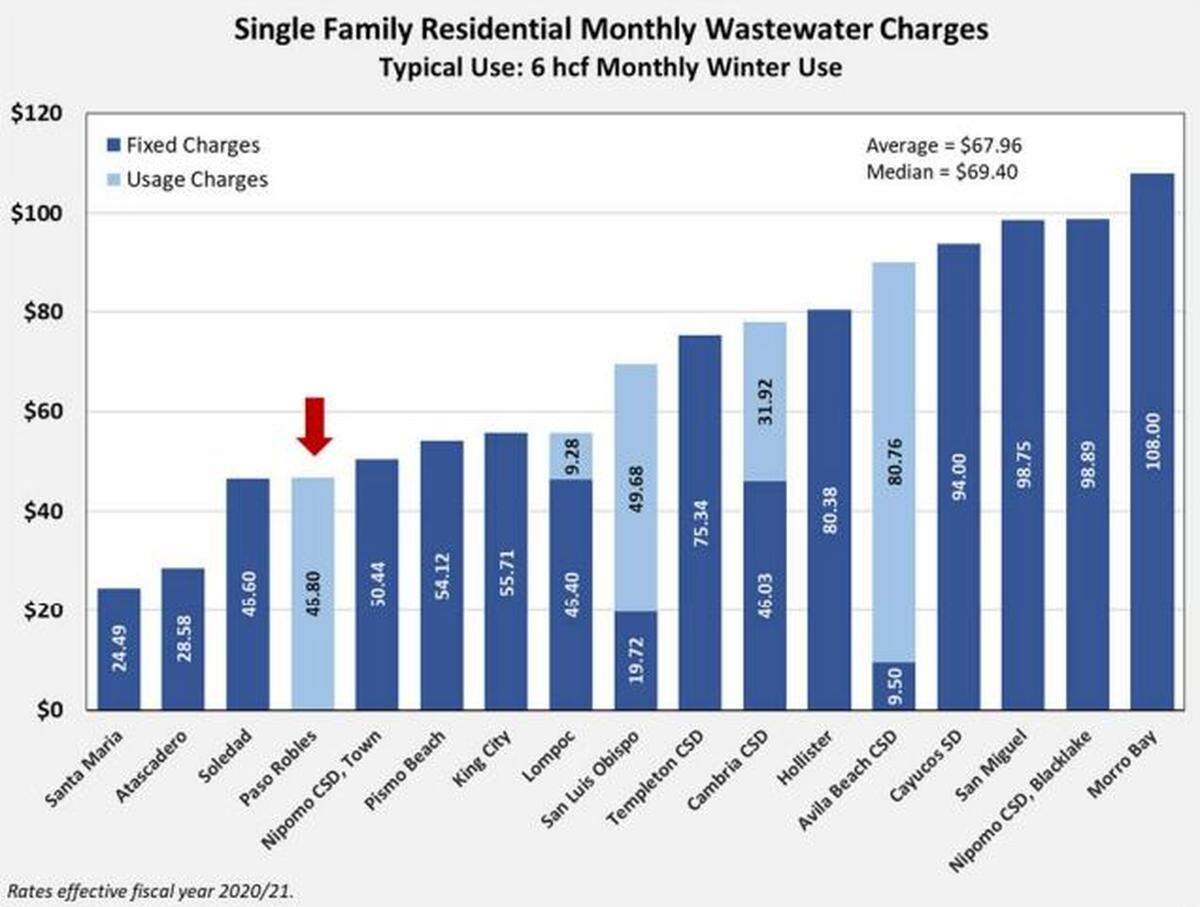
If council members approve the proposed rate hike in April, Paso Robles wastewater customers who use a median amount of water during winter months — about 6 hundred cubic feet (HCF) per month — will see their sewer bills go up by about $11.40, from $46.80 to $58.20. One HCF is equal to about 748 gallons of water, a city staff report said.
From there, customers using an average amount of water will see their rates go up $4 to $5 every April for four years, ending with a projected bill of $76.38 in April 2025.
This is mostly because the city plans to transition sewer rates from a system that allows customers to pay almost entirely based on their wastewater usage to one in which 80% of costs are fixed. As such, an increasing monthly charge will be added to customers’ bills every month.
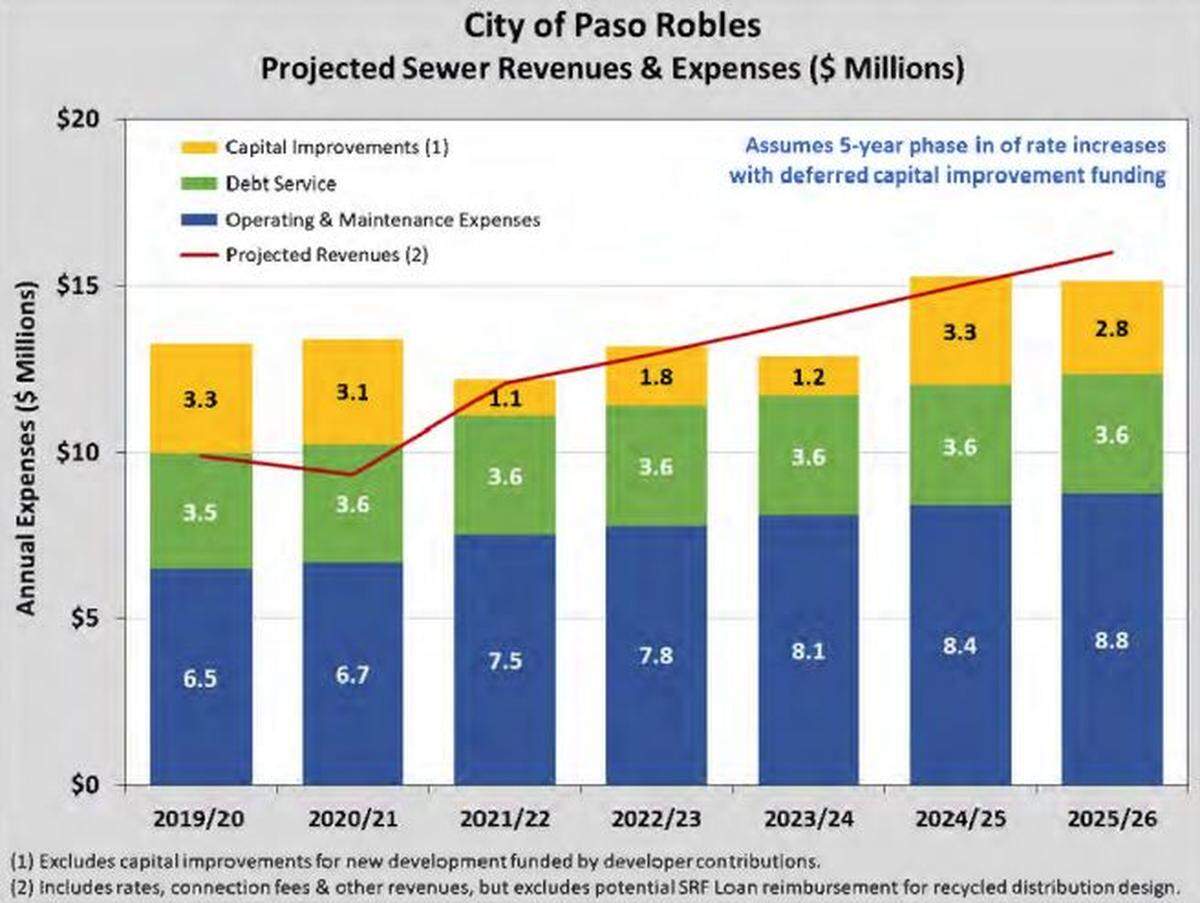
Thompson said this will help stabilize Paso Robles’ wastewater funding system, which has been operating at a loss and draining its reserves for nearly two years, he said.
A 2021 rate hike would be the first time the city has raised rates in about five years, and the increase is badly needed after years of system upgrades and a decline in funding, Thompson said.
“We had an increase in cost and a decrease in revenues,” he said.
Three major Paso Robles sewer system upgrades
For most of the past decade, Paso Robles has been in the process of upgrading its water treatment and sewer system facilities.
The city in 2014 developed a plan to upgrade its water treatment facilities and produce recycled water that can be used to irrigate sports fields and golf courses and that growers can purchase for use on vineyards on the east side of town.
That water could potentially help relieve the pressure on Paso Robles’ groundwater basin, which has long been depleted by agricultural operations.
In 2016, the city finished a $47.2 million upgrade to its wastewater treatment plant that brought it into compliance with state and federal regulations associated with discharging water into the Salinas River, a city staff report said.
Paso Robles in 2019 also completed a $14.4 million Tertiary Treatment Facilities project that gave the city the ability to create recycled water.
The city received a $4 million grant to help pay for the recycled water facility, but it must pay about $3.1 million every year on two low-interest state loans taken out to pay for the projects. Paso Robles will be paying off the wastewater treatment upgrades for the next 17 years and the tertiary treatment project for the next 30 years.
In addition to treatment plant revamp, the city is planning $50.5 million in upgrades to its sewer system over the next 30 years, with $9.7 million in improvements coming in the next five years.
Paso Robles in 2019 hired a consulting firm to conduct a sewer rate study, which resulted in the proposed rate hike and fee schedule.
All of this means Paso Robles now has a large enough wastewater treatment system to support projected population growth, although the city lost customers when Templeton disconnected, Thompson said.
The wastewater system will eventually get an influx of funding from new construction and additional sewage connections, although existing customers may have to pay more in the meantime, he said.
“The city of Paso Robles is in a really good position for the next 20 to 30 years,” Thompson said.
Templeton CSD now managing its own wastewater
A Templeton CSD project to manage and repurpose the community’s wastewater also played a role in Paso Robles’ proposed rate increase.
Templeton for many years sent about two-thirds of its wastewater — primarily from the east side of the community — to Paso Robles for treatment, said Jeff Briltz, CSD manager. The community treated the remaining one-third of its wastewater at its own Meadowbrook Wastewater Treatment Plant.
The CSD paid Paso Robles about $700,000 per year to treat most of its wastewater, the city staff report said.
In 2017, however, Templeton began construction on a project to pump wastewater from the east side of the community to be treated at Meadowbrook, instead of Paso Robles.
This allows Templeton to release more of its treated wastewater into the Salinas River and retrieve it downstream using wells 28 to 35 months later, the CSD’s website said.
The new system, completed in 2019, means the community will get a larger water supply, Briltz said. Repurposed wastewater will eventually make up about 20% of Templeton’s overall water supply, along with allocations from the Salinas River and the Atascadero Groundwater Basin, he said.
“It’s a supplemental water supply project for us,” Briltz said.
How to protest the rate increase
Paso Robles sewer customers can submit written protests ahead of the April 20 City Council meeting, where members will decide on the rate increase.
Protests must contain a statement opposing the rate hike, provide the address or assessor’s parcel number of the property and include the name of the property owner or tenant protesting the increase.
Customers can submit their protests via email to CityClerk@prcity.com or can mail them to the City Clerk’s Office at 1000 Spring St., Paso Robles, CA 93446.
Residents can also drop off their protests at at the utility payment drop-box at 1000 Spring St. or at the April 20 public hearing at City Hall.
For more information, visit prcity.com/495/Wastewater or call the Department of Public Works at 805-237-3861.