Hearst Castle staff rushed to the rescue after storm blew open doors, soaked library
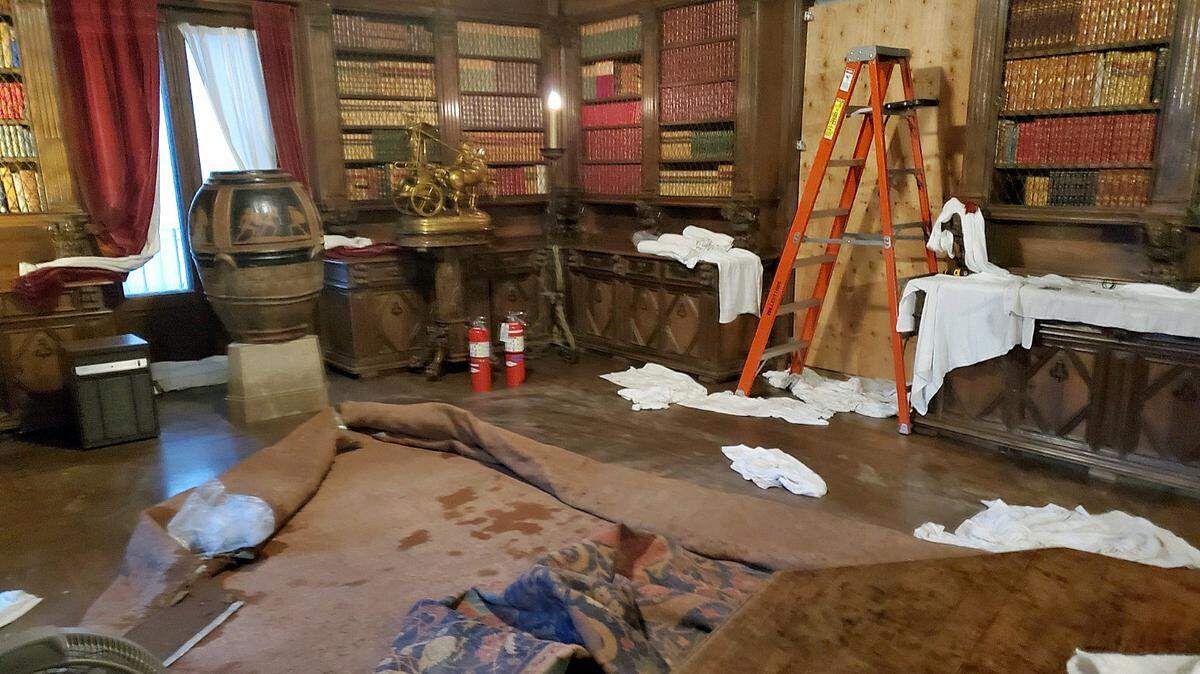
As winds estimated at up to 90 mph howled on Jan. 27, around Hearst Castle, a set of glass-and-wood-framed storm doors blew open, followed in turn by the historic interior doors they protect, sending an onslaught of torrential rain into one of the most well-recognized libraries in the world.
It was one of a series of storm impacts at the Castle that also included another set of doors blowing open in a separate building and a drain failure that sent water flowing through the library, down stairs and into a basement storage area.
Thanks to a quick response by Castle staff, however, no serious damage occurred, and workers have spent the ensuing days cleaning up and drying out the rooms and their contents.
Most of the focus was on the Main Library, and assessments as to the extent and cause of the damage there were continuing as of Saturday morning, according to Dan Falat, superintendent of the state park district that includes the William Randolph Hearst’s famed estate.
He said that it appeared that no severe structural damage had occurred, despite ongoing, intense scrutiny by trained Castle staffers.
Likewise, no permanent damage to artifacts has been discovered, including to Hearst’s priceless collection of 150 Grecian urn vases, all more than 2,000 years old.
With remarkable foresight, architect Julia Morgan had wired the vases to the wall of the 80-foot-long Main Library, one of her ahead-of-her-time earthquake-proofing techniques.
However, in the Main Library, which houses more than 4,000 books, as well as Hearst’s private library in the Gothic Suite and Casa Del Mar, or, “A” House, one of three large guest residences that surround the iconic main building, Falat said, some valuable items got drenched in the deluge.
Collections and historical-restoration staffers and others are painstakingly tending and drying those items to protect them, he said. Many items that were soaked or dampened were replicas, rather than originals, but all are being treated with the careful, proper attention they deserve, he added.
The Castle has been closed to the public for nearly a year amid the COVID-19 pandemic. Located at the southern end of the famed Big Sur coastline, the Castle is now further cut off to visitors after the storm washed out a section of Highway 1 north of Lucia.
Alarm sets Hearst Castle staff in motion
According to reports from Castle staff who responded to the storm, Falat said, workers learned of the breach when an alarm went off at 4:30 a.m. Jan. 27.
“That alerted firefighters and security staff that a door had opened in the Main Library,” he said. “Later, another alarm sounded, notifying them that a door had opened up at ‘A’ House.
“They assessed the damage, determined what had to be done and did what they could to secure the area, mopping up, cleaning up, and checking other areas to determine if there were other problems,” Falat said.
Subsequent reports indicate that “the water flow was likely caused by a blocked drain on the balcony into the library,” he said. Because of the ongoing, torrential downpour, “water flowed from the library down two floors through a stairwell, pooling maybe 2 inches deep in the basement where some furnishings are.”
Meanwhile, dispatchers sent out crisis alerts and calls for employees who were due to arrive for their regular shifts at 6:30 a.m., along with others who were drafted for emergency duty.
That team ultimately numbered about 15 to 20 staffers, Falat said, including people from the grounds crew, collections, historic restoration, rangers, firefighters, duty officers, managers, supervisors and eventually the superintendent himself.
Staff informed him of the situation soon after 7 a.m. and that they were getting it under control, said Falat, who immediately left his Morro Bay home to help. He remained in constant contact with his staff and checked on his way north for impacts from fallen trees and other hazards in the district’s 10 other parks, arriving at the monument about noon, in the midst of the still-raging storm.
At the Castle hilltop, Falat immediately jumped in to join the efforts to secure valuable items. The team constantly checked and rechecked drains, windows, storm doors and the wires that secure them, while reviewing security measures to make sure the historic house museum was as well protected as possible.
And, indeed, those rotational checks paid off, he said, when staff discovered that wires securing the doors on the other side of the Main Library had loosened, even after having been rechecked multiple times earlier in the day. They immediately retightened the wires.
Those intense efforts continued throughout and after the storm.
Not the first time a storm has battered the Castle
Storms have caused problems before at the hilltop, century-old structure, which has been open for public tours as a state park monument since June 1958.
The most recent relentless storm, which parked itself over the Central Coast and hammered it with hurricane-intensity winds and hours-long downpours for days, came in from the south, as had been predicted by PG&E meteorologist John Lindsey, rather than from the more customary direction of the northwest.
Lindsey likened the tempest to a massive 1995 storm, which caused huge damage up and down the coast, including in Cambria, where runoff was so heavy, it buried the West Village business district under water so deep it rose almost to the tops of a service station’s gas pumps.
As it turned out, the meteorologist’s predictions of a severe storm this year were right on.
On Jan. 30, retired museum director Hoyt Fields, who continues on a part-time basis in his 52nd year of working at the Castle, recalled similar weather events from earlier decades.
“This one sounds like it would be the second or third worst storm that I can remember (at the Castle),” he said, elaborating further on one that he estimated hit the monument in 1979.
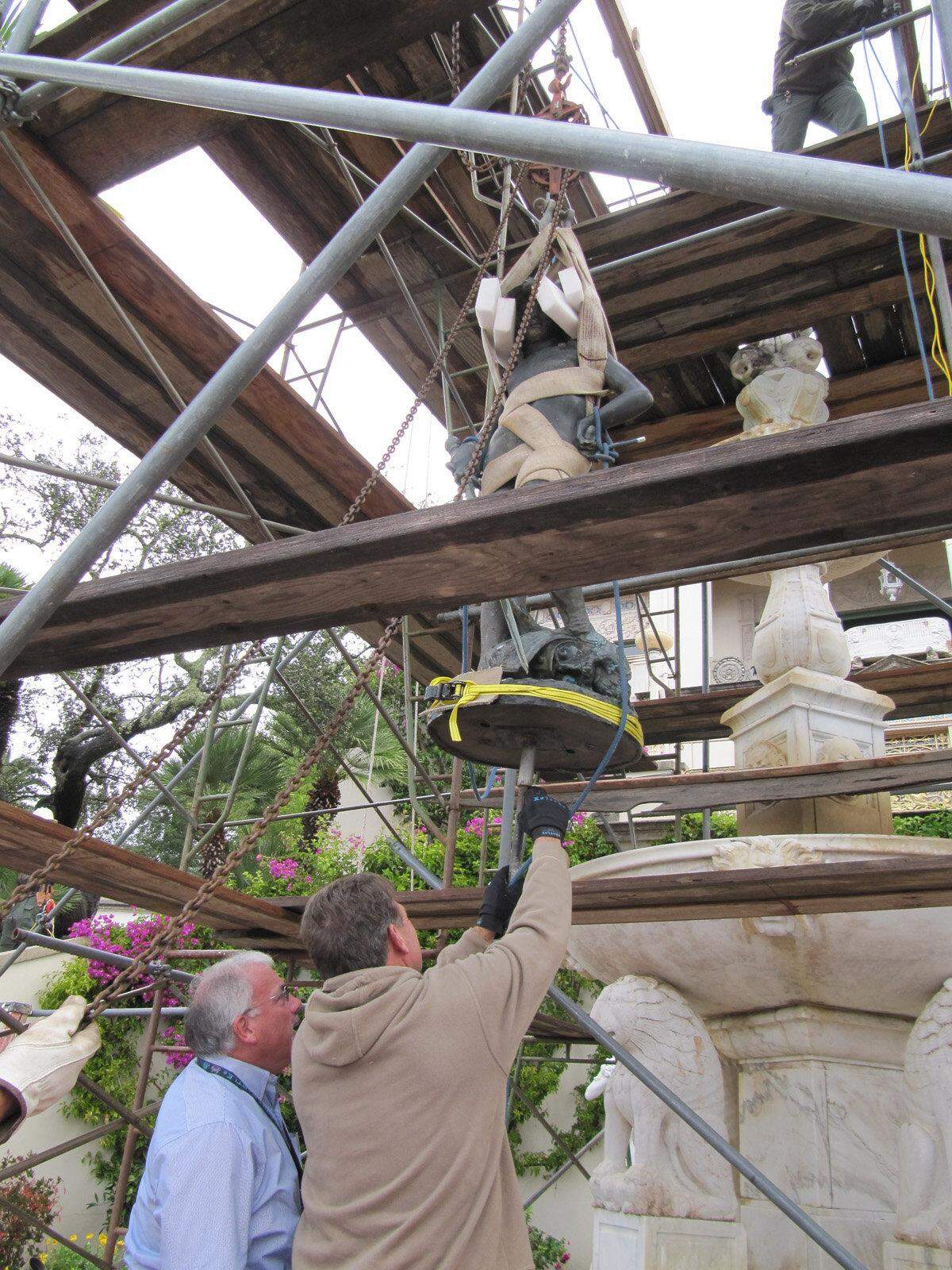
That storm hit during in the daytime, Fields said, which was an advantage staff didn’t have this time around.
In the 1979 meteorological onslaught, “winds were more than 100 mph,” he said, “and a clerestory window in the Celestial Suite sitting room blew open, shattering beautiful 15th Century Anatolian plates. We don’t know if a palm frond hit them or what happened. We were pulling books out as fast as we could, to get them away from the moisture coming in.
“Statuary was knocked over outside,” he said. “The Castle’s many drains plugged up with debris, even though we were checking them every hour. A huge oak tree went down on the Main Terrace, blowing toward C House.”
And there was other damage. “Because the B House sitting room doors had blown open,” Fields recounted, “we were going to have to prop them closed with a 4-by-8-foot sheet of plywood, carefully, because of all the beautiful gold-leaf ornamentation around the doors. Frank Young and I had to carry that plywood across the main terrace in 100 mph winds, which almost lifted us off the ground.”
As will be the case this time, Fields said, “We were able to repair and take care of everything then, and after every storm since then. It’s all repairable. We have excellent people working there, and experts we can call in. And we were so lucky; none of the outside statuary was damaged at all.”
Staff bracing for next storm
With much of winter still ahead, Falat said the staff is preparing for the worst, as they always do.
Going forward, he said, “it will be a matter of what we’ve learned from this storm, trying to determine if wind speed and direction were the only reasons why one set of storm doors in the Main Library held and the other didn’t. We’ll research other ways of securing those doors, for instance.
“But for now, we’re just getting everything dry, repaired and settled, put back together as quickly as we can,” Falat said, “especially with another storm coming in (on Feb. 2)” and the rest of the rainy season to get through.
This story was originally published January 30, 2021 at 12:54 PM.