Tianna Arata got ‘a little not-sound advice,’ SLO police chief says at diversity forum
San Luis Obispo police chief Deanna Cantrell addressed her department’s recent arrest of local protest leader Tianna Arata during an online community forum Wednesday night, saying the 20-year-old and other organizers received “a little not-sound advice maybe from some of their mentors.”
“Do I want her to have criminal convictions and a record that’s going to impact her life later? No. What I do want is I want her to realize that she cannot engage in that kind of behavior,” Cantrell said.
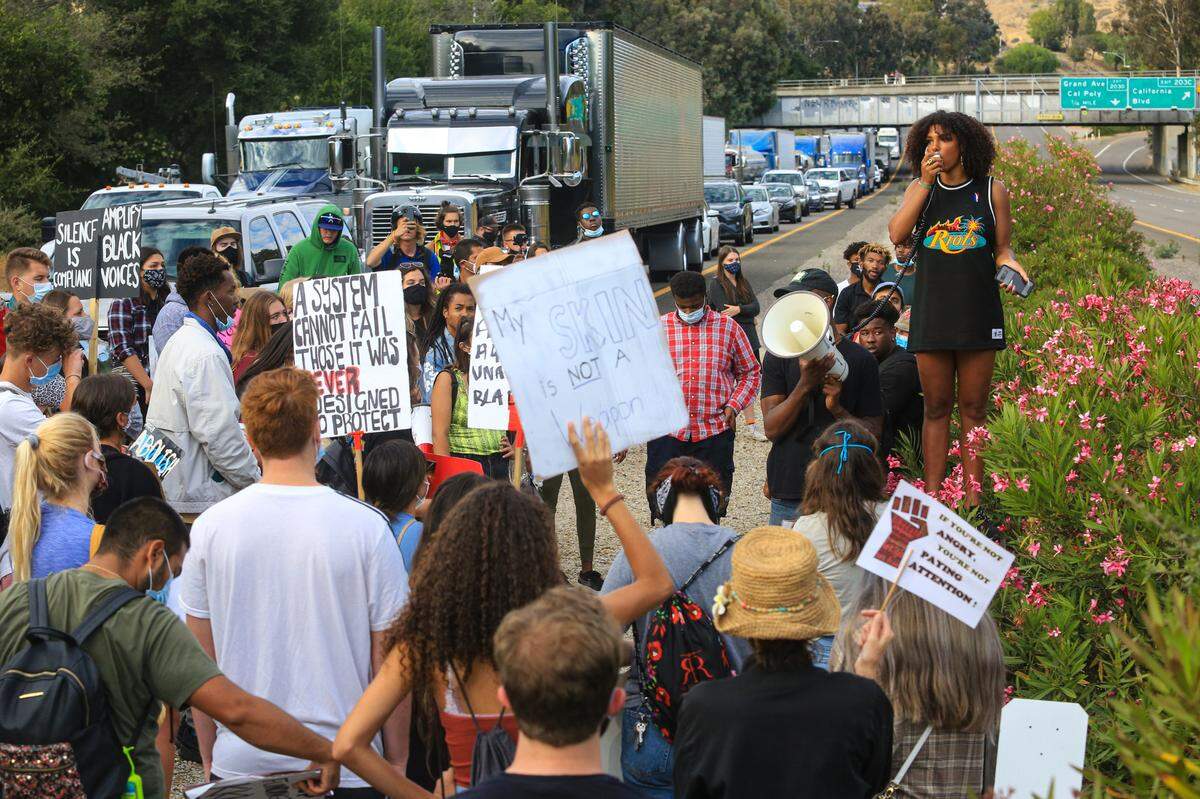
She was speaking about a July 21 protest in which demonstrators, led by Arata, marched on Highway 101 and blocked traffic for about an hour. Arata is accused of five felonies and three misdemeanors related to the march.
Cantrell and county District Attorney Dan Dow — who said he can’t comment on the arrest because his office is investigating whether to file SLOPD’s recommended charges against Arata and another protester — appeared on a Zoom panel discussion titled, “How to be an ally, a public safety perspective” hosted by the Diversity Coalition of San Luis Obispo County.
The event featured a handful of audience questions, on topics including the arrests of the protesters, the Black Lives Matter movement, and the idea of “defunding” law enforcement agencies in favor of social services support.
It also featured Vivien Devaney-Frice of the nonprofit Restorative Partners and Arroyo Grande Councilwoman Lan George. The discussion was moderated by actor and educator Fanshen Cox.
The participation of Cantrell and Dow was the first time they’ve publicly sat down with a local community group for a discussion
about race relations and local protests.
The arrests of Arata and Elias Bautista, conducted at Mitchell Park after the event had ended peacefully, was described by witnesses as an “ambush.”
Cantrell previously said that Arata violated the law when she broke a prearranged agreement not to go onto the highway. During the closure, Dow tweeted a “public safety alert” in response to protesters blocking the highway, writing, “This is unlawful and incredibly dangerous. It must stop.”
Protesters have demanded that Cantrell and Dow dismiss the case against Arata, which carries a potential sentence of a few years in County Jail, her attorney previously told The Tribune.
The arrests have attracted national publicity, and Arata appeared with civil rights attorney Lee Merritt on ABC News Wednesday night decrying the charges against her. Her online legal defense fund has raised roughly $52,000 as of Thursday morning. A change.org petition calling for the case to be dropped has attracted more than 350,000 signatures.
A restorative response to protesters’ arrests
The public Q&A portion of the forum quickly turned to the July 21 protests, and Cantrell stood by her department’s conclusion that Arata broke the law.
“Here’s the reality: I like Tianna,” Cantrell said, also naming off several other local protest organizers. “I think they’re young kids and I think maybe they’ve gotten a little not-sound advice maybe from some of their mentors.”
“And I know she’s 20 years old,” she said. “I was 20 years old once and I was dumb — and I’m not saying she’s dumb — I’m saying I was immature and, you know, I did crazy things. So I get that. On one hand, I’m also the police chief, and I’m responsible for public safety.”
“Sorry, I just want to clarify: Are you saying that what she did was a crazy — are you saying she just did it because she’s young or that it was a crazy thing to do?” Cox, the moderator, asked.
“I’m speaking for me. I said I did crazy things,” Cantrell said.
“What’s the connection with her?” Cox asked.
“I was 20 and I didn’t know as much things as I know now, and Tianna, I think, has a lot of potential,” Cantrell said. “I told her that. I think she’s got a lot of potential in the Black Lives Matter movement and as a leader. She’s a natural leader of people.”
She continued: “Do I want her to have criminal convictions and a record that’s going to impact her life later? No. What I do want is I want her to realize that she cannot engage in that kind of behavior. And I’m sure there’s a disagreement — some people think that there was nothing wrong with any of the behavior. I disagree with that. This is why she was charged with the crimes that she was charged with. And so there’s got to be a level of accountability.”
Devaney-Frice said that Restorative Partners has been in discussions with law enforcement leaders about the July 21 protest and the possibility for a restorative justice resolution that doesn’t lean on heavy jail time.
The principals of Restorative Justice is to repair any harm caused to victims, preferably with two or more affected parties deciding on a way forward together, and using the process to cause fundamental changes in people, relationships, and communities.
Cantrell said that she had a conversation with Sr. Theresa Harpin, the head of Restorative Partners, shortly after Arata’s arrest.
“Restorative justice isn’t about no accountability,” Cantrell said. “There is accountability in it. It’s just what kind of accountability, what is it going to look like?”
Cantrell said that on the other side, there are alleged victims in the case, “and I don’t get to decide for them.”
“I don’t get to speak for those victims. And that’s why it goes into the process that it’s in,” she said. “There’s checks and balances: The Police Department deals with probable cause. We send all charges that we think apply to the DA’s Office. The DA’s Office deals with a completely different standard of proof and will take a look at that and talk to victims and determine which is the best way to go.”
She said it is ultimately up to the DA’s Office whether Arata’s case “goes a restorative justice way.”
Dow said he could not ethically comment on the case, but that he’s generally supportive of restorative justice.
“It’s complex but I absolutely believe in using restorative justice when it’s appropriate,” Dow added. “I also will say it’s not something that can be used in every case.”
“This process can be exactly what we need it to be in any situation,” Devaney-Frice said. “This case is just a really good example of so many moving parts where a restorative justice approach could be really beneficial.”
Dow added that it’s his office’s duty to review the work done by local police departments, and that last year his agency rejected roughly 18% of charges recommended for prosecution by local departments.
To Dow: ‘What does BLM mean to you?’
Wednesday’s event followed the release of controversial videos showing county Sheriff Ian Parkinson criticizing protests and denying the existence of local systematic racism, as well as another in which Dow shares the stage with a CHP officer who also said he doesn’t believe racism exists locally.
Dow, who did not make any statement related to race and protests in his July 4 video, later clarified that he takes racism “very seriously.”
“Black lives absolutely matter,” Dow said during Wednesday’s forum. “Black Lives Matter is a movement, and it is an organization with a desire to bring to the forefront a lot of the challenges that the black community is facing and has faced for a long time in our community.”
In terms of what it means locally, Dow said what’s important is that all government and non-governmental organizations “work together to make sure that people of all color are treated fair and equal.” He said his role to that end as district attorney is to make sure the criminal justice system also treats all people that way.
Cox pushed back, saying it’s important that people do see color as “a way to see disparities and to see the historical context of where we are with criminal justice right now,” and that the present discussion was specifically about systemic racism and people who currently aren’t treated equally.
“I’m going to ask you to keep that in mind and not tag on each time, ‘everybody’ and ‘all people’ because we are specifically talking about people who are marginalized racially,” Cox said.
“Fanshen, my personal worldview is that we’re all created by God, and we all are equal regardless of where we were born, where we were raised, what communities we live in. So that’s to me the dignity of every human life, and I’m not willing to compromise on that.”
“We’re just not all treated that way,” Cox said.
“And I agree with that,” Dow replied.
On ‘defunding’ the police
Cantrell said she’s “on a neutral side” of the call to reallocate some funding from law enforcement toward social services and community programs.
“I don’t like that term ‘defunding the police.’ It’s more about restructuring,” she said, noting that police departments have not received money cut from social services. “It’s not like the funding for all those services came over to us, what came to us were all of the calls for service and all the problems, with no training.”
“We’re not social workers. We don’t get a lot of mental health training ... and so we came from behind,” Cantrell said.
She said that funding shouldn’t be reallocated from police departments until a system is in place to handle the burden elsewhere.
“Who’s going to respond to it in the meantime? That’s really the issue, because police are still going to have to respond until a system gets put in place,” Cantrell said. “I would say find the funding somewhere, get the system put in place, and then if you see police calls for service start to come down ... fantastic. And then yes — the Police Department should restructure at that point.”
But mental health and homeless-related calls for service oftentimes also have a criminal element requiring a police officer, she said.
She noted the success of the city’s somewhat recent Community Action Team, which pairs a social worker with a police officer to deal with the city’s chronically homeless, and said the department is seeking grant funding for a second social worker.
Dow said he doesn’t agree “that it’s one or the other.”
“We need to have both. We need to have our law enforcement agencies properly staffed and properly resourced,” he said, citing a Gallup poll from Aug. 5 that found 81% of Black respondents said they want police to spend the same amount of or more time in the areas in which they live.
“I don’t quickly jump in to the defund movement because I think statistics show that we need strong public safety and we also need to do things in a way that is better than what we have done, but I don’t think we need to have one or the other.”
“OK, but we’ve been doing it with lots of funding for the police, and that’s not working,” Cox said.
“Well, I think there’s a lot of police agencies that would differ with you and say they don’t have enough funding,” Dow said.
This story was originally published August 13, 2020 at 10:54 AM.