SLO County board cuts $26 million from budget — resisting push to divert law enforcement funds
San Luis Obispo County leaders will cut $26 million from next year’s budget — and they mostly ignored demands from local anti-racism activists to reallocate funds from law enforcement and put them toward community services, mental healthcare and nonprofits.
The county Board of Supervisors is facing a budget shortfall of $32 million to $56 million due to economic impacts from COVID-19, the illness caused by the new coronavirus.
“The pandemic’s impact on the budget is unprecedented in terms of how quickly our financing sources were impacted, and the need for immediate response, which has impacted our financing uses,” wrote Emily Jackson, budget director, in a staff report. “Put simply, we are faced with both revenue loss, and expense increase. At this point, the bigger issue is revenue loss.”
Supervisors on Tuesday voted 3-1 to adopt the 2020-21 budget, which primarily involved figuring out how to cut an initial $26.2 million from the county’s coffers. Supervisor Debbie Arnold voted against the budget adoption, and Supervisor Adam Hill was absent.
The board largely decided how to spend the county’s money during two days of budget hearings on June 8 and 9 — the Tuesday vote was mostly a formality.
On June 9, supervisors voted 4-1 to approve the initial cuts, with Arnold as the lone dissenting vote. During the budget hearings and on Tuesday, Arnold pushed to reallocate funds to fully fund public safety and law enforcement health care, which provides medical care for jail inmates.
How will the county spend its money?
Local departments are funded using county general fund dollars, as well as state and federal money. The county’s largest general fund spending allocation, about $52.2 million, goes to the Sheriff-Coroner’s Office in the 2020-21 fiscal year.
Even with budget cuts, the Sheriff’s Office will receive about $2 million more in county funds than it did last year.
Rounding out the top five county-funded departments are County Fire, which will receive about $18.4 million, Behavioral Health, which will receive about $13.8 million, the District Attorney’s Office, which will receive about $12.7 million and Probation, which will receive about $12.3 million.
The budget includes 4% across-the-board general fund cuts for all county departments except the four categorized as public safety: the Sheriff-Coroner’s Office, County Fire, Probation and the DA’s Office.
The four public safety departments will receive 1% budget cuts. Staff originally recommended an additional $3.4 million cut to projected Proposition 172 funds — money that comes from a special state sales tax approved in 1993 to support local public safety activities — in anticipation of a decline in revenue due to the coronavirus.
County staff initially suggested spending $1 million from the Proposition 172 savings account to offset that expected state funding loss.
However, supervisors opted to use nearly all of the savings to backfill the entire $3.4 million cut, leaving $158,483 in the account.
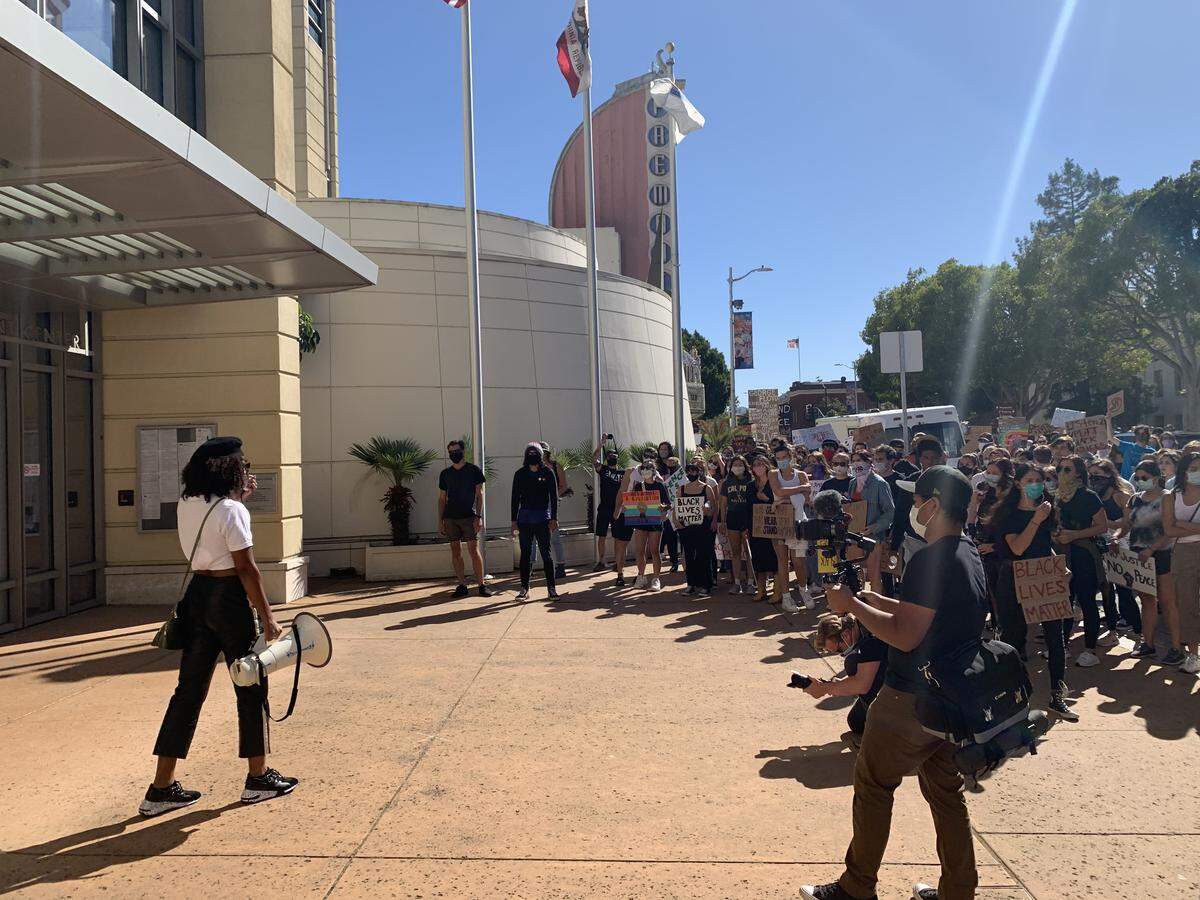
Protesters demand reallocation of funds
In recent weeks, protesters demonstrating against police brutality and racism in the wake of George Floyd’s death, including R.A.C.E. Matters SLO County, to community services, mental health and nonprofits.
“We’re not looking to defund or disband police departments, we are looking to reprioritize where our county’s standards and mission lay,” Katie Grainger of R.A.C.E. Matters told The Tribune at a June 8 protest. “We spend about five times as much on the Sheriff’s Office and Probation than we do on mental health services. That has to change. “
But protesters’ and residents’ demands largely went unheeded, in spite of many calls and emails to supervisors. The budget process — which kicks off months before supervisors formally approve the funding plan — moved quickly, and supervisors were primarily focused on preserving programs amid coronavirus cuts.
“The politics of the moment — whether it be the Black Lives Matter movement, which I’m highly sympathetic to — are not at play here,” Supervisor Adam Hill said on June 9. “That’s not what we’re trying to do. We’re trying to figure out how to balance our budget. And this is going to be a multi-year task.”
Supervisors preserve public safety dollars
Arnold, Supervisor Lynn Compton and Supervisor John Peschong all said their constituents want to see law enforcement fully funded, especially those living in rural areas far from cities.
“My constituency, for the majority, does want public safety funded and at its full level,” Compton said. “They don’t want to see decreases in that. We live in a very rural area, my constituents, and only have one incorporated city, and we’re far away from the Sheriff’s Department, and people just want safety. They’re looking forward to building a new sheriff annex down by us, we’ve added additional (deputies) over the years, which has been very well received. We have a (community action) team that helps with the homeless, and that is a very popular program in my district. “
Supervisor Bruce Gibson expressed interest in R.A.C.E. Matters’ demand for a law enforcement civilian review board and said he plans to meet with leaders from that organization, as well as the NAACP.
“I think there’s a lot of discussion about the current situation and in what ways it might be made better that we certainly should engage,” Gibson said.
Gibson spoke out against using all of the Proposition 172 savings to backfill public safety losses, pointing out that the Sheriff’s Office is still receiving more money in the 2020-21 budget than it did this year.
But he ultimately supported the budget and used the county’s Stepping Up initiative — which seeks to reduce the number of jail inmates with mental illnesses — as an example of ongoing efforts to address mental health issues.
“The reallocation of scarce resources is the essence of what we do in forming the budget,” he said. “The struggle that we’ve had to balance this particular budget has a lot to do with where we seek to put those resources, whether it is in traditional law enforcement or whether it is in programs that affect law enforcement, but from a social service side. And, again, part of the community conversation is to get out there and talk about our Stepping Up initiative, which is directly aimed at hopefully preventing the kind of situation we saw with the tragic shooting in Paso Robles, again interfacing mental health.”
This story was originally published June 19, 2020 at 5:00 AM.