
SLO’s Prado Road interchange fully funded pending review. Here’s when it could be built
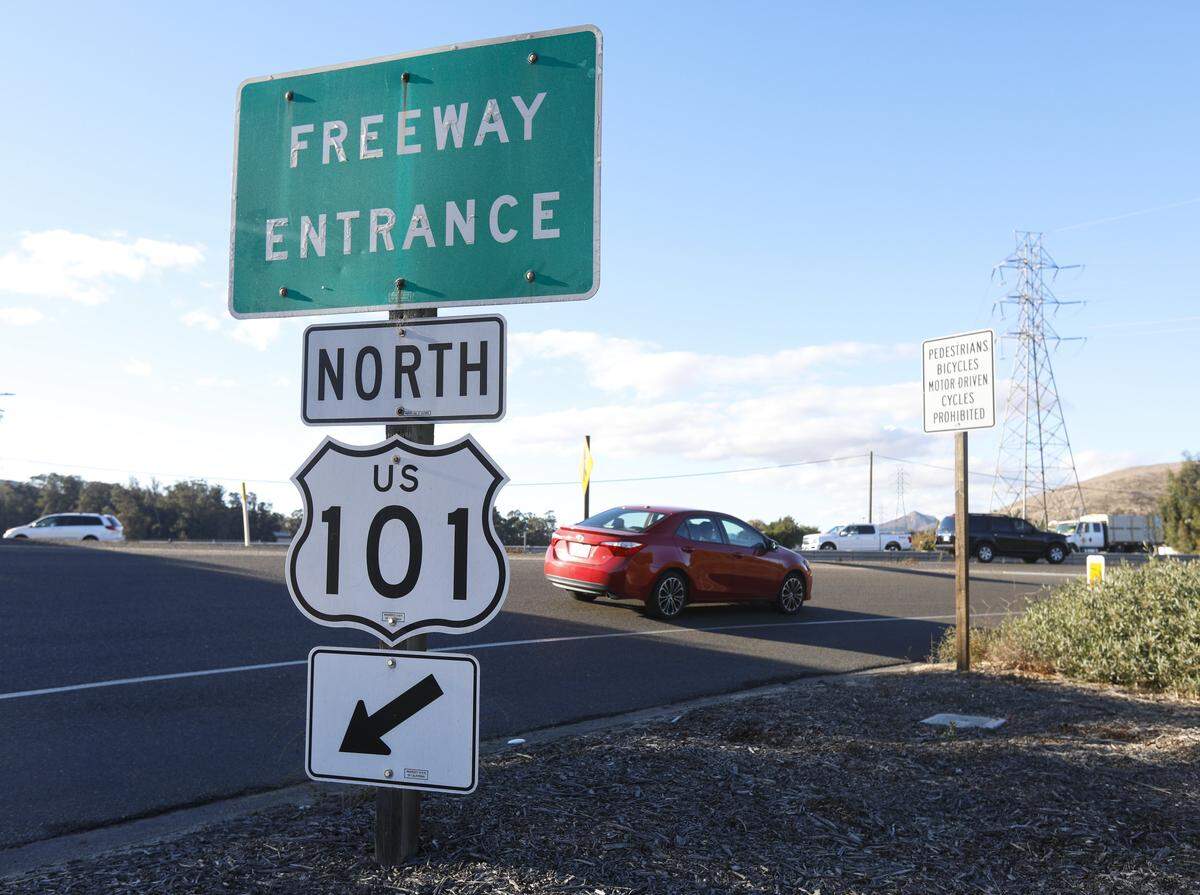
The proposed Prado Road overpass — a critical link in San Luis Obispo’s future traffic infrastructure — is on track for construction to start in the first half of 2022, according to the city’s transportation manager.
The $25 million to $30 million interchange over Highway 101 is now fully funded, pending further design and environmental review.
It has long been envisioned to provide an east-west connection across the city, with a northbound on-ramp and off-ramp to Highway 101, and eventual plans for a southbound ramp, said Luke Schwartz, the city’s transportation manager.
If the Prado interchange plans go accordingly and it’s approved by Caltrans after planning hurdles, construction is now targeted to take one to two years and finish in 2023-24, Schwartz said.
“In terms of overall (traffic) circulation, this is the biggest on the city’s planning list,” Schwartz said.
The city’s plans call for a future, long-term extension of Prado Road to Broad Street, additionally connecting the east and west sides of the city — but the implementation on that extension is several years away.
Prado interchange will accommodate SLO growth
Schwartz said funding levels for the Prado interchange could depend on unforeseen costs. The city is preparing to undertake environmental studies of the site this summer, including the site’s hydrology and potential for flooding, before it completes detailed project designs late next year.
“By the fourth quarter of next year, we expect to have detailed designs,” Schwartz said. “It’s a complex project, and cost estimates could change after we review in more detail what the environmental impacts could be.”
Jake Hudson, the city’s former transportation manager who left his job with the city earlier this year to work in private industry, previously told The Tribune the Prado interchange project is essential to supporting long-term growth in the city.
“The overpass will allow acceptable levels of congestion and without it, we’ll have too much,” Hudson said.
The interchange would be located near the San Luis Ranch housing development, allowing easy access for residents to the Highway 101 freeway, and another route to get to South Higuera Street from the city’s west side besides Madonna Road or Los Osos Valley Road.
Road improvements that are part of the San Luis Ranch project include a wider and separated bike path on Madonna Road, along with pedestrian crossings and improvements.
San Luis Ranch to see first homes in early 2021
The San Luis Ranch development was approved in 2017 to occupy the back half of a 131-acre site bordering Madonna Road and Oceanaire Drive, visible from Highway 101. The developer is responsible for covering about a third of the Prado interchange cost, nearly $10 million.
The first phase of San Luis Ranch homes includes 86 homes, while the second phase would add 196 homes. Future plans also call for a hotel, commercial and office space at the property.
The San Luis Ranch project site is currently under construction with the installation of sewer lines and storm drains, according to its website. And the improvements to Madonna Road, as part of the new development, are scheduled for January as well.
“It’s likely the first completions of homes would be early 2021,” said Cate Norton, the project’s public relations manager. “We should have homes ready to move into by then.”
San Luis Ranch’s home sales reservations will start taking place this spring with an on-site office, Norton said.
Other projects designed to help SLO traffic
The city is in the midst of planning or constructing additional road projects designed to increase walking and biking, as well as reduce traffic.
Some of those include the Railroad Safety Trail, envisioned to start construction this summer. That project has completed right-of-way acquisitions and will provide more than four miles of a bike pathway next to the railroad tracks connecting Cal Poly to the city’s southern limits.
The total cost of the Railroad Safety project is $6.1 million, with $3.2 million from a Caltrans Active Transportation Grant.
Several new roundabouts are also proposed or under construction in the city, including a roundabout at Tank Farm Road and Orcutt Road, where hundreds of homes are going in, to help alleviate backups.
A leg of the Anholm Neighborhood Greenway project is scheduled for late 2019 into early 2020, including “a dedicated multi-use path through The Church of Jesus Christ of Latter-day Saints (LDS) property and a protected bikeway, or ‘cycle track,’ on Ramona,” according to the city’s website.
A Pedestrian Hybrid Beacon (PHB), also called a “HAWK Beacon,” designed to allow pedestrians and bicyclists, including children on their way to school, to cross the street more safety. The project recently was completed on Foothill at Ferrini Road.
The beacon was the first in the city. Others are envisioned for Broad Street and Woodbridge Street for the second half of 2020. Two additional beacons are slated to be installed by the San Luis Ranch Development in the next one to two years — one on Froom Ranch Way and Oceanaire Drive, and one on Madonna Road between Dalidio Drive and Oceanaire.
The city has a goal to achieve a transportation mode shift citywide by 2035 in which 50% of people drive, 20% use bicycles, 18% walk and 12% use shared transit.
“The city’s General Plan identifies a planning horizon year of 2035,” Schwartz said. “However, the ultimate ability to achieve these targets will depend a lot on funding and ability to implement the bike and pedestrian infrastructure and transit improvements that we’re endeavoring towards.”
This story was originally published January 8, 2020 at 5:15 AM.
%20Cropped.jpg)