
Goodbye, Brisco Road ramps — hello, Arroyo Grande’s first roundabout
The Brisco Road area of Arroyo Grande will look very different in the coming years.
After almost two decades of head-scratching and hand-wringing over how to fix the congested intersection, the Arroyo Grande City Council took action Tuesday to reduce the traffic problems at the Highway 101 on- and off-ramps at Brisco Road.
Their decision? A $19.6 million overhaul of the entire area that will close the Brisco ramps, build new ones a couple hundred feet away at Rodeo Drive and Branch Street, add a new bridge and install the city’s first traffic roundabout.
“We need to plan for the future — and not just 2035,” Councilwoman Kristen Barneich said. “We really need to plan for 30, 40, 50 years from now, and not take a Band-Aid approach to this.”
She added: “Even though today, I don’t mind sitting through a couple of lights, 25 years from now, if we don’t do anything or if we do the short-term fix, it’s going to be just horrendous.”
The project will be funded with a combination of local funds and state Transportation Improvement Program funds, according to the city.
Construction is expected to begin in 2022, and will take between seven and nine months to complete.
Two options for fixing traffic
The city has been working to address concerns that traffic backs up on Brisco Road due to the highway ramps there for roughly 19 years.
In 2015, the City Council selected two options: close the Brisco ramps without adding replacements, and funnel money into improving other overpasses and ramps along that stretch of Highway 101; or build new ramps and all of the necessary traffic accoutrements to keep it running smoothly.
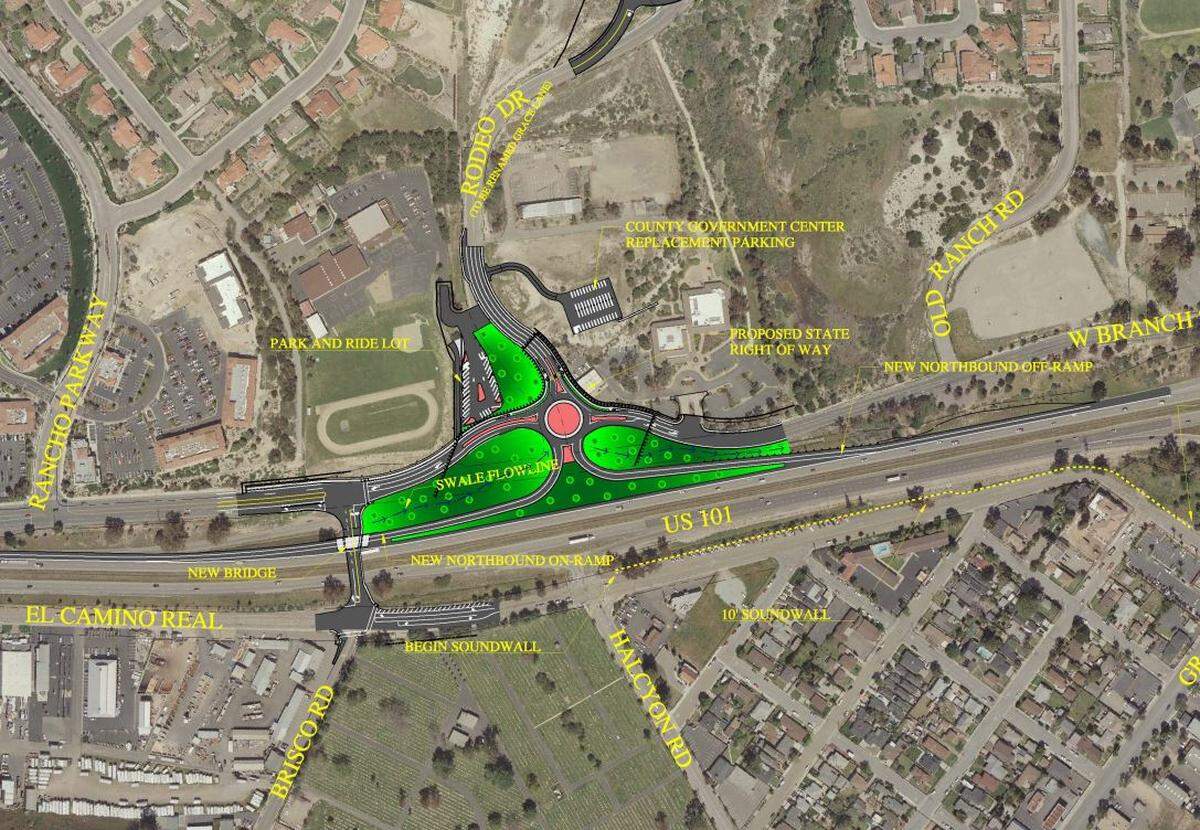
The first option could be done for about $12.3 million, according to city staff, but some worried it would not actually solve traffic problems in the area, and would instead push those to other parts of the city.
It also would require the city to take over part of the land next to the nearby Shell gas station on Grand Avenue, and force the station to remove several of its pumps and reduce its overall size.
Shell station co-owner Araxie Achadjian said this alternative would have negatively impacted her business and would have forced her and her husband, co-owner Katcho Achadjian, to consider firing employees or shutting down the station.
“There is no partial impact in this case,” she said. “It will be full impact on our business.”
Divided community
Meanwhile, the second option worried many residents because of its hefty price tag — something concerning for a city that has been in budgetary straits in recent years.
In response to a Tribune reporter post in Facebook group “Arroyo Grande Current Affairs,” many residents on Wednesday bemoaned the expense, saying they felt “waiting through a couple of lights” was not worth the $19.6 million price tag.
“Given AG’s budget issues, this was the wrong decision,” Beth Plymale wrote in a comment. “I use Brisco as my primary route on/off 101 and while it may require me to sit at a light, it is nowhere near the level of inconvenience that would require a 23 million dollar solution.”
(The original cost estimate for the second alternative was $22.7 million, but the council decided Tuesday night to go with a phased approach that would reduce that cost down to $19.6 million.)
Others characterized the decision as difficult, but necessary in the long-term.
“No change would be the hell we are accustomed to,” resident Shirley Gibson wrote. “Roundabouts may be the best long-term answer, except for the cost. The cheaper plan may have been inadequate for the future. It’s costly to fix the problems created by 40 years of inaction.”
Time to fold
It also wasn’t an easy decision for the divided council: Mayor Caren Ray Russom and Councilman Jimmy Paulding both voted against the expensive second alternative.
Paulding advocated for the first alternative, while Ray Russom said she would instead prefer a “no project” option, where the city would go back to the drawing board and start fresh, despite the $1.8 million it has already sunk into exploring these alternatives.
“The surest way to lose at poker is to worry about money you’ve put in the middle already,” she said during the council meeting Tuesday night. “What you have to do, is sometimes you’ve got to fold. In my opinion it’s time to fold.”
Ray Russom added in an email to The Tribune on Wednesday that she had “grave concerns” for the city’s ability to pay for the more-expensive option.