
SLO County agencies release body cam video of 2017 police shooting, confidential records
California was among the most prohibitive states when it came to releasing information about police officer-involved shootings and incidents of misconduct before a new transparency law went into effect this year.
But on Jan. 1, Senate Bill 1421, signed into law by former Gov. Jerry Brown last September, opened up to the public records of officers who were disciplined for committing acts of sexual misconduct or dishonesty, as well as those related to officer shootings.
Though some California agencies have blocked release of the records, citing challenges by police unions that argue the law isn’t retroactive, agencies across San Luis Obispo County have released to The Tribune and other local media their records, with few exceptions.
The Tribune has joined more than 35 other California media outlets, including sister paper The Sacramento Bee and San Luis Obispo public radio station KCBX-FM, in the California Reporting Project, a consortium of usually competitive news outlets that have pledged to gather and share their local agencies’ newly disclosed records in a database for all to share and scrutinize.
The law
Prior to Senate Bill 1421, records of police misconduct and shootings (whether deemed justified or not) were usually considered confidential personnel records. They typically only saw the light of day if released through court records in criminal or civil cases.
But the new law, authored by Bay Area State Sen. Nancy Skinner, made the following exceptions that now include records related to:
▪ Any incident involving the discharge of a firearm at a person by a peace officer.
▪ Any officer use of force incident that resulted in great bodily injury or death.
▪ Any incident in which a “sustained finding” was made by any law enforcement or oversight agency that an officer engaged in sexual assault.
▪ Any incident in which a “sustained finding” was made by any law enforcement or oversight agency of dishonesty of a peace officer.
“The public has a right to know all about serious police misconduct, as well as about officer-involved shootings and other serious uses of force,” the bill reads. “Concealing crucial public safety matters ... undercuts the public’s faith in the legitimacy of law enforcement, makes it harder for tens of thousands of hardworking peace officers to do their jobs, and endangers public safety.”
But the law isn’t perfect.
A former Paso Robles police sergeant accused of rape last year resigned quietly after a Sheriff’s detective recommended charging the officer with forcible rape, but before a “sustained finding” could be made by his oversight agency, the City of Paso Robles, essentially dodging the new transparency law.
The Tribune and KSBY-TV have pooled legal resources to push back on the city’s denial of records related to ex-Sgt. Christopher McGuire, and urge local lawmakers — including Central Coast Assemblyman Jordan Cunningham — to refine the law. Cunningham, who voted for the Assembly version of SB 1421, said his office is researching how it can help.
SLO County agencies
Between January and February, The Tribune made similar requests under the California Public Records Act to the Sheriff’s Office and each municipal police department for records that apply to SB 1421, for a five-year period from Jan. 1, 2014, to Jan. 1, 2019.
A majority of the records obtained by The Tribune relate to previously reported incidents, though some records of officer dishonesty — each handled administratively — never hit the news.
Here’s what The Tribune has received so far:
San Luis Obispo County Sheriff’s Office
Though the Sheriff’s Office has not completed its full response to The Tribune and other local media due to a variety of issues, it promptly released letters of discipline and related records of two deputies who were terminated over the past five years for dishonesty.
One deputy, who was terminated in November 2014, made false statements in his report of an incident involving an alleged burglary in which the officer claimed to have seen a person drop a purse and run into a residence when he arrived. A followup by his supervisor found that the deputy could not have seen the woman as he reported.
The incident followed the deputy’s 20-hour suspension in August 2012 for using his position as deputy to gain entrance for his children and their friends to a Mid-State Fair concert. A few months after that incident, the deputy was suspended 100 hours for claiming to have worked patrol for two hours at Lopez Lake when in fact he had been dropped off at his family’s personal campsite.
Another officer, who worked as a custodial deputy at the San Luis Obispo County Jail, was terminated in November 2018 for being caught on camera fudging time cards and inmate observation logs.
According to his notice of intent to order termination, the deputy was seen by his supervisor on jail surveillance monitors leaving his post at the Main Jail Dorm for 41 minutes; correctional officers are required to conduct safety checks every 30 minutes and to seek relief from another deputy if they are to be absent for more than five minutes, the letter reads.
A following audit showed the deputy falsified jail security check logs to cover his absences seven times in an at least 18-hour shift on July 30, 2018. The incident occurred a year nearly to the day that San Luis Obispo County announced a $5 million settlement with the family of a 36-year-old Atascadero man who died after being held in a restraint chair for nearly two straight days, one of several inmate deaths that brought greater public scrutiny to jail operations.
“The importance of timely safety checks in the jail cannot be understated,” former Undersheriff Tim Olivas wrote the deputy. “Your negligence jeopardized the safety of inmates. In addition, your falsification of official Sheriff’s Office security logs is a breach of integrity and counterproductive to the values of this organization.”
Olivas cited inexcusable neglect of duty, dishonesty and violation of department policies in terminating the deputy.
The Sheriff’s Office said in January that it had an additional 400 pages of records it would release to The Tribune, but because of the high number of similar requests its received, new redaction software it’s purchased, and its “two staff available to work on these requests,” the agency anticipated in January it would take six months to fully respond.
San Luis Obispo Police Department
By the time The Tribune requested SLOPD’s records in mid-February, the city had already gathered applicable records for other organizations and promptly turned them over, including incidents of dishonesty dating back to the late 1990s, though The Tribune didn’t request them.
Much of the city’s documents, which have been posted on the city’s website, were related to high-profile cases such as former Officer Daniel McDow, who was terminated after being detained at the U.S.-Mexico border in 2009 for possession of prescription drugs without a prescription. McDow and another officer, who resigned, were charged with misdemeanors in federal court. A legal battle between McDow and the city dragged on for years.
Other records related to a former city detective assigned to the Sheriff’s Office’s narcotics task force who pleaded no contest in 2013 to extortion in a scheme to obtain opioid drugs involving confidential informants. Cory Pierce was sentenced to 18 months in prison.
Another officer, who fought his 2014 termination from the city between 2015 and 2017, was found to have failed to show up for work on time. That incident followed another seven months prior, when the officer used a screwdriver to remove a wheel cover from a Bentley car that had been involved in a rollover crash. The officer claimed it was “a poorly thought-out” prank.
The last record of discipline involved former officer Russ Griffith, who was serving as director of student life at Mission College Prep in 2017 when local prosecutors declined to charge him for placing a student in an apparent choke hold. In 2009, while an officer with the SLOPD, Griffith disobeyed a lieutenant’s orders while on light duty in the records unit, and falsified information related to a bicycle theft.
Griffith had previously received a reprimand for insubordination and received a below satisfactory rating in a 2009 evaluation. He was given a pay reduction equivalent to 40 hours of his salary.
Grover Beach Police Department
Grover Beach did not report any records of misconduct between 2014 and 2019, but the department released both internal and District Attorney reports and hours of video related to the July 12, 2017, fatal shooting of 58-year-old Kenneth Alan Eustace.
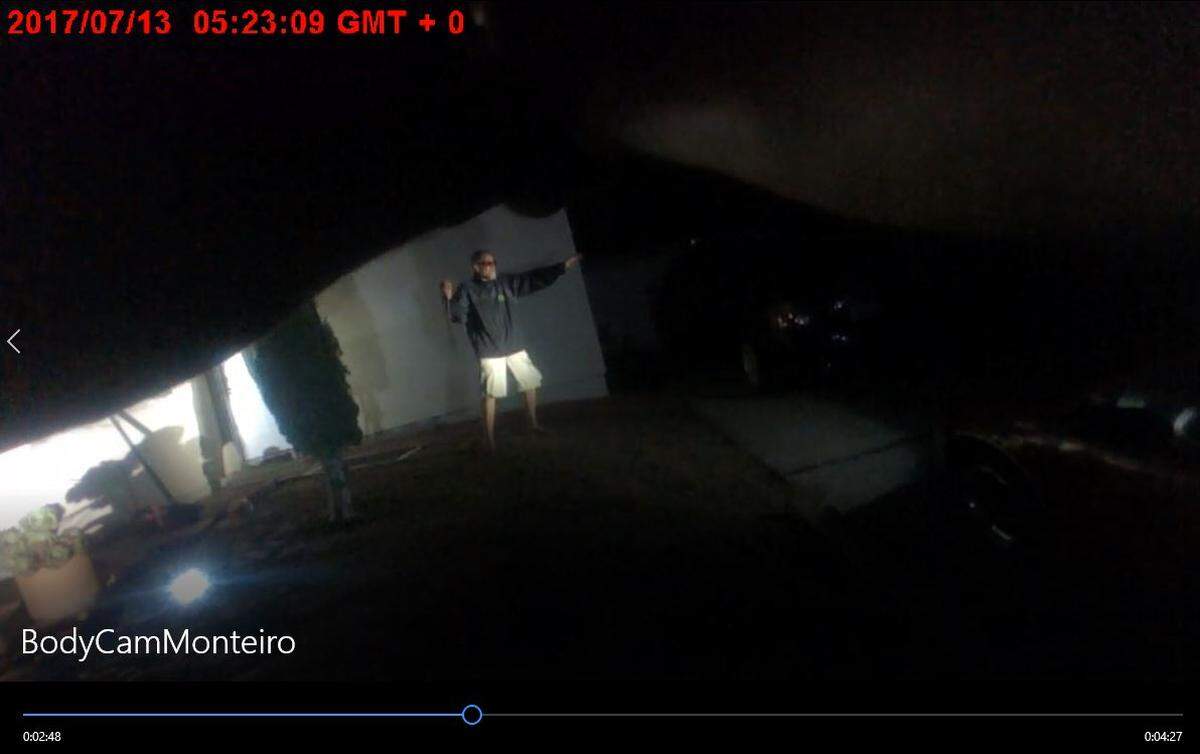
When two officers responded to the 1000 block of Brighton Avenue for a reported disturbance, Eustace was outside the home shouting nonsensically and swinging a metal pipe affixed with a rope.
In the officers’ body-cam footage of the incident, Eustace is seen in the front yard holding the pipe and yelling, “Come at me, Satan.”
The officers repeatedly try to calm him down and get him to drop the weapon.
“Drop the stick, Kenneth. We don’t want to hurt you, man,” Sgt. Juan Leon tells him.
“You can’t hurt me,” Eustace responds. “I’m gonna tell you one more time — you wanna die?”
Eustace then swings the rod at a car parked in the driveway, smashing the windshield, and begins to advance toward Leon with his arm raised before Leon fires two rounds and Eustace collapses to the ground.
“You’re good, you’re good. You shot me, thank you,” Eustace says as officers wait for paramedics to arrive.
The entire incident lasts about four minutes.
The District Attorney’s Office deemed the shooting justified.
Morro Bay Police Department
Though it produced no responsive records of misconduct, the Morro Bay Police Department released in January dash-cam footage and audio of an Oct. 30, 2015, officer-involved shooting of Alec Stephenson.
Stephenson, then 20, was a suspect in a commercial burglary when he struck an officer in the head with a stick as the officer got stuck in his seat belt while trying to exist his vehicle, the officer testified at Stephenson’s March 2016 preliminary hearing.
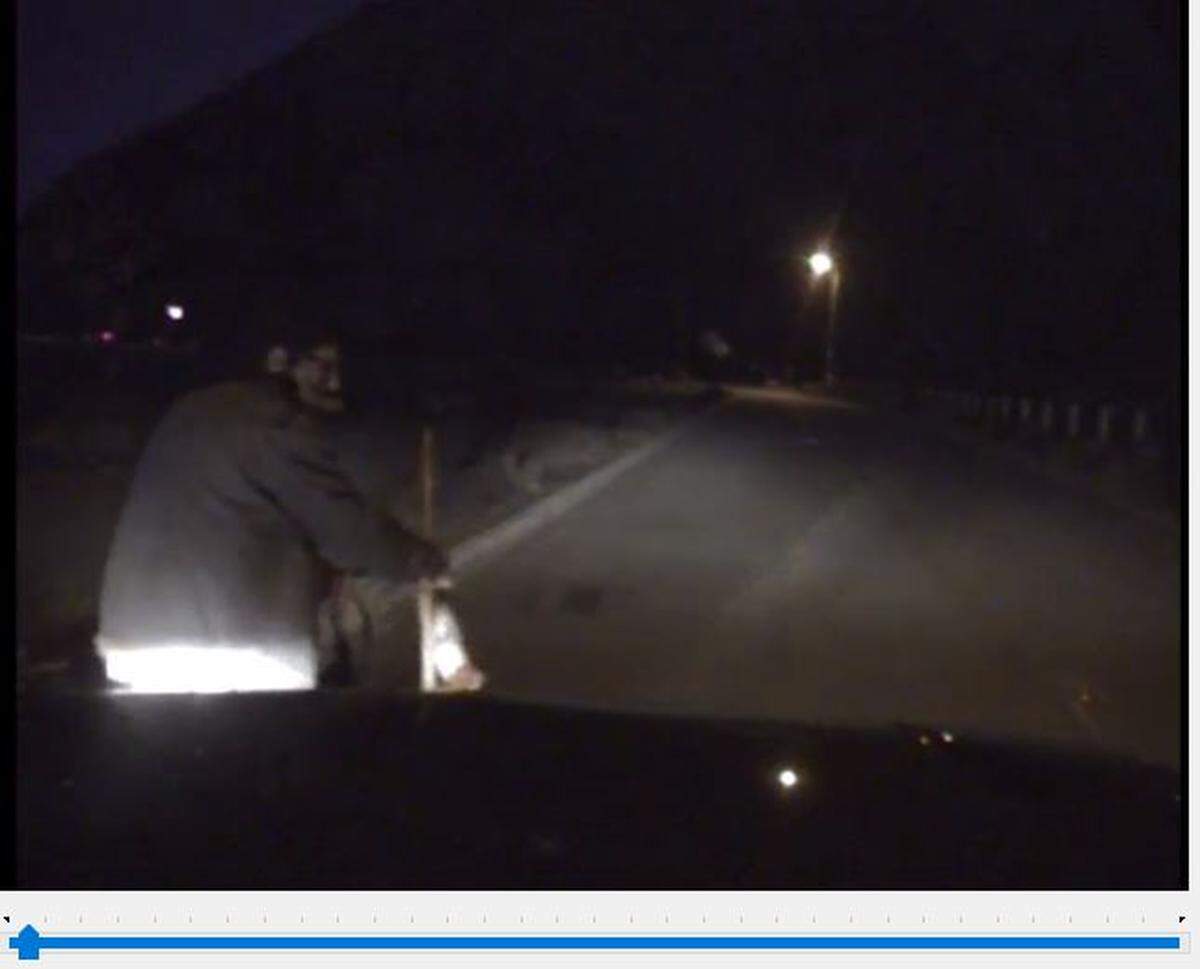
The dash-cam video released by the city does not directly show the shooting, but it does show the Officer Dale Cullum’s SUV pull up behind Stephenson, who was riding a bike, and flash his lights. Stephenson responds with a middle finger and keeps riding down Coleman Drive toward Morro Rock despite being “bumped” two times by Cullum’s SUV.
After a third bump sends Stephenson to the ground, he is seen getting up as Cullum stops and attempts to get out of the SUV.
“Get on the ground — right now,” Cullum shouts. “Right now!”
A struggle is heard off screen, followed by a single gunshot. Stephenson was shot in the leg in the incident and remained in the hospital for a day before being booked into jail. The shooting was later deemed justifiable.
Stephenson ultimately pleaded no contest to felony battery on an officer and spent about a year in jail for that offense, according to court records.
The city had no records of dishonesty or sexual misconduct.
Atascadero Police Department
The Atascadero Police Department had one releasable record, an internal affairs investigation report of the July 6, 2016, non-fatal officer-involved shooting of Gary Roger Reynolds.
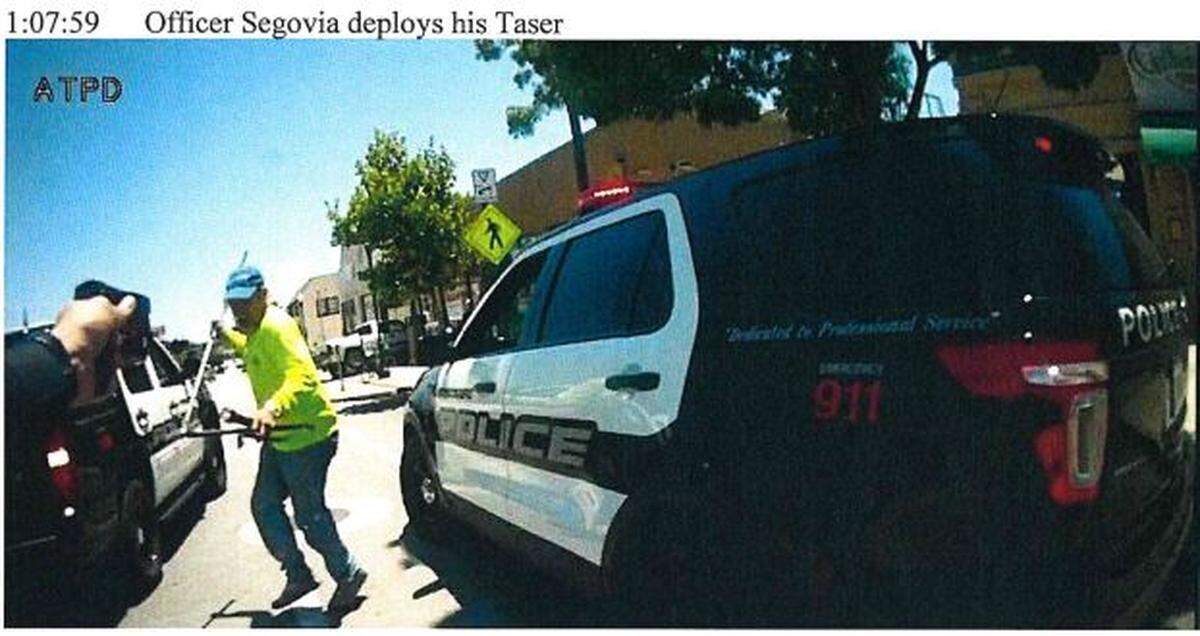
Reynolds crashed his truck into a vacant building on El Camino Real and was shot in the stomach after he allegedly advanced on officers with a crow bar in his hand and refused to comply with their orders.
The city did not provide video of the incident, but the partially redacted report contains still photos of officers’ body-camera footage. A report written by Chief Deputy District Attorney Jeret Gran stated that a person reported that a man, later identified as Reynolds, had driven his truck through a roll-up metal door on the front of the building, armed himself with several weapons and was “acting crazy.”
When officers arrived, Reynolds was armed with a painter’s pole, a metal flashlight and a crow bar, the report states, and didn’t respond to officers’ commands to drop the objects. One officer deployed a Taser device on Reynolds, to no effect.

“At that point the suspect literally began to chase the officers around their police vehicles while armed with three deadly weapons,” and struck one of the police vehicles, the report reads.
After swinging the pole at an officer, Sgt. Gregg Meyer fired a single round from his .40-caliber handgun, disabling Reynolds, who was taken to a nearby hospital and later County Jail. After pleading no contest to several felonies, Reynolds was sentenced to six years in state prison. The shooting was deemed justified by the District Attorney’s Office.
Other departments
The police departments in Arroyo Grande, Paso Robles and Pismo Beach said they did not have any applicable records for the five-year period.
In addition, the Santa Barbara County Sheriff’s Office said it had no releasable records, and the Ventura County Sheriff’s Office denied The Tribune’s request, citing a temporary restraining order filed against the county preventing it from releasing records related to incidents prior to January 2019.
“Until the restraining order is lifted, we will not be moving forward with your request,” the Sheriff’s Office’s response reads.
This story was originally published March 29, 2019 at 1:02 PM.