
Thousands in SLO County scramble for care after Anthem drops Dignity. ‘We’re kind of lost.’
Several thousand San Luis Obispo County residents received shocking news in the mail in mid-July: Their health insurance, Anthem Blue Cross, would no longer work at Dignity Health hospitals — one of the biggest health providers in the county.
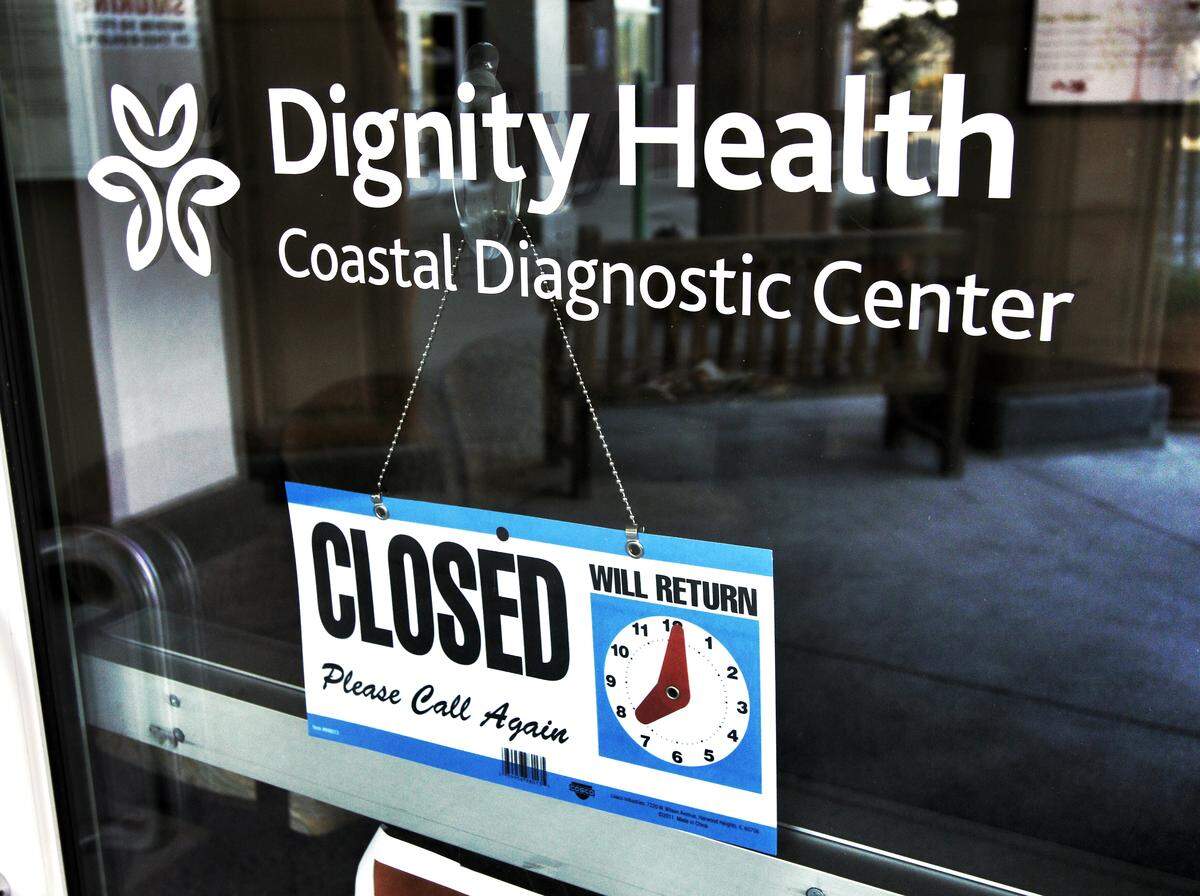
Anthem and Dignity were in the midst of contract negotiations that stalled primarily due to disagreements over Dignity’s proposed rates. On July 24, Anthem announced Dignity had severed coordination between the two agencies.
Since then, SLO County residents — already plagued by in many cases months-long waiting lists to see local doctors — have been scrambling to figure out how and where they will receive medical care.
For many, this means having to travel out of the area for specific specialists, or pay out-of-network fees to stay local. Others say they will try to find new local doctors, but are unsure if that will be possible given high demand for primary care physicians or specific immediate health needs they have.
“I’m due to give birth next month — that’s not a lot of time,” Kim O’Neill, of Atascadero, told The Tribune on Tuesday. “It’s next month. What am I gonna do, you know? I can’t really put this off.”
O’Neill is scheduled to give birth at French Hospital Medical Center, a Dignity hospital, in late August, but with the news, wasn’t sure if that would be covered under her Anthem plan. At the suggestion of her OB-GYN, O’Neill applied for a continuation of care request that will hopefully ensure the birth is covered, she said.
“That feels a little better, but it’s, you know, not quite sure,” she said. “It just really is unfair for our health to be used as a negotiation tactic to add pressure.”
Jessica Stewart of Arroyo Grande has been on medication for osteoporosis — something that requires her to get bone density scans done. Those scans should be done on the same machine, Stewart said, to prevent any disparities due to individual machines’ calibrations.
“So now I get to try and figure that out before I have my next one in October,” she said. “I think I may just have to pay the out-of-network cost because this scan is vital for comparison as I have been on Fosamax for a year, and we have no idea if it is working. So the comparison is vital.”
Stewart said she worries she will likely have to “bite the bullet and pay for the bone density scan” herself, not to mention potentially pay out of pocket for local mammograms, which she said she would prefer to also take place in the same location they have in the past because of abnormal findings she’s had.
“Not knowing how much I will have to pay out of pocket, I don’t know if that will continue to be an option for me,” she said.
Rate increase dispute cuts off health coverage for SLO County
Cutting off coordination between a health insurance provider and health system is actually not an unusual situation.
Most recently in September 2020, Dignity and Cigna reached a multi-year agreement to keep Dignity within the Cigna network after a nine-month standoff in which Dignity patients didn’t have Cigna coverage.
But when Dignity and Anthem — the biggest health insurance provider in California — were set to begin contract negotiations again this year, the parties say they entered in good faith intending to emerge with a mutually beneficial new contract.
That didn’t work out.
Anthem, which reported annual income in 2020 at $121.9 billion, says Dignity’s proposed rate increases were simply too high to accept as proposed.
“The problem is Dignity’s rates are some of the highest among all health systems in California, making it almost 30 percent more expensive than other health systems in the state,” an Anthem representative told The Tribune in a statement. “We don’t think our members and customers should pay substantially more for health care at Dignity when they can receive quality care from the many other providers in our network, and we are working to fix that.”
Dignity contends that its rates are not the highest, and that its requested increases were less than inflation.
“Our position is we are not, nor near, the most expensive,” Dr. Robert Quinn, CEO of the Dignity Health Medical Foundation, told The Tribune on Thursday. “So we feel that our good faith offer is reasonable and necessary to sustain the access and quality.”
Both cited the same RAND Corp. study of health system rates in the United States between 2016 and 2018 as evidence for whether the rates were high or not.
That study examined health system rates in comparison with Medicare rates, finding that many major systems were charging private health insurance companies upwards of two times what they might receive from Medicare for the same procedures, according to the New York Times.
In the study, Dignity was found to charge private insurance providers roughly three times the Medicare rates.
They were not the highest in the nation, however, nor even in California.
In the study, the median cost for inpatient or outpatient care at Dignity Hospitals was roughly comparable to two other California health systems, Adventist Health and Sutter Health, and was below HCA Healthcare and Quorum Health, both of which operate in California as well.
Tenet Healthcare, the other major health system operating in San Luis Obispo County, had a median cost slightly lower than Dignity’s, though not markedly.

In all, Dignity ranked approximately sixth or seventh for the highest median costs among the 40 national health systems examined in the RAND study.
According to the Anthem representative, the company does recognize that “costs do go up” and offered Dignity increases over its current rates, but that was denied.
“We cannot agree to what Dignity is asking because our members and customers will pay the price, seeing as the majority of them are in self-funded plans that pay for medical costs directly,” the representative wrote. “That’s why we continue to work with Dignity in addressing the high prices it charges so we can protect affordability, and ensure quality for consumers.”
Quinn said Dignity would also like to see an end to the dispute.
“Obviously we’d rather not be in this position,” he said. “But it’s tough. It’s important to remember, this is a difficult negotiation for us. We’re the biggest provider of Medicaid service in the state of California. We lost money last year, and we find ourselves negotiating with a company that just reported billions of dollars in profit for the first time. So we definitely feel like this is a very difficult negotiation for us. We want to put our patients first.”
Both Dignity and Anthem are still in talks attempting to find a resolution, but in the meantime, uncertainty remains for the people most impacted: patients.
Anthem, Dignity dispute impacts thousands of SLO County patients
It’s unclear exactly how many people may be in situations similar to O’Neill and Stewart’s locally.
Neither Dignity nor Anthem representatives could provide estimates for how many San Luis Obispo County residents could be impacted by the contract dispute, but several other sources show the estimate is in the thousands.
Approximately 1,200 Cal Poly employees receive health coverage through Anthem Blue Cross, a university spokesperson confirmed this week.
Anthem Blue Cross is also the provider for most local school districts: Atascadero Unified, Paso Robles Joint Unified, Coast Unified, San Luis Coastal Unified and Lucia Mar Unified school district employees are all covered primarily by Anthem plans.
Lucia Mar Unified Teachers Association President Cody King said the loss of Dignity coverage among Lucia Mar teachers will have far-reaching impacts.
“It is a significant problem for teachers to have to schedule care at the remaining in-network hospitals, which often are not located in their communities,” King wrote in an email to The Tribune.
In the South County, where Lucia Mar is located, the only hospital is a Dignity one: Arroyo Grande Community Hospital. Many South County residents also use Marian Regional Medical Center in Santa Maria, yet another Dignity hospital.
King said local teachers already struggle for affordable insurance options because the region is “not big enough to have viable options to choose from.”
“Insurance is always a major issue for our members,” he wrote. “Typically, rates increase at a rate that far outpaces any increases in compensation, which causes our members to take home less money each year and have to forgo care that is simply unaffordable. Unaffordable insurance is a problem that all community members face, and it is frustrating when our ability to access care is further reduced because two giant companies are fighting to increase their profits.”
Another large group who could be impacted by the dispute: Dignity employees themselves.
On Thursday, Quinn confirmed that Dignity insures “a significant number of our employees through various Anthem products.”
This means many local Dignity workers cannot for the near future receive care at the places they work. According to Quinn, there are roughly 150 Dignity providers throughout San Luis Obispo County.
“It’s a big deal,” he said.
Renée Saldaña, who represents the Service Employees International Union-United Healthcare Workers West (SEIU-UHW) which includes Dignity employees, said members are not expected to lose coverage while Dignity and Anthem are still negotiating a contract.
“We are counting on Dignity Health and Anthem to ensure both workers and patients have full access to treatment at Dignity Health facilities, and to come to a resolution that allows healthcare workers to continue providing compassionate, accessible care,” Saldaña told The Tribune in a statement.
Though it is not the most popular option in San Luis Obispo County, roughly 320 local residents are insured through Anthem Blue Cross plans via Covered California as of March 2021, according to the Covered California website.
‘What are we supposed to do?’ SLO County residents worry about future medical care
One of the biggest issues about the contract dispute and the way it has played out is the uncertainty for local residents who don’t know what to do next.
Sarah, a Cal Poly employee who declined to share her last name for fear of retribution at work, said she was upset that this news was sprung on this many people so quickly.
“We were all very much basically caught with, you know, our pants down — like it was such a shock,” she told The Tribune on Tuesday.
Sarah said several co-workers actually reached out to Cal Poly administration upon hearing of the news to ask what could be done about it, and they were told that administration was just learning of the changes as well.
“The CSU system has been the process of negotiating our contracts the past six months, and for them to say that they’re just now finding this out, kind of seems like that’s a stretch,” she said.
Sarah said now she and her wife are worried about where they will find medical care.
“A lot of GPs (general practitioners) locally have basically been bought out by Dignity,” she said. “So we’re kind of lost. It’s like what are we supposed to do?”
Sarah said for the near future, she thinks she and her wife will just have to continue seeing their regular doctors, but pay the out-of-network fees.
“It’s just not worth trying to find another doctor right now,” she said. “I mean, for one, it’s hard to find a doctor in a normal, you know, time period. Two, because we’re in a pandemic, it’s even harder. And three, trying to find doctors who are in-network and not part of Dignity in this, the Central Coast area, is near impossible.”
Instead, they’ll wait it out and hope for a resolution soon.
“I’m just hoping that we don’t have anything serious come up within that time period,” she added.
What to do if you have health insurance through Anthem
Anthem has identified a number of alternate hospitals that clients should use in the meantime, including Sierra Vista Regional Medical Center in San Luis Obispo, Twin Cities Community Hospital in Templeton, as well as Santa Barbara Cottage Hospital, Goleta Valley Cottage Hospital and Lompoc Valley Medical Center in Santa Barbara County.
According to Anthem, members will still be able to access Dignity facilities for emergency medical services, i.e. ER visits, because emergency medical services are always considered a covered benefit and do not require pre-authorization, regardless of where they are delivered.
Members who require ongoing care from the same provider can also apply for a continuation of care through their doctor to ensure they can continue to see them in-network.
“Kids with asthma, people with depression, hypertension, diabetes — they need to contact their physician, and there’s a mutually agreed upon process called ‘continuity of care,’ where the physician will document that this person has an evolving medical condition, and we will advocate, to make sure that they get their care,” Quinn said. “In no instances when a patient thinks they need care, should they not seek it out.”
Anthem customers with questions about their plans and where to find in-network coverage can call a toll-free member number listed on their Anthem member ID card, or can use the “Find a Doctor” function at www.anthem.com/ca/find-care/.
Mackenzie Shuman contributed to this report.
This story was originally published July 30, 2021 at 2:06 PM.
%20Cropped.jpg)