
Central Coast researchers just launched projects to track local COVID variants. This is why
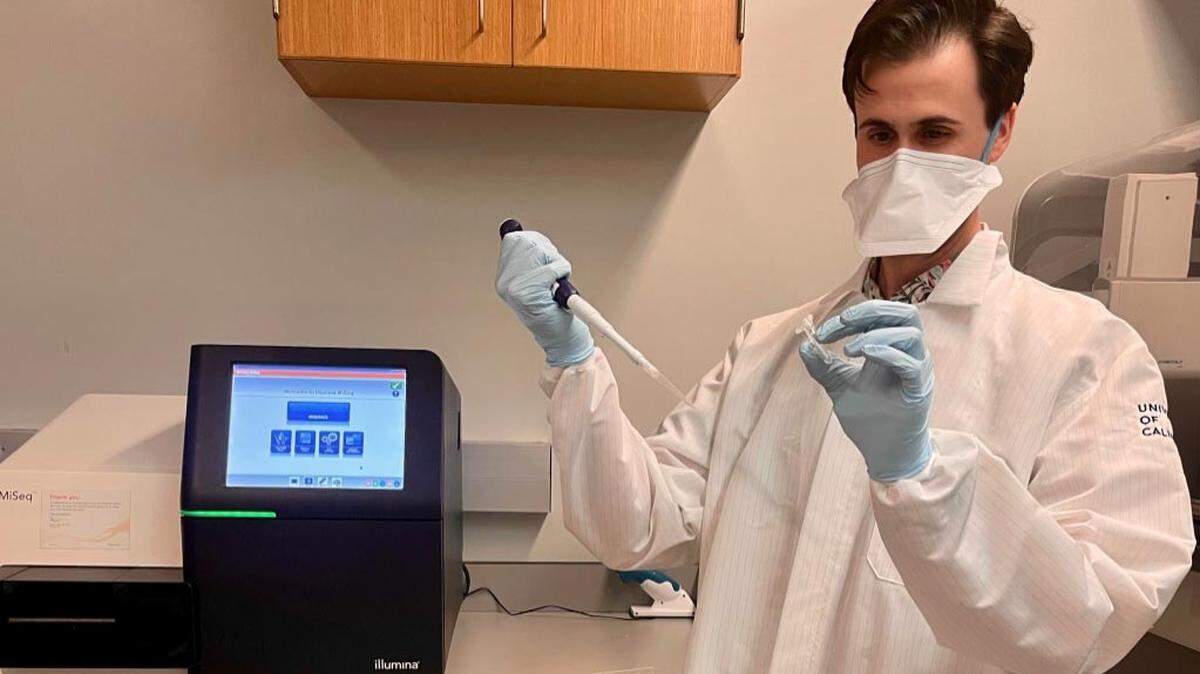
UC Santa Barbara researchers and Cottage Health both recently launched research projects to analyze local novel coronavirus samples — to track and better understand the threat of virus variants in the community.
“We need to know what is circulating here,” UCSB virologist Carolina Arias told Noozhawk.
“The moment you detect variants of concern or variants of interest, you know how to adjust your measures of prevention. If we are fighting the fight against an opponent that’s completely different than the first one that we faced, then we are not going to have the tools to defend ourselves.”
Cottage Health and UCSB launched their complementary projects two weeks ago and began testing virus samples to determine if there are virus strains of concern in the community, said Dr. Lynn Fitzgibbons, an infectious disease specialist at Cottage Health.
A team of UCSB researchers tests samples from the campus community and a Cottage Health variant task team analyzes samples from the greater Santa Barbara County area, but the two research efforts are very much intertwined.
“Both of these efforts are moving ahead quickly to help give us information about the variants circulating in our community, but also look both backwards and forwards,” Fitzgibbons said.
“Backwards at what variants were circulating perhaps two or three months ago, but also looking forward to what variants may be emerging and making sure that we have the ability to find them in a timely way that we need.”
After UCSB and Cottage Health acquire the samples, they are sent to Arias’ lab for genetic sequencing and variant detection.
“We extract the genome of the virus and use that as a template for generating little pieces that can be de-sequenced,” Arias explained. “The variants have little changes at certain positions, so we go through the entire genome and look at where the changes are so we can determine what variants are emerging here.”
The researchers look for patterns that fit with the United Kingdom, South African and Brazilian virus strains that are identified by the Centers for Disease Control and Prevention as “variants of concern,” as well as the West Coast variant that has emerged in California and is on the CDC’s “variant of interest” list.
Variants of concern are virus mutations that have increased transmission and pose a threat to the community, whereas health professionals are keeping an eye on the variants of interest to see if there is something to worry about, explained Stuart Feinstein, a UCSB biologist who coordinates the campus’ COVID-19 response team.
In the last two weeks, researchers have already generated 29 results from the local community, Fitzgibbons said. While no variants from outside of the country have been detected, 16 results are suspected to be of the West Coast strain, Arias said.
“Information occurs very fast, so as we learn more about the West Coast variant, it might become a variant of concern later,” Feinstein told Noozhawk. “It won’t be months until we know more, but it will be a few weeks.”
Virus mutation is a normal process, Feinstein continued, but the way to avoid the negative outcomes is to minimize the number of variants in the community by masking and social distancing.
It is critical to learn as much as possible about the variants in order to reach the end of the pandemic, Fitzgibbons said. Through small changes in the virus, there is potential that the new variants could be more infectious than the original strain of the virus.
“To some degree, as you’re fighting a fight and winning that fight, at some point your opponent becomes stronger,” Fitzgibbons said. “That’s a huge concern.”
The most practical concern is the idea that the virus could shift in such a way that even if a whole population is protected because they already were infected with the virus, the change could re-infect those that had previously been exposed, Fitzgibbons said.
“If the virus were to change to where it could re-infect people, that could mean that we’re at the beginning of the pandemic all over again,” she continued.
Health professionals are more concerned about the virus mutation found in Brazil, as it seems to have the ability to re-infect, Fitzgibbons said.
The Cottage Health variant task team provides counsel on virus variant samples to Santa Barbara County Public Health Officer Dr. Henning Ansorg, Fitzgibbons said. While the Public Health Department has been a strong ally for the work that’s being done, it is not directly involved with this research, she noted.
Research projects such as these are very sophisticated and require a lot of time, resources, and effort, but the researchers hope to continue the virus sampling as long as they can, Arias said.
Even with new virus strains, Fitzgibbons said that the vaccines on the market are very reassuring in regards to how they match the variants in California.
“The vaccine still responds, it still offers protection and prevention of severe disease, which is the interest that we have,” Arias said, adding that both the Moderna and Pfizer-BioNTech vaccines can be engineered very quickly to create a booster shot.
Fitzgibbons advised people to get the first vaccine they are eligible for, regardless of if it is the Pfizer, Moderna or Johnson & Johnson vaccine.
Even after vaccination, it’s critical to continue following public safety precautions.
“There’s a misperception among almost everybody that once you get your vaccine, you’re good to go,” Feinstein said. “It takes your immune system a month to six weeks to build up your immunity and you need to continue the methods needed to protect yourself.”
Once everybody is vaccinated and protected, it is much easier to respond to the virus variants, he added.
“What we’re interested in is what’s happening in our community,” Feinstein said. “We’ve got the right people in the right places, we can get that information quickly and know what’s happening from a basic scientific perspective.”
“We are able to give our clinicians information about what’s in the community and what they’re confronting so they can try to mitigate it and manage it for everybody here.”
Arias, Feinstein and other UCSB experts discussed the COVID-19 vaccines and virus variants during a Feb. 25 panel discussion.
This story was originally published March 10, 2021 at 10:31 AM.