
Got a question about COVID vaccines in SLO County? Here’s everything we know now
Three-hundred-and-forty-five days, 19,500 people infected, 680 hospitalized, 221 dead.
These are the statistics that show the coronavirus pandemic’s impact in San Luis Obispo County. Now there’s a new figure worth tracking: 55,919.
That’s the number of COVID-19 vaccines that have been doled out in San Luis Obispo County so far.
For months, coronavirus vaccination has been heralded as the light at the end of the tunnel after a long year filled with death, sickness and businesses closing.
Many have been anxious to receive shots in hopes that being vaccinated will magically return their lives to normal.
But because of uncertain supply, there is likely a long path forward before the county reaches so-called “herd immunity” and life returns to its pre-coronavirus state.
“I think that once we get a very large proportion of our community vaccinated, we will be able to return to normal without all of the protections that we are using now,” county Public Health Officer Dr. Penny Borenstein told The Tribune in January. “When we get to that place, we’ll be able to travel, able to gather with families — we’ll certainly have our students back in school.
“If things continue without problem, with vaccines, and if people continue to demand vaccines at a high rate, I think we will be there in the current calendar year,” she said.
But that all hinges on that one word: “if.”
“There remain some unknowns,” Borenstein added. “I just don’t know.”
Because of confusion surrounding the process and speed of local vaccinations, The Tribune has delved into the topic to answer your questions and trace the path forward for San Luis Obispo County herd immunity.
Here is what you need to know.
Where we stand now: SLO County COVID-19 vaccine numbers
Borenstein said about one in five people in San Luis Obispo County will be immune to coronavirus as the county nears the one-year mark since the first local case.
In the two months since vaccinations began locally, 55,919 doses have been administered in San Luis Obispo County, the California Department of Public Health said on Wednesday.
That includes doses administered by the county Public health department, as well as those administered at local long-term care facilities and through pharmacies.
The dashboard does not differentiate between first and second doses, however, so it’s difficult to estimate how much of the population has been partially or fully inoculated.
Public Health does track the number of vaccines it administers to the public.
According to the county, roughly 26,734 people have received at least their first dose of the vaccine, approximately 9.4% of the population.
An even smaller subset of people — about 3.4% of the total San Luis Obispo County population — have received both doses of the vaccine and are fully immunized.
Most who have been vaccinated are healthcare workers, long-term care employees or residents and people 65 years and older — yet some exceptions have been made so as to not waste any vaccines.
So what does that mean for local immunity?
Take those who have already had the virus within the past eight months and likely have some natural immunity — about 18,669 people as of Tuesday. Combine that with those who have received at least a first dose of the virus (26,734), and it seems at least 16% of the population is likely at least somewhat immune to the virus at this time.
This again does not include those vaccinated in long-term care facilities or through pharmacies, as well as people who received the vaccine outside the county, meaning the true number is higher.
For those who are fully immune, that number is closer to 10%.
Borenstein said between 70% and 80% of the county’s population needs to be immune before the county reaches herd immunity — the point when most of a population is immune to an infectious disease and there’s thus a certain level of protection against its spread.
This means San Luis Obispo County and its various health affiliates still have a ways to go before the county can truly ease off coronavirus protections.
“It’s a long road,” Borenstein said.
SLO County vaccine rollout dictated by low supply
A massive reason for the uncertainty surrounding the local availability of vaccines has been low supply.
The California Department of Public Health (CDPH) has drip-fed vaccines into the hands of the local Public Health Department, leading to a slower-than-expected vaccine rollout.
As of Feb. 24, the CDPH has delivered 10,302,040 doses of vaccine across the state — of those, 39,805 have been allocated to San Luis Obispo County Public Health directly.
More vaccines within the county have been sent to Dignity Health and some chain pharmacies, including CVS and Vons.
Unfortunately, the county never knows how many doses it will receive each week, making it difficult to predict the number of appointments it might be able to administer and even a timeline of local herd immunity, Borenstein said.
The county asked the state for information on how vaccine allocations are determined each week but has never received an answer.
In a news briefing on Jan. 20, county Administrative Officer Wade Horton said the county was “prepared for a time when vaccine is no longer the limiting factor.”
“At this point, our main constraint remains the number of vaccines available to us,” he said. “We continue to request more vaccine from the state.”
Horton added that “there has been nothing predictable about our vaccine supply.”
“We have ranged from a high of 5,000 doses to a low of 600 doses,” he said. “Bluntly, we don’t know.”
According to Borenstein, the county’s three vaccination sites — located in Arroyo Grande, Paso Robles and San Luis Obispo — could theoretically administer 3,000 doses per day, five days a week. That’s a total of 15,000 people a week.
The county has received at most nearly 6,000 coronavirus vaccine doses of both first- and second-dose allocations in a single week.
During the week of Feb. 8, the local vaccine supply was so limited that the county closed two of the three vaccination sites. The following week, the three sites only opened for three days instead of five.
When reached for comment in early February, Darrel Ng, senior communications advisor for the state’s COVID-19 Vaccine Task Force, said the state’s dose allotments are based off of the eligible populations in each county, for example, the number of health care workers or the number of residents ages 65 and up.
He did not provide a specific formula or information on why dose shipments vary so widely per week.
“It’s crickets at the federal level,” Borenstein said in a January interview. “Not knowing the millions of doses that will be coming out in the coming weeks, I have a hard time answering that. I have no insights into what the actual supply chain is.”
Borenstein said Feb. 17 that the county’s goal, given current supply, is to administer 1,000 first- and second-dose vaccines five days a week at each of its three sites. On Feb. 24, Borenstein said the county will reach that goal at one of its three vaccination sites the week of March 1.
The supply has made it challenging to predict when people outside of the current vaccination phase can be inoculated.
“The vaccine allocation and the slowness with which it’s coming, I can’t tell you, ‘If you’re a 64-year-old with underlying conditions it will be Feb. 17,’ ” Borenstein said in January. “That’s what people want and we cannot provide that, so the best we can do is say, ‘This is who is eligible today. This is who is up next.’ ”
As of Thursday, the county is vaccinating healthcare workers, long-term care facility residents and employees and people age 65 and older.
When will certain groups get vaccine? Residents wonder
San Luis Obispo County resident John Hausman is one of many who just wants to know when he will be eligible for vaccination.
“I fall into this gray area that I bet a lot of people do. I’m not in one of the specific groups that has been called out. ... I don’t have a job that requires in-person interaction,” Hausman wrote in an email to The Tribune. “On the other hand, being diabetic and 60, I am at more risk than the most healthy.”
Hausman said that, given his health conditions and age, he is not sure where he should fall on the list of people prioritized for vaccines. But he’s worried that when the time comes, limited supply will push him even further down the line.
“I can’t figure out from what has been said and published so far if I will be prioritized at all or if at some point in the spring they are just going to say ‘And now, everyone else,’ and I will be part of a mad scramble of, say, half the country all trying to get it at once,” Hausman wrote.
Hausmen is not alone in that worry.
The state has gone back and forth on whether vaccines should be distributed through an age-based or risk-based approach.
Most recently, the CDPH announced that, as of March 1, 10% of every county’s vaccine allocations must be set aside for educators and childcare workers.
Additionally, as of March 15, people in Phase 1A, Phase 1B and people from age 16 to 64 with certain underlying medical conditions will be eligible to receive coronavirus vaccines in the state of California, according to the state.
Phase 1A includes healthcare workers and long-term care residents, while Phase 1B includes people 65 and older, agriculture and food workers, education and childcare workers, and emergency services workers.
While Borenstein said the county will honor the state’s mandate regarding educators, people with underlying health conditions in the 16-to-64 age bracket in San Luis Obispo County shouldn’t get their hopes up.
“That is an aspirational goal in this county,” Borenstein said Feb. 17. “We are progressing as quickly as we can through the current eligibility tiers.”
Also, as recently as last week, Borenstein said there is not enough supply in San Luis Obispo County to vaccinate many of the other state-eligible groups. The county only recently opened vaccines up to residents between ages 65 to 74.
San Luis Obispo County recently announced it would conform to state regulations and set aside 10% of its vaccines for teachers starting next week.
“At this time we cannot guarantee that we will have the vaccine to accommodate that group as well as some of the other groups that per state guidance are eligible but not yet in this county, because the numbers simply don’t add up,” Borenstein said.
Borenstein said Feb. 24 that the SLO County Vaccine Task Force has plans to set aside specific times to vaccinate farmworkers, as well as create vaccine opportunities for higher education employees and law enforcement officers in the next two to three weeks.
Most other emergency service workers have already been vaccinated, Borenstein said.
Still, not all people eligible for vaccines under Phase 1B will be given the chance to get vaccinated right away, according to Borenstein. There are no clear plans for when all workers in the food and agriculture sector may be vaccinated.
According to Borenstein, about 70,000 people total fall into the categories of education and childcare workers, food and agriculture workers and emergency service workers.
The county did announce on Friday it would start opening up vaccines to teacher, education workers and childcare workers who are most at risk. Those people will have their appointments scheduled through their employers, the county says.
SLO County residents who’ve gotten vaccines feel fortunate, yet guilty
The limited supply of coronavirus vaccines has left some county residents who have received them feeling both grateful and guilty.
Paso Robles couple Courtney and Mike McNerney work in the medical field and were quick to receive their vaccinations.
“It feels great, there’s a sense of relief,” Courtney McNerney said. “You feel good and you feel guilty and sad for all the people who haven’t gotten a vaccine yet.”
Her husband shared a similar sentiment, saying he wishes some of his more vulnerable family members could have been vaccinated first.
“I felt fortunate, you know. I felt a little guilty,” Mike McNerney said. “I would’ve liked to see my mom get vaccinated before me, but I felt good. It felt safer.”
The McNerneys are among more than 3,000 people that have received both a first and second dose of vaccine from the county Public Health Department.
Courtney McNerney, a registered nurse at Sierra Vista Regional Medical Center in San Luis Obispo, formerly worked in vaccine research for Kaiser Permanente. So she had “a level of confidence” going into the vaccination that others might not have, she said.
“I don’t know why anyone would want to play a sort of Russian roulette with this virus,” she said.
Both she and her husband said they experienced soreness after the first vaccine that lasted less than 24 hours.
Mike McNerney said his first shot left him with “a pretty good sore arm, sorer than I’ve ever felt for a tetanus booster or a flu shot.” “But that was gone within 24 hours. Then I was fine,” he added.
After her second dose, Courtney McNerney said she felt “icky and blah,” experiencing chills and a fever. She said she took some Tylenol and felt fine the following day.
Mike McNerney advised people to take a day off of work if possible after receiving their second dose. He said he felt tired but relatively fine within a day.
The couple said getting the coronavirus vaccine hasn’t changed many other aspects of their life. They still wear face masks, wash their hands regularly and haven’t expanded their social circles.
“I know I’ve had two vaccines and I have a 95% chance of being protected against significant disease, if any, but I’m still a little bit nervous that it could still happen,” Mike McNerney said. “I just hope people, despite getting vaccinated, will still wash their hands, don’t go out in public when you’re sick, and if you do, wear a mask.”
The only change his wife noted so far is her plan to visit her parents, who live out-of-state, for the first time in a year once they too are vaccinated.
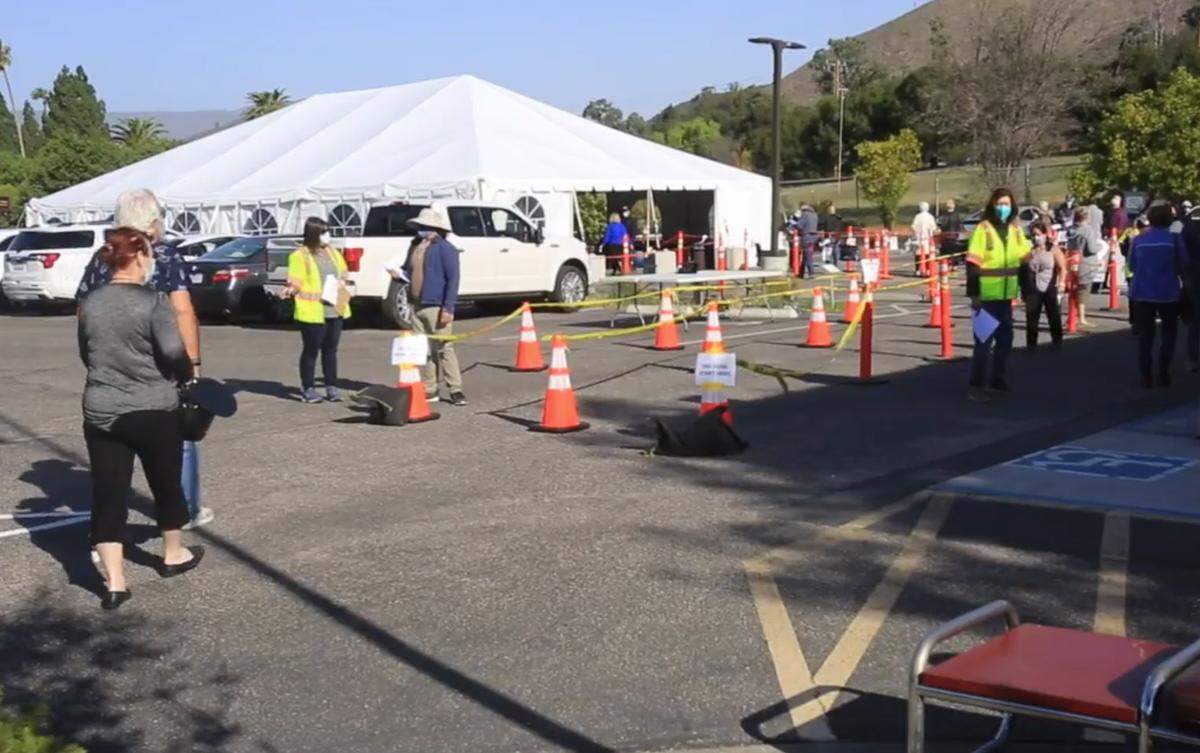
COVID vaccine appointments and clinics ‘like a game of Tetris’
As for how the process of administering coronavirus vaccines is going, county spokeswoman Michelle Shoresman said it can be “like a game of Tetris.”
In San Luis Obispo County, vaccines are administered by appointment only, but sometimes people don’t show up — putting a running clock on unclaimed coronavirus doses.
The Pfizer COVID-19 vaccine must be kept in a deep freezer until it’s almost ready for use. Once thawed, the doses need to be administered within a six-hour period, Borenstein said. Moderna’s coronavirus vaccine also has to be kept cold, but not quite to the same level, she added.
According to Shoresman, about 10% of people each day don’t show for their scheduled vaccine appointments.
But the county doesn’t waste coronavirus doses.
The Public Health Department has a waiting list for some people to receive the leftover doses at the end of the day.
“If you have to open a vial of five doses and there are only four people who show up even though you had five appointments, someone is going to take that fifth syringe and try to find any arm of a willing and healthy person to put it into,” Borenstein said.
The waiting list, however, is not one people can sign up for themselves.
The county first gave leftover doses to people working at vaccination clinics, then those in county offices and, more recently, teachers who work with students who have disabilities.
Even within those groups, Borenstein said, the county tries to prioritize by giving doses first to the oldest or most vulnerable members.
“We get calls all the time, ‘Why did the librarian get a vaccine? Why did the auditor get a vaccine?’ That’s just the price of being as efficient as we can be, but not perfect,” Borenstein said.
At this time, the county said it does not have the resources to create a waiting list for all who want to eventually receive vaccines.
Borenstein said the county also wants to avoid large numbers of people waiting in line for a chance at shots.
Meanwhile, a majority of San Luis Obispo County’s population is still without COVID-19 immunity.
In January, Borenstein said that it could be spring — or maybe summer — before the county starts to see bigger leaps toward herd immunity.
As of Feb. 19, she said that, given everything, she just doesn’t know when vaccines might become more widely available.
“My crystal ball is not just broken; it’s shattered,” Borenstein said.
How to get a coronavirus vaccine appointment in SLO County
As of Wednesday, the county was in Phase 1B of its vaccine distribution plan.
The groups that are currently eligible for coronavirus vaccines are:
- Healthcare and community health workers
- Long-term care residents and staff
- Adults ages 65 and older
Teachers and the most-at-risk education and child care workers (starting March 1)
Up next are those at risk of exposure in the following sectors:
- Emergency service workers
- Food and agriculture
On Wednesday, the county announced it was launching a new method of getting an appointment: a lottery-based system in which eligible residents’ names are drawn at random.
To enter, eligible residents must submit their names at recoverslo.org/en/vaccine-registration.aspx. Because the county’s vaccine supply varies weekly, appointments are limited.
Residents will then be notified if their names are drawn and can get help setting up appointments. If a person’s name is not drawn the week that they register, they don’t need to reapply to be in the running the following week.
For more information on San Luis Obispo County vaccines, visit recoverslo.org.
This story was originally published February 25, 2021 at 5:00 AM.
%20Cropped.jpg)