4 things you need to know about new COVID-19 guidelines — and what they mean for SLO County
San Luis Obispo County is in the most severe category of coronavirus spread, which also means the most restrictive tier for businesses based on California reopening guidelines released Friday.
The new guidelines group counties into four color categories based on the counties’ testing positivity rate and the number of daily new cases per 100,000 people, known as case rate. The previous guidelines had six criteria and no clear path forward.
Among the four colors, purple means that a county has widespread COVID-19 cases; that tier is followed by red, orange and yellow. As counties move down through the tiers, more business sectors may reopen, according to state guidelines.
Purple tier counties have higher than an 8% testing positivity rate and/or more than seven new cases per day per 100,000 residents.
Other than hair salons and barber shops being permitted to reopen, all restrictions enforced when San Luis Obispo County was put on the state’s coronavirus watchlist remain the same.
If the county moves to the red tier — which would require fewer new daily cases per day and a maintained positivity rate of less than 8% — restaurants and other businesses could open indoors at limited capacity and schools could offer in-person classes once more.
“I’ve heard it from many people that (reopening is) a moving goalpost,” county Public Health Officer Dr. Penny Borenstein said Wednesday. “I don’t see that because prior to this change, we had no idea what might come next.”
Borenstein said this new system “provides a lot more clarity” on what were to happen if the county’s coronavirus spread were to decrease.
Which coronavirus color tier is SLO County in and why?
San Luis Obispo County is in the purple category with a calculation of 7.3 new COVID-19 cases per day per 100,000 residents and a positivity rate of 4.2%.
Although the county’s coronavirus positivity rate is far below the metric that is considered widespread, the number of new cases per day still exceeds seven.
Borenstein said the raw data shows San Luis Obispo County’s number of new coronavirus cases is actually higher than the state’s website reflects.
However, the state factors in a case rate adjustment based the number of people the county tests per day, Borenstein said.
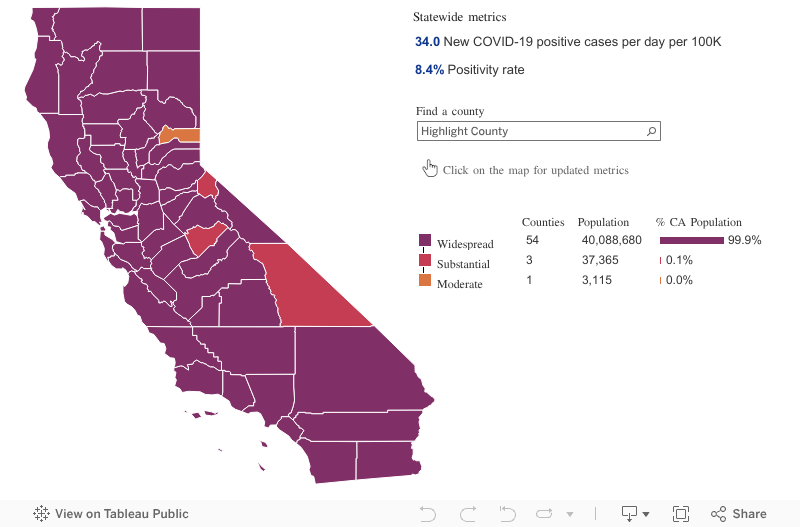
“If people are looking at that map and see ‘Oh, we’re very close to that threshold for moving into the next tier,’ (it’s because) our case rate is offset by the amount of testing we’re doing,” Borenstein said. “Based on the number of tests per population done every day, you can get a credit against your case rate.”
According to Borenstein, the county has been conducting more than 300 tests per day per 100,000 residents between the county health lab, state-sponsored test sites, private physicians and testing for the California Men’s Colony state prison in San Luis Obispo.
For counties that test more than 300 people per 100,000 residents per day, there is a case rate adjustment of 0.78, according to state guidelines.
The state’s data also excludes coronavirus cases among state prison inmates when calculating spread.
How does SLO County move to the red tier?
San Luis Obispo County needs fewer than 20 new cases per day for two consecutive weeks to move from the purple category to the red category, according to Borenstein.
The county would also need to maintain a positivity rate below 8%.
About 75% of all California residents live in purple-tier counties, and only two counties — Modoc and Alpine — are in the yellow tier.
“It is a heavy lift for a population like ours to get to that place of much greater opening,” Borenstein said Wednesday. “But I do have confidence that we can get there.”
When can SLO County move to next COVID-19 tier?
The soonest San Luis Obispo County could move to the red tier would be Sept. 22, Borenstein said Wednesday.
“If everything went perfectly well and we suddenly dropped out all our cases, we would only be able to achieve the next tier down or tier two on Sept. 22,” Borenstein said.
Once a county is placed in a color category, it will remain there for at least three weeks, according to state guidelines.
In order for it to progress to the next color, it must have a lowered positivity rate and daily new case count for at least two consecutive weeks.
In other words, San Luis Obispo County was placed in the purple category Aug. 31. The soonest it could move to the red tier would be Sept. 22.
To get there, the county must have fewer than 20 new cases per day and below an 8% positivity rate every day from Sept. 7 to Sept 21.
Borenstein said the same process would occur moving from red to orange and orange to yellow.
According to state guidelines, schools can reopen once a county is in the red tier for two weeks. The soonest possible date schools could reopen for in-person classes would be Oct. 6, Borenstein said.
“Moving between these tiers really depends on all of us as a community,” Borenstein said before once again reminding people to social distance, wear face masks and wash their hands.
Why are certain businesses allowed to reopen faster?
In the purple tier, much of the restrictions already in place remained the same — with the exception of indoor hair salons and barber shops.
The red tier would allow for restaurants and places of worship to open indoors at 25% capacity and gyms to open indoors at 10% capacity. Other business sectors, including zoos and museums, would also begin to reopen.
However, not all businesses want to wait.
Kennedy Club Fitness called for a full reopening of its indoor operations in an email sent to The Tribune in mid-August.
The business has been offering exercise options in its outdoor locations, per state guidelines.
The health and fitness company employs 350 people and has four San Luis Obispo County locations, in Arroyo Grande, Atascadero, Paso Robles and San Luis Obispo. Kennedy Club Fitness said it has suffered sharp business impacts that could affect more jobs in the near future, as well as the services it provides its customers.
“We need your support and understanding, especially in the next 30-60 days, as we move forward out of the current situation we are in,” Brett Weaver, Kennedy Club managing partner, wrote in a letter sent to The Tribune on Aug. 13. “If we don’t get back to operating business under the state’s original guidelines very soon, many of us could be forced into extinction.”
Weaver wrote in an email that a return to the state’s guidelines allowing for full services, including indoor use, will be “critical” to the business over the next few months.
Borenstein said she understands that many business are frustrated. However, she added, the reopening process is based on “how business can be delivered.”
“This is no longer based on whatever a business is essential or not essential,” Borenstein said. “Everyone’s businesses is essential. Everyone’s right and necessity of making a living is absolutely important.”
Borenstein said safety measures, the number of people who congregate in certain businesses and the demographics, including age, of certain business’ customers are all factors in what is allowed to reopen.
“It is what it is and I, along with you, very much want to see our community drive our numbers down, move through these stages as quickly as we can and allow all of our suffering businesses to reopen,” Borenstein said.