What color are we? Here’s what California’s new COVID system means for SLO County
After months of uncertainty, San Luis Obispo County residents and businesses now have a better guide about how COVID-19 restrictions will be applied locally — and what it will take to ease into wider reopening.
On Aug. 28, California Gov. Gavin Newsom announced a new color-coded system that ranks how and when counties may reopen based on two simple metrics: the number of daily COVID-19 cases per 100,000 residents and the testing positivity rate.
At the moment, the numbers land SLO County in the most severe, purple category, but not by much, according to state data. But county health officials said they believe the county is worse off than is reflected in state data.
“COVID-19 will be with us for a long time and we need to adapt,” Newsom said at Friday’s news conference.
The new framework, which takes effect Monday, reflects lessons state and local have learned over the last five months of adapting to the pandemic, he said.
“It’s simple, also slow,” Newsom said, describing the new plans.
The color categories — purple, red, orange and yellow — will determine how much of a county’s economy can be open.
For example, in purple-tier counties like San Luis Obispo, where COVID is deemed most widespread, restaurants can only operate outside. In the red tier one step down, restaurants can operate at 25% capacity indoors.
In a significant change from previous guidelines, hair salons and barbershops can now open for indoor service with modifications throughout the state, even in purple counties. Meanwhile, nail salons can only operate outdoors in purple counties.
Tiers will be updated every Tuesday under the new guidelines. Counties must stay in each tier for at least three weeks before they can move to a less restrictive tier. They will only be eligible to move to a less restrictive level if their numbers show improvement for at least two weeks. If they fall short of the metrics for their tier for two weeks, they will be moved to a more restrictive tier.
Newsom said that’s a significant change from the previous guidelines, which allowed for faster reopening.
What is SLO County’s color?
Although SLO County is in the purple tier. now, its county’s metrics position it well to move quickly to the less restrictive red tier.
The county’s positivity rate is 4.2% — meaning 4.2% of people who have been tested for COVID-19 were coronavirus-positive — which is considered moderate.
However, San Luis Obispo County had an average of 7.3 daily new coronavirus cases per 100,000 residents from Aug. 12-18. That’s just above the red-tier limit.
To drop down, San Luis Obispo County needs 7 or fewer new COVID-19 cases per 100,000 residents.
Although the county nearly meets state criteria to move to the red category, the San Luis Obispo County Health Department isn’t so sure.
“We are not clear, but continue to seek clarity from them about how that rate is being calculated currently,” SLO County Public Health Departmetn spokesperson Michelle Shoresman wrote in an email to The Tribune. “We believe our case rate to be higher than what is shown on the map indicating each county’s status.”
According to Shoresman, county health officials are in close communication with the state and are planning to speak with the California Department of Public Health about the potential discrepancy next week.
Local data shows that San Luis Obispo County had the highest single-day case increase in August and Shoresman said the county’s August numbers are no better than July’s case counts, which were high enough to land the county on California’s watchlist.
“The case numbers have not been lower in August,” Shoresman wrote. “Our highest per-day-case-number occurred in August and it has been somewhat sporadic after that.”
“We believe our county’s rate to be higher than what is reported on the state’s website and are trying to confirm their calculation with them,” she added.
Shoresman said for the time being, the new state guidelines do not affect most local businesses — except for barber shops and hair salons.
The County Public Health Department asked that San Luis Obispo County residents continue to use safety precautions to protect themselves and others from COVID-19.
“We support the modifications to allow greater refinement of which business sectors can open based on risk,” Shoresman wrote. “We continue to ask of community members to do all they can to bring down our case rate so that we can begin to open or sectors.”
Most counties, including San Luis Obispo, Monterey and Santa Barbara, are in the purple tier.
As of Aug. 28, eight counties were listed in the red tier, eight were in the orange tier, and three were in the yellow tier.
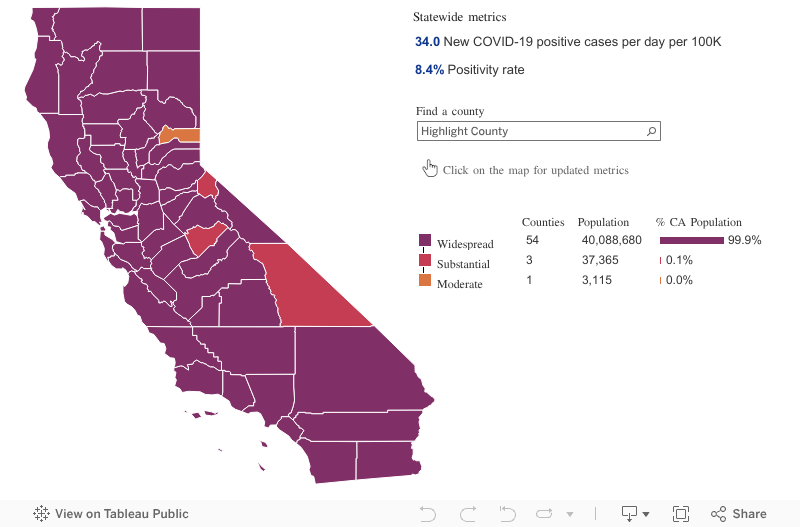
What do the colors really mean for SLO County?
Generally, the counties that have been on the state’s monitoring list are in the purple tier, Newsom said.
In those counties, the virus is considered “widespread,” with more than 8 percent of tests coming back positive and more than 7 new cases daily per 100,000 residents.
Under the new guidelines, all activities that have been permitted for counties on the watch list, such as outdoor dining, indoor retail at 25% capacity and outdoor worship services, can continue.
Purple tier counties may also do the following under new guidelines:
- Indoor hair salons and barber shops may reopen with modifications.
Museums, aquariums and zoos may open for outdoor activities.
Only schools that have been approved to reopen through a waiver process may reopen for in-person instruction.
Counties in the red tier are considered to have “substantial” disease spread. This has a positivity rate between 5 to 8% and an average of between 4 and 7 daily new cases per 100,000 residents.
Red-tier counties have the following looser restrictions:
Schools can reopen for in-person instruction once their county has been in red- tier for at least two weeks.
- Restaurants may open indoors at 25% capacity or 100 people max.
- Retail and shopping centers may open indoors at 50% capacity.
- Places of worship may open indoors at 25% capacity or 100 people with modifications.
- Personal care services may open indoors with modifications.
- Gyms may open indoors at 10% capacity with modifications.
- Museums, aquariums and zoos may open indoors at 25% capacity.
Disease spread is considered “moderate” in orange counties. Counties in this tier have a positivity rate between 2 to 4.9% and an average between 1 and 3.9 daily new cases per 100,000 residents.
Here is what can open for orange-tier counties:
- Restaurants may open indoors at 50% capacity or 200 people max.
- Retail is no longer limited in capacity indoors, but modifications must remain in place.
- Places of worship may open indoor at 50% capacity or 200 people with modifications.
- Museums, aquariums and zoos may open for indoors at 50% capacity.
- Gyms can may open indoors at 25% capacity with modifications, and indoor pools may reopen.
- Wineries may open indoors at 25% capacity or 100 people max.
- Bars may open outdoors with modifications.
In yellow counties, spread is considered “minimal,” under the new guidelines. Yellow counties have an average of less than one new case per 100,000 residents and less than a 2% positivity rate.
Yellow-tier counties have the least restrictions:
- Gyms may open indoors at 50% capacity with modifications, and saunas, spas, and steam rooms may reopen.
- Wineries may open indoors at 50% capacity or 200 people max.
How SLO County businesses feel about the new guidelines
Barber shops and hair salons have teetered back and forth, opening and closing with nearly each new set of guidelines for businesses during the coronavirus pandemic.
In the latest guidelines, Newsom said barber shops and hair salons will be allowed to reopen indoors once again.
Ray Shearer the owner of Anderson Barber Shop in San Luis Obispo said he is just happy to be able to open again, even though uncertainty lingers.
“Hooray! We can pay our rent,” Shearer said with a laugh when asked how he felt about being able to reopen indoors. “I’ve just kind of rolled with it. I know (health officials) are doing the best they can and we’re doing the best we can.”
Shearer said Anderson Barber Shop has been closed since July when indoor hair salon and barbershop activity was prohibited. Not being able to control the elements -- lighting, wind and smoke -- prevented him from setting up shop outdoors like some other local barbers.
When Anderson Barber Shop reopened in mid-June, he said they had a rush of people. And although he said he is hopeful, he isn’t sure what to expect next.
“When we opened back up, the phone was ringing off the hook for four weeks. On the fifth week it slowed and in the sixth week it slowed even more,” Sherar said. “Most of the customers were coming through only once.”
Shearer said since barber shops have had to re-close, many people have opted to try cutting their own hair, and without frequent returning customers, Anderson Barber Shop will lose a lot of their business.
“We don’t know when we’ll see them back,” Shearer said. “There’s a lot of uncertainty right now.”
“We’re just hopeful, hopeful that we can work together as a community,” Shearer added.
SLO County restaurants react
Restaurants are another industry affected by the new guidelines, although the change will not be immediately seen in San Luis Obispo County.
Restaurants may only open indoors once the county has entered the red tier.
Giovanni DeGarimore, owner of Giovanni’s Fish Market & Galley in Morro Bay, said his business serves outdoor only and won’t be affected by the lifting of restrictions.
But he fears for neighboring businesses in Morro Bay that have limited or no outdoor seating.
“Frankly, I fear we’re going to see a lot of casualties if indoor dining doesn’t reopen soon,” DeGarimore said. “I think everyone’s trying to make as much as they can now because they know the winter months are coming, when it’s less desirable to eat outdoors.”
DeGarimore said that even indoor seating at 50% capacity makes it difficult for businesses to survive.
“Most restaurants have a 5% to 10% profit margin, so if you have seating at 25%, I honestly don’t see how it’s worth it,” DeGarimore said. “You still have full rent and utilities, and you can cut back on some staffing, but it’s not going to be to that level.”
DeGarimore said he understands that people need to stay safe, but purely from a business perspective, the restrictions are difficult to work with.
He expects there will be mixed compliance among businesses to maintain capacity levels because restaurants are fight for survival.
“I don’t understand where they get the 25% or 50% capacity numbers,” DeGarimore said. “I think the six feet of distance is most important and as long as that’s maintained, that should be the requirement.”
The owner of a North County restaurant group, Eric Peterson, said that his restaurants are making the most of the situation and “we’re surviving, and making it all work by adjusting to each new announcement, but it’s challenging.”
Peterson owns Street Side Ale House in Atascadero, and he’s the sole or partial owner of Guest House Grill and Country Touch Cafe in Atascadero; Jack’s Bar and Grill in Templeton, and Comfort American Kitchen and Touch of Paso in Paso Robles.
“I think the outdoor dining situation is working very well,” Peterson said. “Especially in Paso Robles, near the park, I’ve been there on a Friday night when every single table is filled.”
Peterson also said that his businesses have stepped up their takeout efforts, which helps to make up some of the lost business of indoor dining.
He expects the increased attention on takeout will continue when the pandemic has passed.
“It’s a lot of adjustment to the changing restrictions, but each step of the way, we’re trying to make it work,” Peterson said. “We’re doing okay. We’re surviving. But we can’t survive like this forever…and I really feel for restaurants that don’t have outdoor space to use. They don’t have an equal playing field right now if they’re just offering takeout.”
Peterson said his businesses also have had to spend on outdoor table seating and he’s preparing for the winter months by purchasing heat lamps for customers to remain comfortable.
Under red-tier restrictions, San Luis Obispo County’s gyms would also be allowed to reopen indoor functions at 10% capacity.
Business perspective from SLO County gyms
Alex Church, general manager of the gym Headstrong Fit in San Luis Obispo, said that the business is actually excelling because it has plenty of outdoor space at its business location on Archer Street near the House of Bread Bakery at the intersection of March and Higuera streets.
The gym is able to use ample parking lot space.
“We were able to move our pull-up rigs and other equipment outside pretty easily,” Church said. “…It has been a little easier for us because we don’t have as many machines as some of the other facilities in town. We actually have more members than we did before the pandemic because of what we’re able to offer.”
Church said that the winter months may present more challenges, not because of temperatures but possibly because of rain.
“I think we’ll be fine because the temperature here is pretty moderate, but if it’s a wet winter or something we’ll have to see how it goes,” Church said. “But overall, this is actually been good for our business.”
Church said the gym would like to see full capacity, including indoors, but is able to adjust for the time being.
Kennedy Club Fitness Managing Partners Brett Weaver said he expects to face cost challenges moving forward if gyms have to continue to operate mostly outside.
Kennedy operates gyms in San Luis Obispo, Paso Robles, Atascadero and Arroyo Grande.
“As time goes on and we are forced to conduct business outside the costs will rise, the maintenance of equipment and tent rentals, which has tripled in cost over the past couple of years,” Weaver said. “I am glad hair salons and barber shops are allowed to conduct business inside. We need to go back to the states original guidelines for re-opening now. We spent months, and financial resources preparing our business to re-open, which is challenging, but we will make the best of it.”
Ryan Joiner, of Athlon Fitness & Performance in SLO, also wants higher capacity.
“How can I open at 10% capacity?” Joiner said. “Businesses operate at really thin margins as it is. Operating at 80% capacity is a recipe for bankruptcy, much less 10%.”
Joiner said the new regulations are “a giant disappointment and really dashes my hope for a positive outcome from this COVID situation.”
“It appears they’re going to sit tight and wait for a vaccine, even if everything blows up before hand,” Joiner said.
This story changed to add the comments from Kennedy Club Fitness and Athlon.
This story was originally published August 28, 2020 at 2:16 PM.
%20Cropped.jpg)