How can SLO make housing more affordable? Here’s where City Council candidates stand
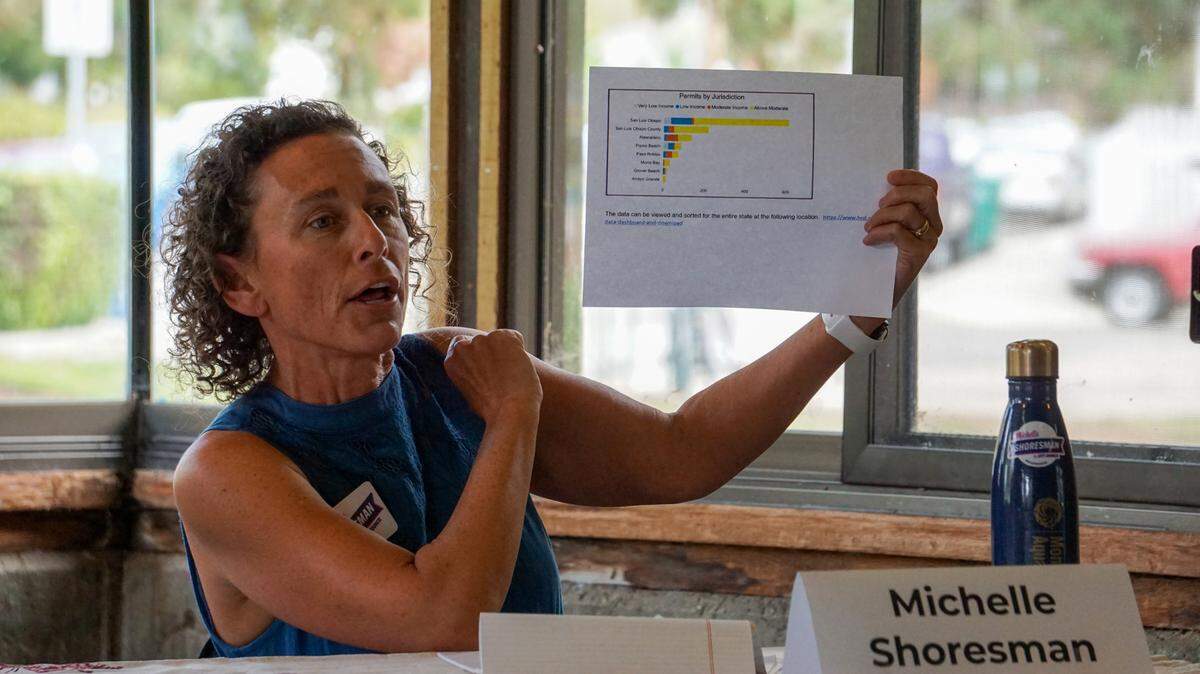
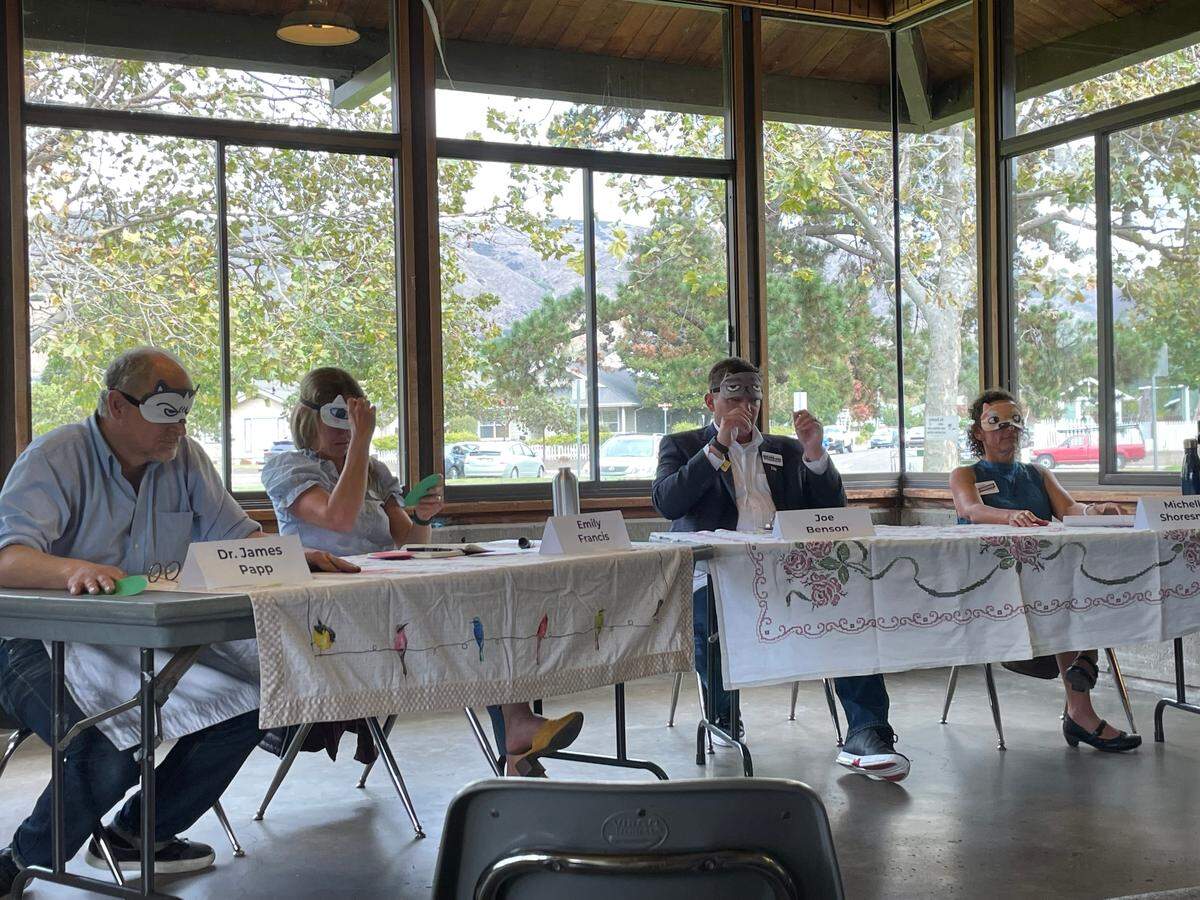
Candidates running for seats on the San Luis Obispo City Council in November debated the best ways to fix the city’s housing problems during a public forum on Sunday.
Sunday’s forum was held at Meadow Park in San Luis Obispo and organized by SLO Yes In My Back Yard (YIMBY), a pro-housing development group.
Four candidates spoke about their stances on rent control, parking mandates and the city’s updated Inclusionary Housing Ordinance, among other issues.
Incumbent City Council member Michelle Shoresman is running along with Emily Francis, a teacher and city planning commissioner; attorney Joe Benson and architectural historian James Papp.
There are currently two seats on the council up for grabs this election cycle: Shoresman’s seat and another seat that will be open due to term limits.
Shoresman and her challengers answered a total of 11 questions from YIMBY organizer Krista Jeffries on Sunday. Here’s how the candidates responded when asked about some of the key issues facing the city.

Does rent control make sense in SLO?
Rent control, also known as rent stabilization, involves capping the amount of rent that can be charged for a dwelling in the interest of keeping it affordable to tenants.
Cities such as Los Angeles, San Francisco and San Jose have all enacted some form of rent control amid skyrocketing home and rent prices
Jeffries asked the candidates about implementing a similar ordinance in SLO.
Shoresman said she would need to see more community support before implementing a rent control ordinance in the city.
“We are not New York City, (and) we are not L.A.,” Shoresman said. “We have a different rental market and different rental populations, especially within the city of San Luis Obispo.
“There are lots and lots of people who can’t afford to buy homes and whose only option is to rent, but we also have a really large renting population in the Cal Poly student body. ... That creates some dynamics around regulating rent prices and the rate at which they can be increased.”
Benson said he does not support a rent control ordinance. Instead, he would prefer more investment in self-help clinics for renters to prevent evictions.
“Rent control is treating the symptom. It’s not treating the problem,” Benson said. “Rent control has a couple of unintended consequences that I I hope folks would consider.”
One of those unintended consequences, he said, could be less investment in existing properties by landlords who wouldn’t be able to pay for repairs and upgrades because they’d be getting less rent money.
Francis said her concerns about rent control in SLO are centered on the policy’s untested background in cities of SLO’s size, as many current implementations have been in large metropolitan areas.
She shared Benson’s sentiment that the policy could have unintended consequences.
“Rent control has been shown at least in these larger areas to lead to gentrification, to lead to homes being taken out of the rental market, and that’s not what we’re looking for here,” Francis said. “We don’t want to create a long-term problem by creating a short-term fix. But we can’t ignore what’s happening in the short term, right?”

Does inclusionary housing work?
The SLO City Council recently voted 4-1 to update the city’s inclusive housing ordinance.
The revamped ordinance increases in-lieu fines for developments without affordable housing and removes Table 2A, a guideline that encouraged construction of market-rate homes by requiring developers to build a set number of inclusionary housing units. Instead, developers must now build a set percentage of affordable housing units.
Papp said he doesn’t think inclusionary housing works as a solution to San Luis Obispo’s housing shortage.
“It essentially says ‘Okay, you can have this little bit’ (to low-income buyers), and then that little bit isn’t enough, and that will be subsidized by everybody else,” Papp said. “You’re essentially saying the developers will have controlled this problem, and we will tax some of the people going into the development in order to make it more affordable for other people going into the development.”
Francis said she supported updating the inclusive housing ordinance.
She said the previous version of the ordinance incentivized the construction of smaller homes, but meant that around 70% fewer homes were built for low-income buyers compared to pre-IHO construction.
“Over time, the unintended side effect can be that less homes get built overall, but the really challenging thing is that if we just look at the long term effect,” Francis said. “In the short term, we’re ignoring all of the people in our community who need access to housing.”
Benson called the updated IHO a “missed opportunity” to build more comprehensive affordable housing solutions, and said it won’t help create so-called “missing middle” housing, which is below market-rate and targeted at moderate-income buyers.
“The IHO, as approved, continues to exacerbate the issue in our city of the haves and the have nots,” Benson said, shifting too many costs onto developers while failing to address the missing middle.
Shoresman, who voted in favor of the inclusionary housing ordinance update, defended her position.
She said the previous version of the IHO was succeeding in getting homes built, but they were all above market rate, which did little to fix the affordability problem.
“That inclusionary housing ordinance isn’t the place for incentivizing that missing middle housing,” Shoresman said.
Instead, she said, it’s a way that the city can incentivize developers to build very low, low and moderate income housing.
“It’s just one tool in your toolbox,” Shoresman said.
How eliminating minimum parking requirements can help
The candidates also discussed Assembly Bill 2097, which passed the California State Legislature in late August.
The bill, which as yet to be signed into law, eliminates “any minimum automobile parking requirement on any residential, commercial, or other development project,” provided the new building is within half a mile of high-quality public transit, which it defines as featuring transportation vehicles that arrive once every 15 minutes or less.
Some public transit systems in San Luis Obispo County have rides that arrive less frequently, which may disqualify most of the county from the parking exemptions.
Jeffries asked the candidates if they would consider scaling the bill down to the city level to lower the cost of building.
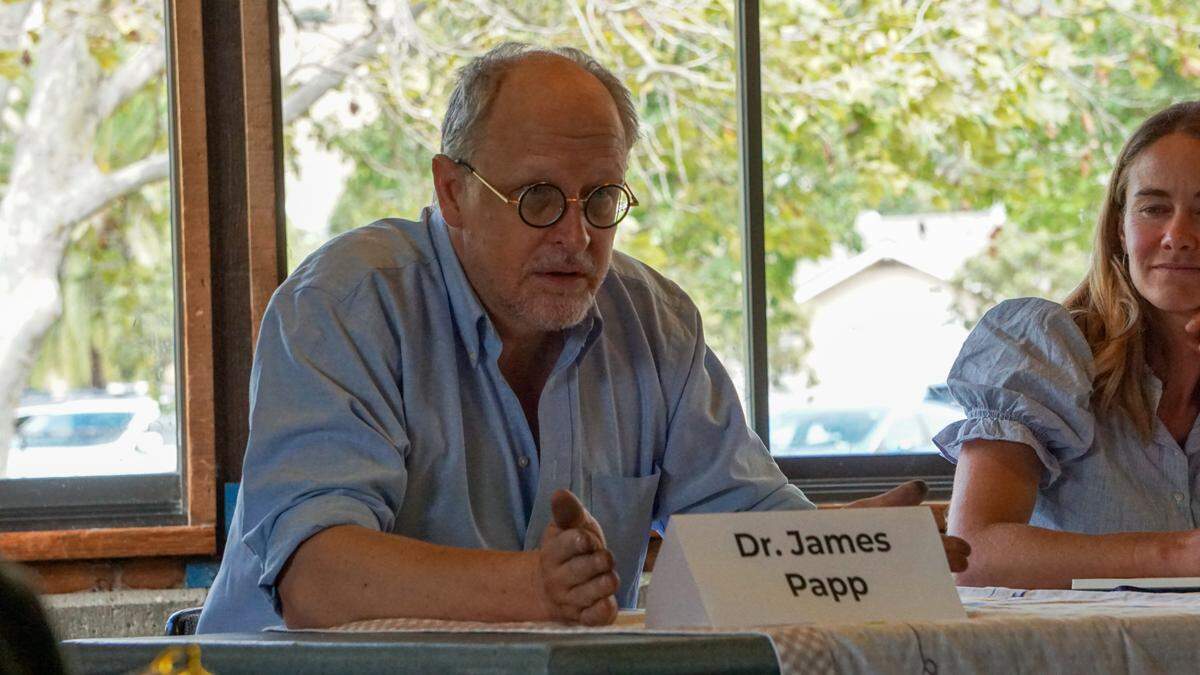
Papp, an architectural historian, said he opposes parking mandates due to their detrimental aesthetic and economic effects on new and old buildings alike.
“It disincentivizes actually creating a unit,” Papp said. “Something that I experienced in five years on the (city’s) Cultural Heritage Committee, is that if you’re a big enough developer, you can get away with not providing stuff, and if you’re the day-to-day single owner who wants to add an (accessory dwelling unit), you don’t have the political clout to get away with stuff.”
Benson similarly opposes parking mandates in SLO.
“Land is a premium here, and I think it’s important that we acknowledge that,” Benson said, encouraging residents to “go ride a bike or walk” rather than drive “We built all these beautiful bike lanes in our city, which is wonderful. If we’re gonna build all that, why not go the next step and remove the opportunity to drive and park your car? Maybe there’s a better way to do it.”
Francis said she supports a “graduated approach” to rolling back parking mandates in the city, because the public transport system is not currently able to make up for the needs of people who would otherwise be driving.
Francis said she’d prefer to focus on improving the transportation systems in specific parts of the city before expanding those improvements and rolling back parking mandates.
Shoresman agreed that a slower approach to removing parking mandate makes the most sense, as the transit system is still behind on hiring bus drivers.
She also said that, because Cal Poly students make up a large chunk of the bus system’s ridership, the university should “pay their fair share” in any improvements to public transit.
How can SLO make housing more affordable?
To end the forum, Jeffries asked the candidates to provide one idea to make housing more affordable in SLO.
Papp said the city needs to stop tearing homes down, as rehabilitating and expanding existing buildings is cheaper than knocking them down and putting in a new development.
Francis said the city should focus more on affordable housing by signing a letter to the state expressing support and desire for affordable housing developments.
Meanwhile, Benson said he’d like to see the city pursue a “pro-housing designation” from the California Department of Housing and Community Development, which would allow the city to apply for specialized infill infrastructure grants and other affordable housing funding.
Finally, Shoresman said finding a sustainable, long-term funding source for affordable housing — likely through a tax supported by the community — would have the most traction.
This story was originally published September 20, 2022 at 10:28 AM with the headline "How can SLO make housing more affordable? Here’s where City Council candidates stand."