Here’s how SLO County agriculture did in 2020 — one crop had its worst season in 5 years
San Luis Obispo County crops lost only a small amount of value during 2020 — although some did better than others during the coronavirus pandemic.
The value of the county’s agricultural products was $978,675,000 in 2020, a decline of 1% from 2019, according to the county’s annual crop statistics report. Martin Settevendemie, county agricultural commissioner and sealer of weights and measures, presented the report to the Board of Supervisors on Tuesday.
The 2020 season was the second year in a row the overall value of the county’s agricultural products fell just short of $1 billion. The county first topped that mark in 2018, when its crops were valued at $1,035,499,000.
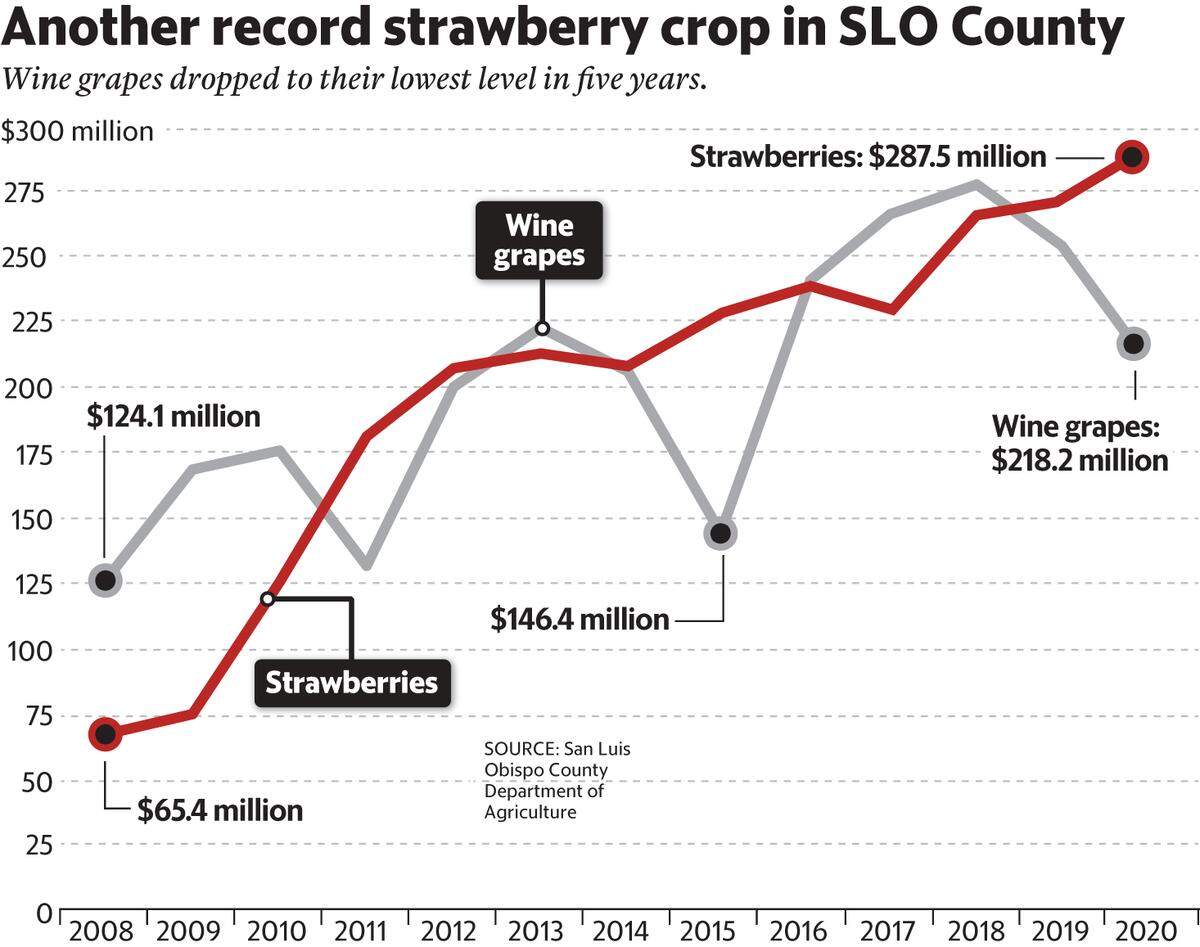
Strawberries were the county’s top crop in 2020, beating out wine grapes for the second year in a row. The fruit’s value went up by nearly 6%, from $271 million in 2019 to $287 million in 2020 — a record-setting total.
Wine grapes were worth $218 million in 2020 — a five-year low. The crop — which was the county’s top agricultural product from 2016 to 2018 — “experienced considerable challenges in 2020,” the report said.
“With both prices and yields down considerably due to a combination of challenges — including reduced demand, oversupply in the market and concerns about possible smoke taint from late season wildfires — the overall value for wine grapes decreased 14% from the previous year and marked their lowest value in the past five years,” the report said.
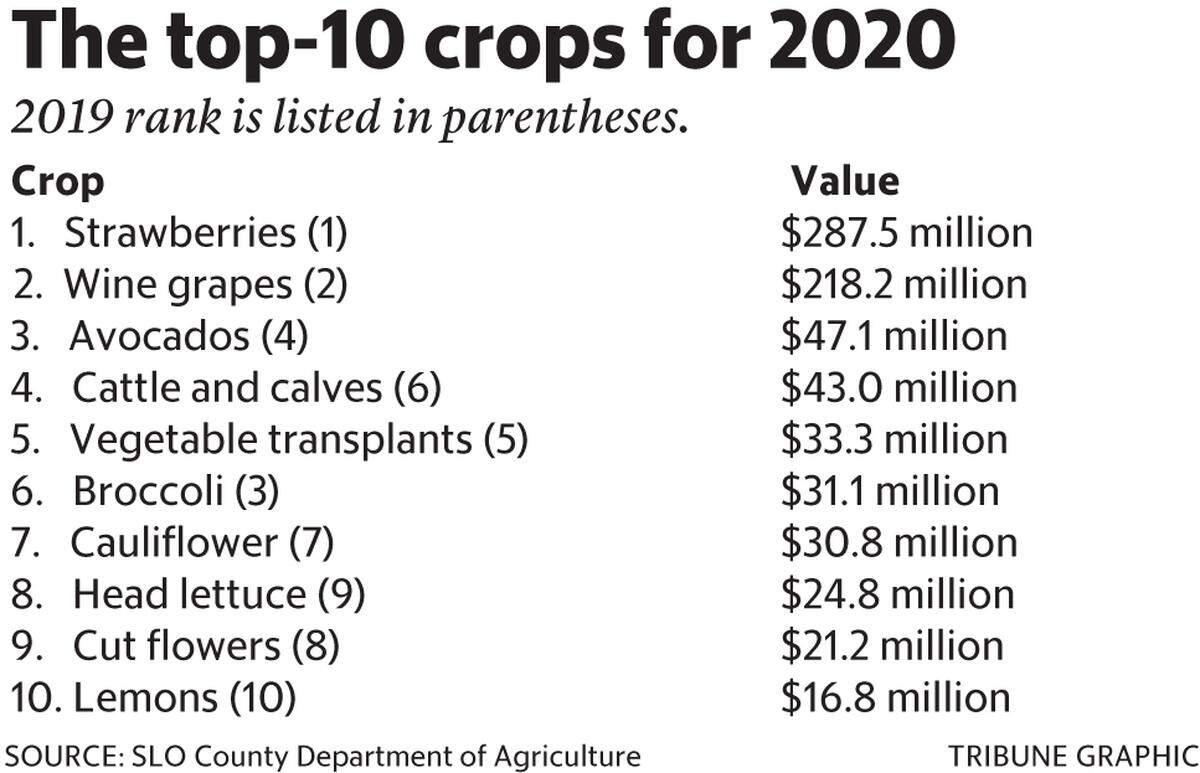
Avocados, cattle and calves and vegetable transplants rounded out the county’s top five crops for 2020.
SLO County ranchers, growers weather pandemic impacts
The county’s animal industry — which is primarily dedicated to cattle and calves — had a notably strong year and saw a 13% jump in value due to “significant increases in cattle sales.”
Cattle producers sold 28% more head of cattle in 2020 compared to the previous year, a trend Settevendemie believes will increase as ongoing drought conditions worsen.
“As we saw in past droughts, we most likely will see another spike in sales in 2021 as ranchers reduce herd sizes to match the carrying capacity of their land and their ability to provide water and supplemental feed,” he told the Board of Supervisors.
Overall, the county’s agriculture industry felt the impact of the coronavirus pandemic, which caused restaurant closures, changed buying patterns and disrupted production.
This was especially true for vegetable crops, which ultimately saw a 7% value increase but struggled with a “chaotic year.”
“Despite challenging markets during the early stages of the pandemic, demand for vegetables rebounded later in the season after the initial shock of restaurants closing around the country subsided,” the report said. “Favorable weather conditions also helped vegetable growers withstand the challenges brought on by the unprecedented nature of a global pandemic.”
Field crops experienced a 16% decline in value “stemming from a variety of both market and weather-related factors,” the report said.
In particular, growers planted 29% less alfalfa in 2020, marking a significant shift away from the crop.
Nursery products — including commercial vegetable transplants and cut flowers — also saw their value decrease by about 6% amid declining demand.
“However, certain segments within the nursery industry fared surprisingly well, as those growers who produce bedding plants, indoor and outdoor ornamentals and direct-to-consumer vegetable transplants flourished due to increased consumer demand from home gardeners,” the report said.