In March 2020, California’s coronavirus restrictions threw the San Luis Obispo County wedding industry into a yearlong hiatus.
Some wedding vendors survived on savings and Paycheck Protection Program loans, while others had to find new jobs.
Then, on June 15, California dropped most of its coronavirus restrictions, and weddings swung back into action.
Many 2020 weddings were pushed into 2021, with new couples scheduling for this year and 2022 — flooding vendors with requests for services.
“We have two wedding seasons rolled into one this year,” San Luis Obispo wedding planner Amanda Holder told the Tribune. “It’s kind of like drinking from the fire hose.”
Now, Holder said vendors are struggling to keep up with the volume of weddings.
“We’re all just trying to stay afloat,” Holder said. “We’re happy to have the business, but it’s very busy and chaotic so we’re all just trying to manage the best we can.”
From bakers to hairdressers, here’s how different businesses are navigating the nuptial surge in SLO County.
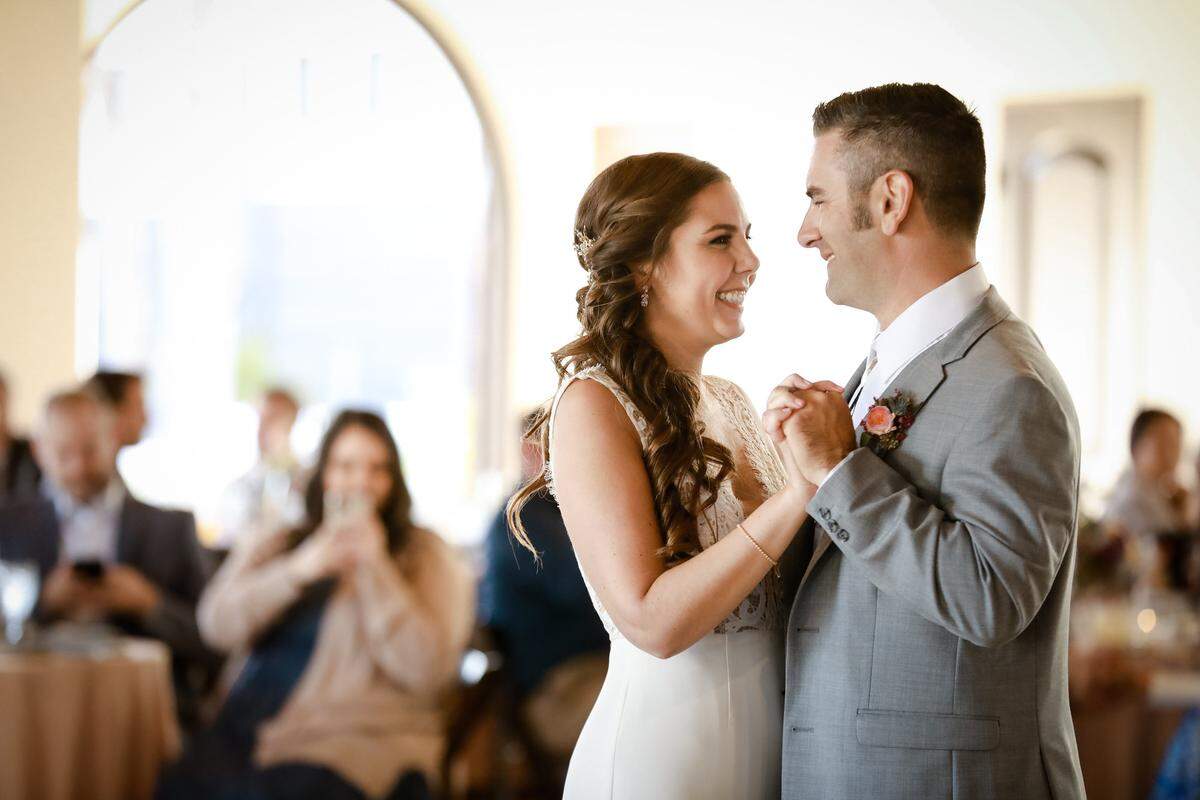
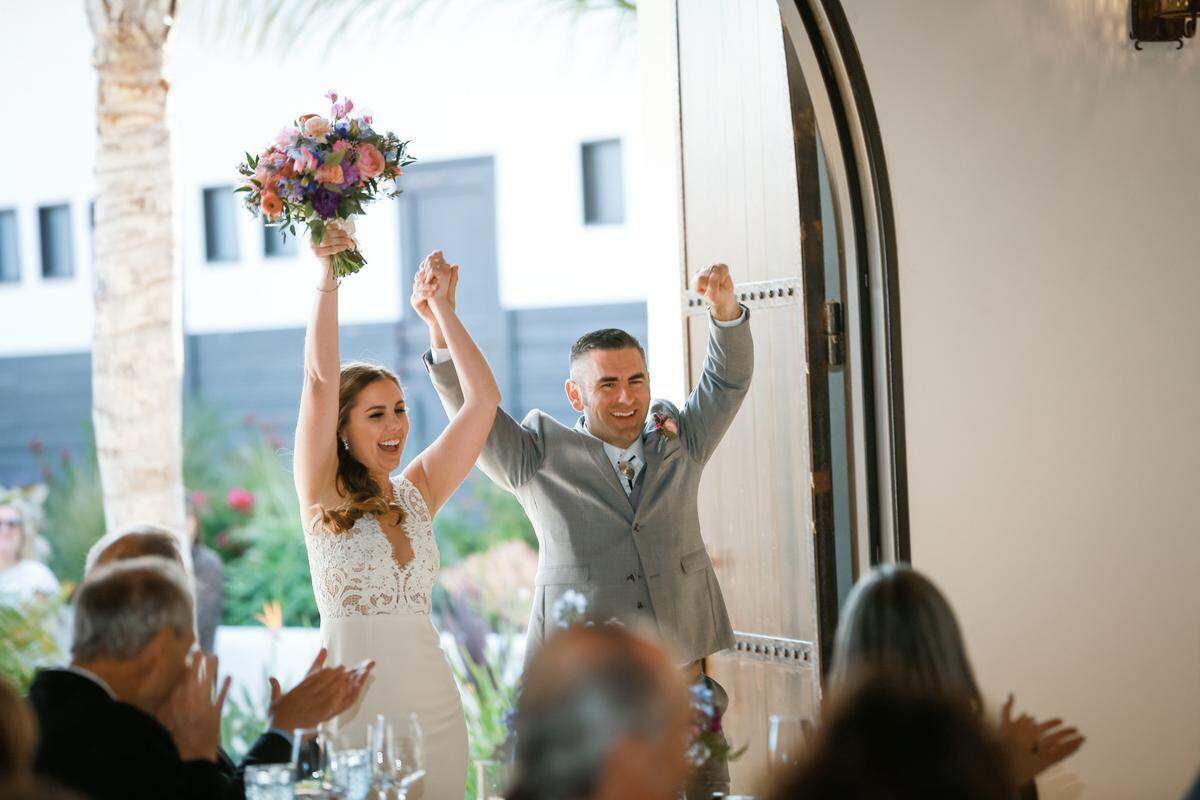
Erin and Nick Bollier were married April 10, 2021, at La Lomita Ranch in San Luis Obispo. Cassia Karin Photography
What’s it like for wedding planners?
Holder runs a 16-person event-planning business, Amanda Holder Events, that primarily focuses on weddings. She’s also a member of the San Luis Obispo Wedding Planners, a group of six industry professionals who collaborate to support the local wedding industry and each other.
In 2020, she had 43 weddings booked for the season. When the pandemic hit, three of those weddings were canceled, 17 occurred during the pandemic and 23 were postponed to 2021, she said.
Holder’s business lost revenue, but with fewer weddings occurring, expenses were down, too. She secured a Payment Protection Program loan to cover payroll from March to November, which kept her business running.
“A lot of our other colleagues were not so lucky, and our industry has really come together to support each other, which has been really nice,” Holder said.
This year, Holder’s business booked 70 weddings, and already scheduled about 25 for 2022. They’re planning two to three weddings a weekend, when during a typical year they’d only have one or two.
“We’re back in full swing,” Holder said. “People are really happy to be out of the house and celebrating.”
How Thank You Boxes supported a bakery through the pandemic
From wedding cakes to berry-topped panna cotta, Pardon My French Bakery at 1544 West Grand Ave. in Grover Beach does it all.
When the pandemic struck, brides canceled, postponed or downsized their weddings, and the bakery lost money, co-owner Jamie Tejeda told the Tribune.
Instead, the bakery pivoted and began selling $15 Thank You Boxes, a container of pastries customers could order by phone to send to first responders. During the first two months of the pandemic, it sold about 200 boxes, and customers flocked to the shop for more desserts.
The bakery typically closed at 5 p.m., but with so many new customers it sold out by 1 p.m. almost every day during the spring and summer of 2020.
“The community just came out in full force,” Tejada said. “They lined up out the door, and it was very touching.”
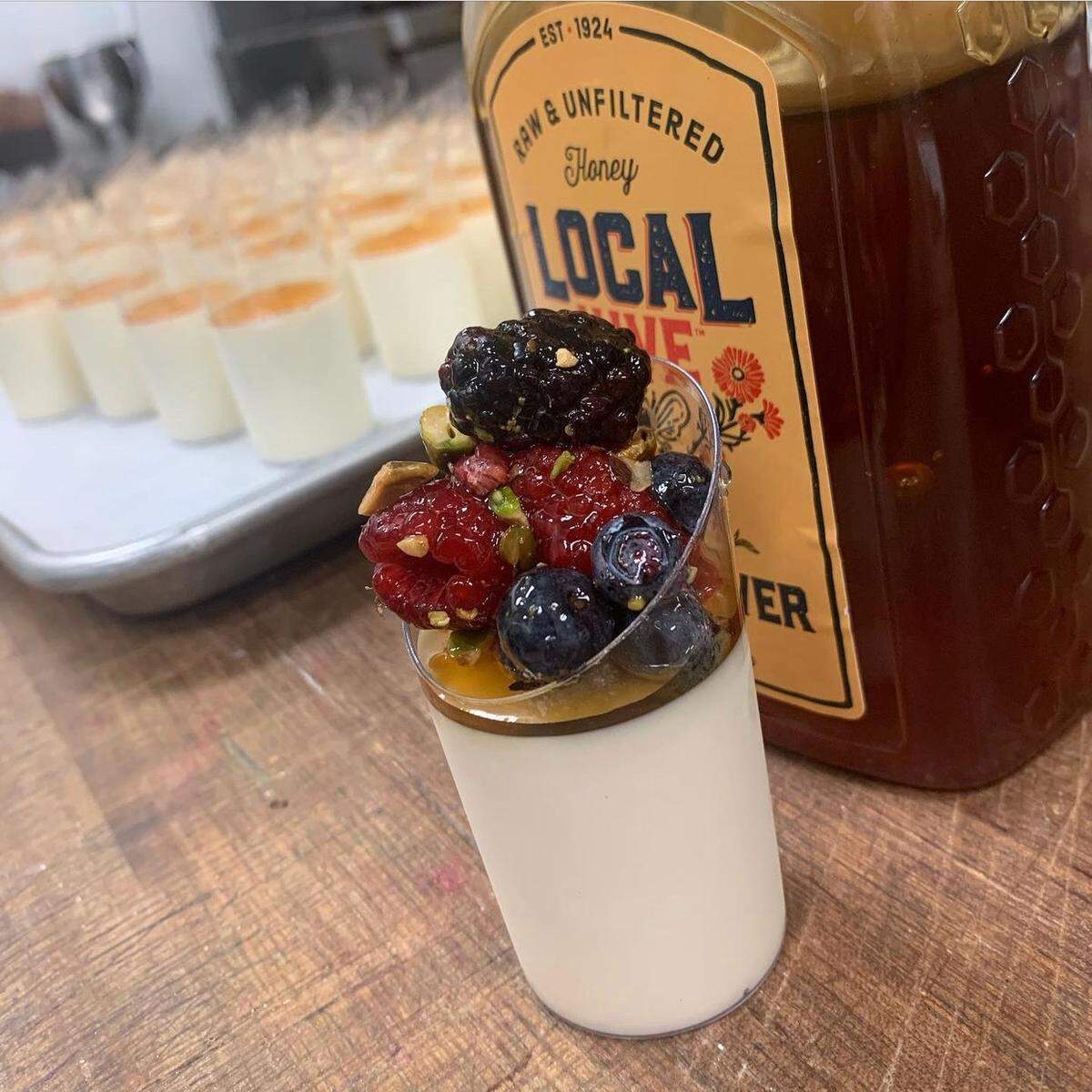
Pardon My French Bakery in Grover Beach served panna cotta in a glass topped with berries, pistachios and honey at a recent wedding. Jamie Tejeda
Business was steady until November, when the county saw a surge in coronavirus cases. People visited the bakery less, and it began to lose money again.
Couples pay three fees for their wedding cake: a retainer fee to reserve the wedding date, a down payment of the cake’s cost, and the second half of the cake’s cost when it’s finished. When couples offered, Tejeda allowed them to pay the full cost of the cake upfront in order to pay the bills.
The problem now is, the bakery needs to make desserts for weddings that were paid for a year ago. To cover the cost of ingredients and labor, Tejada is dipping into savings and using money from the shop’s business.
Though the bakery’s wedding revenue is down, the store is making 2.5 times the amount of revenue it used to, so Tejeda thinks that profits this year will balance out and look similar to previous years.
Before the pandemic, weddings had decorated dessert bars and large wedding cakes, but now, in the interest of health and safety, each wedding-goer gets an individual grab-and-go box of pastries.
Tejeda’s current favorite offering are verrines, a layered dessert served in a glass. They recently served a panna cotta verrine topped with fruit, crushed pistachio and a layer of honey.
“It was beautiful,” she said.
Erin and Nick Bollier on their wedding day, April 10, 2021, at La Lomita Ranch in San Luis Obispo. Cassia Karin Photography
Caterers struggle with labor shortages and a high volume of weddings
Phil’s Catering at 8030 Santa Rosa Road in Atascadero expected 2020 to be a “rocket year,” but “it shut down immediately” when the pandemic hit, owner and executive chef Gary Vierra said.
Vierra returned about $60,000 in deposits for canceled weddings, even after catering for multiple pandemic micro-weddings.
“Can you imagine all the work you have to do — all the contracts, all the tastings, all the email returns, questions and answers — and you get paid zero for it?” Vierra said.
After a dormant year, weddings surged locally in May and June when coronavirus restrictions loosened, and Vierra was bombarded with catering requests. Now, he’s almost entirely booked for the rest of the year.
2020 brides who postponed their weddings are battling 2021 brides for catering dates, he said.
“There’s only so many Saturdays in a year,” Vierra said, and as a result, he’s seeing more Friday and Sunday weddings than usual.
Vierra’s primary challenge now is finding staff; many of them are either on workers compensation or working for other catering companies that booked weddings before him.
Food is also pricier because the pandemic disrupted supply lines, he said. Tri-tip, a popular wedding food, is more expensive than ever, and Minute Made lemonade is hard to find.
“I’m stressed,” Vierra said. “But, you know, it’ll all get ironed out.”
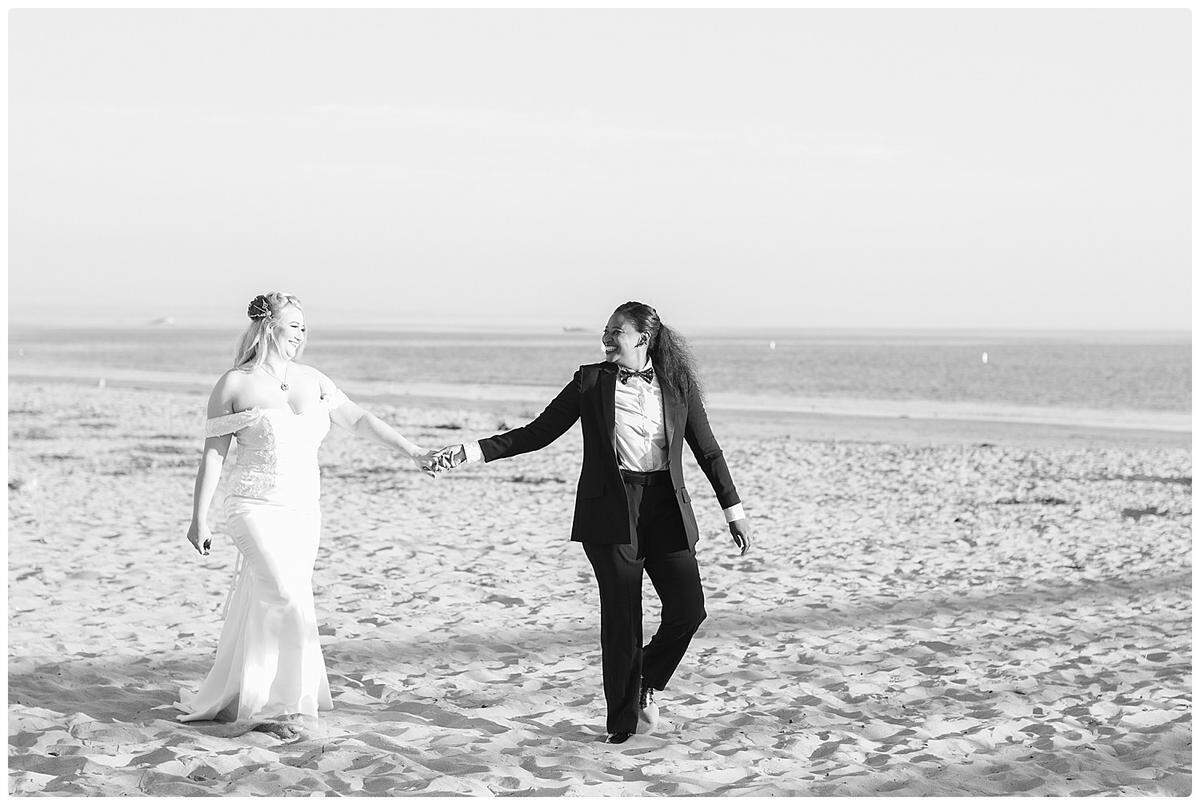
Nastacia and Jaalah Parham married in 2020. Renoda Campbell Photography
Wedding photographer sees a SLO-er return to business
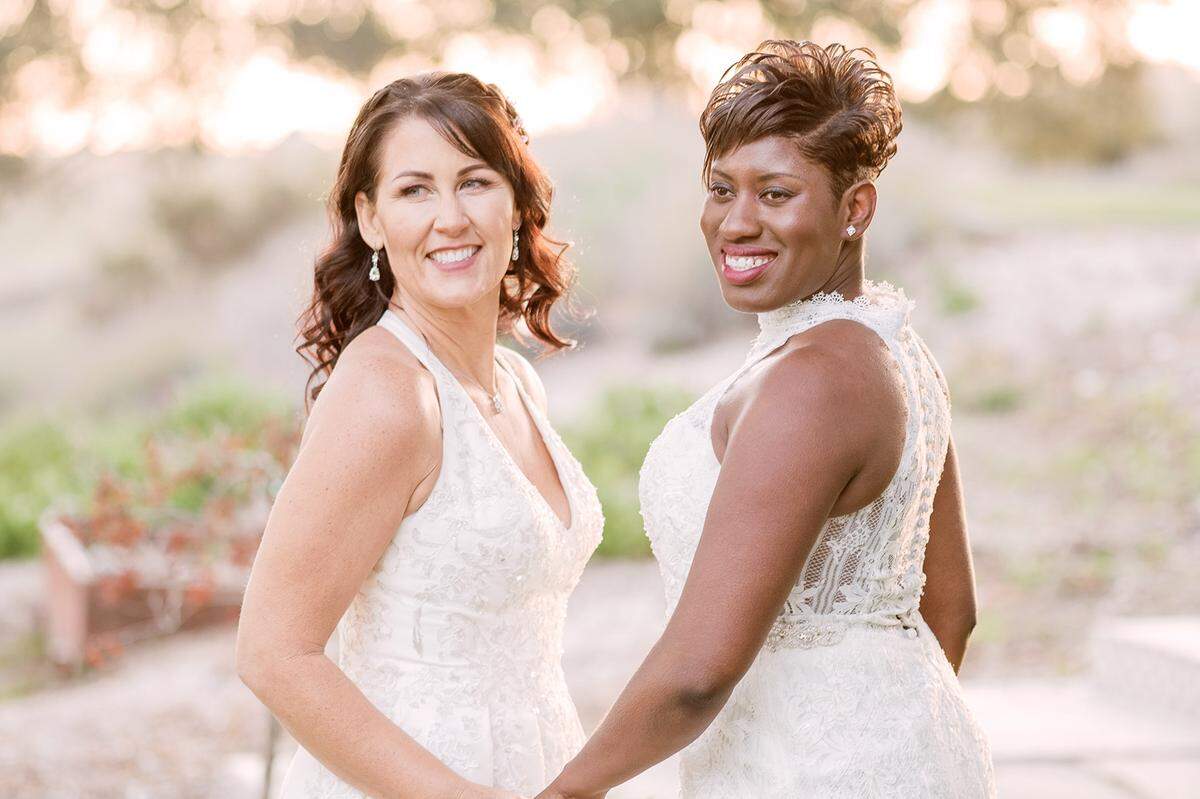
San Luis Obispo wedding photographer Renoda Campbell calls herself an activist with a camera. That’s because she specializes in photographing LGBTQ+ couples, couples of color and couples who believe in inclusion.
Gay couples and couples of color typically aren’t featured on wedding websites or magazine covers, so Campbell said she’s passionate about featuring them in her photography. She wants mainstream audiences to see these couples and think “wow, that’s beautiful,” she said.
“The bridal space is very homogeneous,” said Campbell, who is Black and in an interracial relationship. “You do see beautiful brides and grooms, but you don’t see people like me on, you know, Brides Magazine.”
Kristina and Tiphanie LaGue were married in San Luis Obispo in 2018. Renoda Campbell Photography
When a couple books Campbell as the photographer, they pay 30% of the cost as a down payment. When the pandemic struck, Campbell refunded couples who canceled their weddings, but in August she altered her contract so she could keep the 30%.
“The tipping point was there was no money coming in at all,” Campbell said.
She moved out of her photography studio in August and got a job as an academic adviser at Cuesta College for California Men’s Colony inmates.
Now, slowly but surely, couples are reaching out to Campbell to photograph weddings again. She enjoys her part-time job but hopes to go back to wedding photography full time as soon as she books enough to be financially stable, she said.
“When you’re photographing a wedding and you’re seeing how excited they are,” she said, “it just puts a spark in my heart.”
DJ Bob Stock’s music set-up. Bob Stock
DJ-ing during the pandemic
Local DJ Bob Stock said 2020 was supposed to be his “best year ever” with 53 events scheduled, but most rolled over to 2021 when the pandemic hit, he told the Tribune.
The DJ officiated a few weddings during COVID-19, but had such little business in May 2020 that he went to work for his family’s construction company.
During the pandemic, Stock DJ’d for socially distanced barbecue and drink events on the weekends at the Cliffs resort in Shell Beach. This comprised 20% of his revenue for the year.
“It was so fun,” Stock said. “It’s all just reggae and fun music. Whatever it took to make people happy.”
By the end of this May, he was splitting his time between DJ-ing weddings and working in construction. In a few months, Stock hopes to be back playing music full time again.
At his last wedding, people filled the dance floor enjoying the music.
“For the first time in over a year, I just felt like I was alive,” he said.
Jenn Hix, owner of The Queen’s Bees Salon, said the 2021 wedding season is “three seasons in one.” Her salon is doing about 11 weddings a week, with more weekday weddings than ever. Stephanie Zappelli
Meet Jenn Hix, the hairdresser who did it all during the pandemic
March 20, 2020 — the day California shut down hair salons — was Jenn Hix’s birthday.
She closed her salon, The Queen’s Beesin San Luis Obispo, and applied for a job at Food for Less. Not quite the birthday she imagined.
The federal government denied Hix’s initial request for unemployment and a Payment Protection Program loan for the salon.
“As a small business owner we kind of got the middle finger from the government,” she told The Tribune. Hix found support in the community instead.
Her landlord reduced her rent by half. R+Co, a hair care line that sold products in the salon, paid the salon 40% commission for products bought online by their clients, and revenue from those commissions covered three months of rent. In November, Hix finally received unemployment back pay and a $5,000 grant from the city of San Luis Obispo.
On top of this, brides were postponing and canceling their weddings.
“It was a wild time,” she said. “I was working full time at the grocery store — 40-plus hours — and then going home answering email after email of devastated brides having to postpone or cancel.”
In May 2020, California allowed stylists to do hair for weddings outside, and on June 19, they could return to doing makeup outdoors. So, Hix’s team jumped back into wedding work.
But more challenges were ahead.
On June 16, 2020, Hix’s last day at Food for Less, her father called to say he had lung cancer. So she jumped on a plane, picked him up and flew him back to San Luis Obispo to care for him.
She said she was in fight or flight mode: running the salon, working at weddings and taking care of her father.
“It was crazy,” Hix said. “I was going to weddings because I had to work, but then I also had to be really careful because I had lung cancer at home.”
In March 2021, when California was reopening, her father died.
Hix said the salon community rallied around her, offering to help with bookings and styling, and she felt supported.
Now, she’s fully immersed in the 2021 wedding season, which she said is “three seasons in one.” Her salon is doing about 11 weddings a week, with more weekday bookings than ever.
“I just make the joke constantly, ‘too blessed to be stressed,’” she said, laughing.
And she means it. She said she’s grateful for a supportive salon community and to be back working with brides.
In a strange coincidence this year, she said,many of her brides have also lost their dads.
“We get to talk and cry while I’m doing their makeup,” Hix said. “I get to be at work grieving with these people and loving each other and just having this really emotionally intimate time. It made me realize, like, wow, I really am exactly where I’m supposed to be.”
Stephanie Zappelli is the environment and immigration reporter for The Tribune. Born and raised in San Diego, they graduated from Cal Poly with a journalism degree. When not writing, they enjoy playing guitar, reading and exploring the outdoors.