This SLO company harvests seaweed from Central Coast tide pools – ‘pretty magical’
For Melissa Hanson, the experience of standing neck deep in a tide pool and hand-harvesting seaweed with scissors “is pretty magical.”
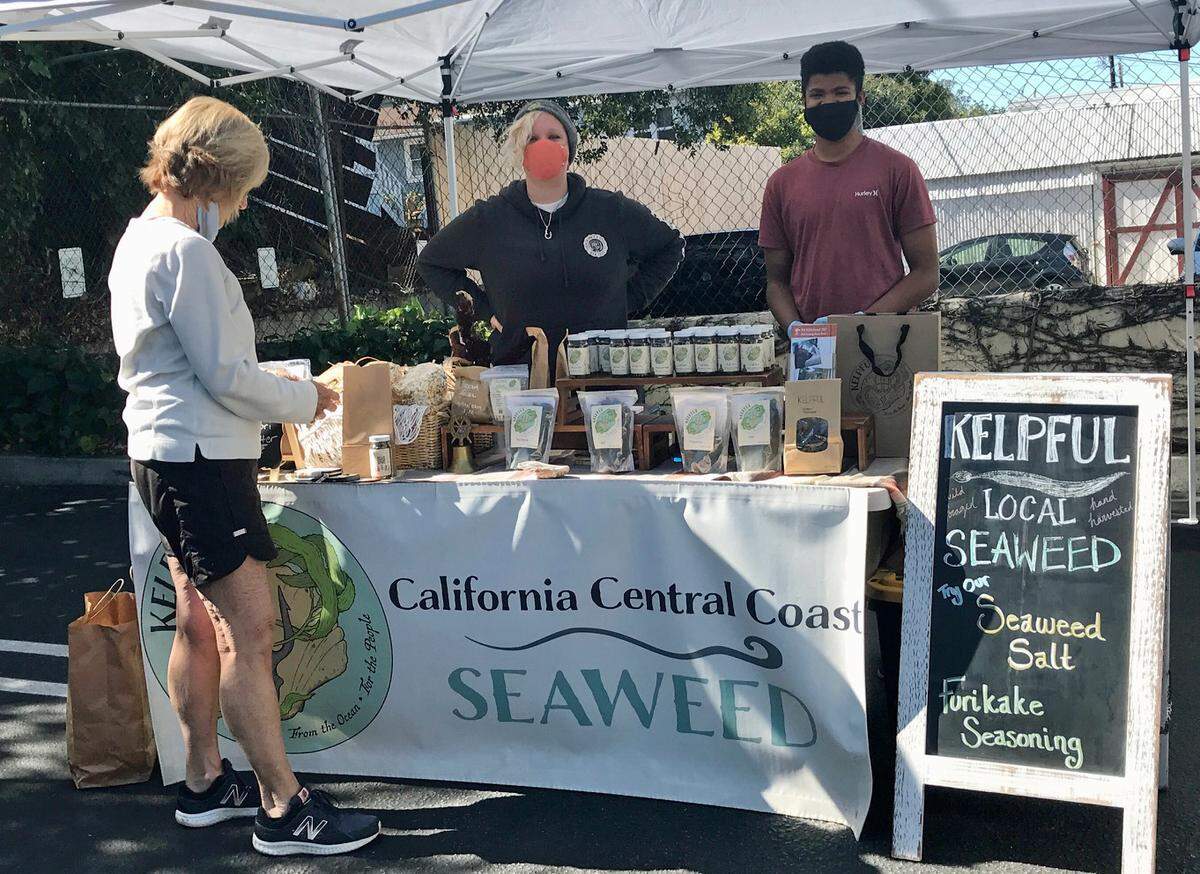
She and her partner, Austin Rogers, own and operate Kelpful, a seaweed harvesting business in San Luis Obispo, with the firm’s other co-founder, Jules Marsh.
Hanson and Rogers sustainably harvest, dry, package and sell various varieties of seaweed from San Luis Obispo County’s North Coast, products that their customers then eat, cook with or can even use medicinally.
Kelpful has a commercial seaweed harvesting license from the California Department of Fish and Wildlife.
Hanson, who grew up in Maryland and North Carolina, and Rogers, who hails from Waco, Texas, met while working in San Luis Obispo for Grid Alternatives, a national nonprofit organization that installs solar power systems and provides job training for underserved communities.
Hanson became interested in seaweed while working there. She and Austin worked there until the nonprofit lost some of its grant funding and closed the San Luis Obispo office in 2019.
Marsh, a civil engineer for GHD Group who specializes in sustainable engineering, became intrigued with seaweed farming in 2017 after hearing a Bioneers podcast interview on the topic.
Hanson had started developing her fledgling Central Coast seaweed business when a Facebook post led her to Marsh, who had posted about her desire to link up with others interested in kelp farming.
By 2019, their Kelpful enterprise had moved from concept to reality. It’s been expanding ever since.
Central Coast has history of seaweed harvesting
For Hanson, Rogers and their small team, collecting kelp and other seaweeds is much more than a commercial enterprise. All share a passion and respect for the sea and what it provides to the Earth and its inhabitants.
While on shore and in the sea, Hanson said, they always think about the cultures that harvested seaweed on the Central Coast before them.
“The Chumash were doing this for 10,000 years before we came,” Hanson said. “We honor verbally that history every time that we harvest. We start by giving gratitude to the ocean and its ecosystem for its abundance, for the privilege that we get to harvest food and medicine to share with our community.”
The Northern Chumash weren’t the only ones who collected seaweed on the Central Coast.
There are informational plaques on some North Coast shorelines that celebrate the history of Chinese and Japanese harvesters who have been part of flourishing Central Coast communities for decades, starting in the mid-1870s.
In addition to harvesting seaweed, those harvesters worked as miners, farmers and collectors of abalone and guano, or, bird droppings.
According to Geneva Hamilton’s book “Where the Highway Ends,” seaweed harvesters from China set up “at regular intervals from the Monterey County line to the mouth of Villa Creek near springs on the cliffs and steep hillsides, overlooking the wave-washed rocks where the produce of their farms grew.”
Their target crop was ulva, also known as sea lettuce, which Hamilton describes as “a large, broad, luscious-looking, green, wavy-edged leaf” that “requires specific conditions in order to flourish abundantly. Only certain types of rock are suitable for the algaeal, root-like holdfast” that anchors the plants.
“Day or night, whenever the tide was low,” the author wrote, “the men and women, isolated from their neighbors by long stretches of rugged coastline, worked at their trade. No machinery was used, and there were no shortcuts. Weed farming required painstaking, hard and often dangerous hand labor.”
The work is difficult, but it’s also thrilling, Hanson said.
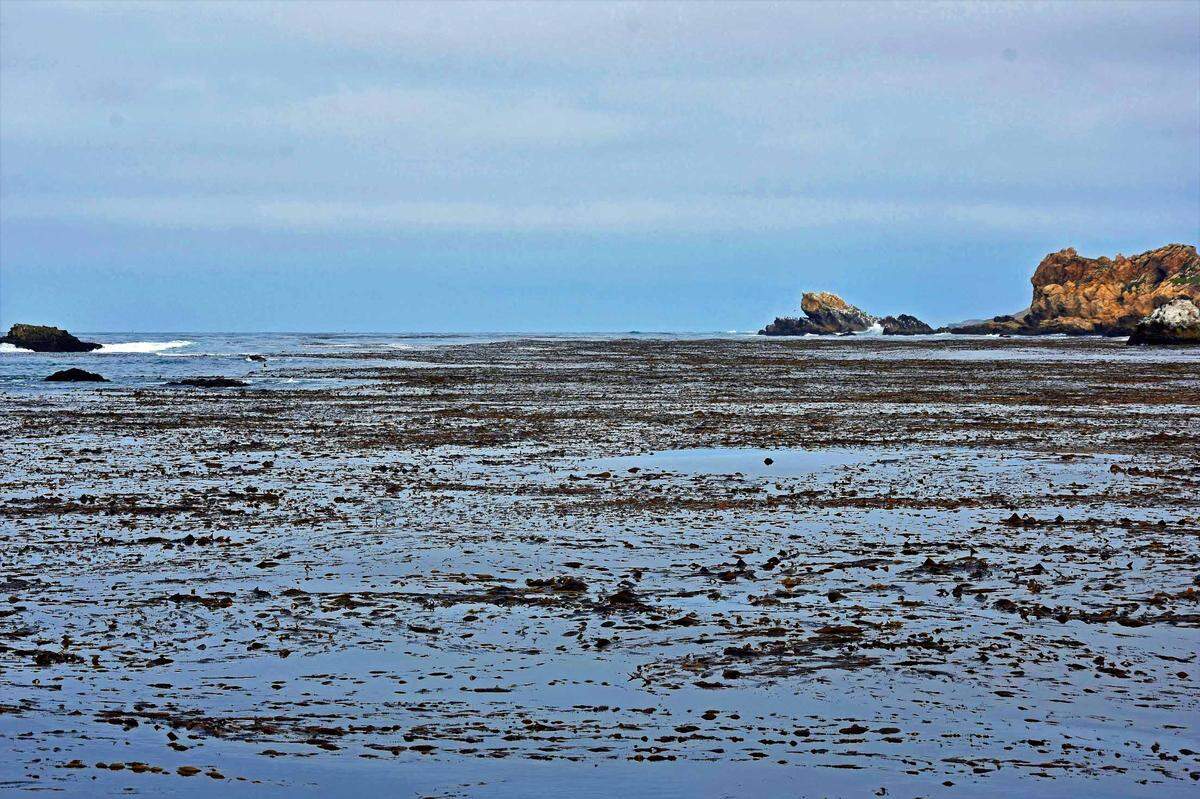
She relishes standing “waist deep in this teeming tide pool with hundreds of different creatures and hundreds of species of seaweed and to be gathering food in a way that people have done for millennia,” she said. “And we’re honoring that it’s a delicate ecosystem. We try to move very carefully.”
Is ocean vegetable farming in SLO company’s future?
Sea lettuce is just one of seven ocean vegetables currently harvested and sold by Kelpful. Others include nori and grapestone seaweed.
Most varieties are sold dried, either whole or crumbled.
Some are sprinkled on popcorn, mixed into seasoning blends or, with the help of Monica Knapp of Colony Culture in Atascadero, blended into butter. Some of the seaweeds are even sold fresh, to be used to make soup, or blanched, dressed and consumed as salad.
Eventually, the partners hope to farm various seaweeds, she said,
Seaweed farming “has a potential to produce a lot of low-cost, nutrient-dense food,” Hanson said.
That enterprise can “take the stress of agriculture off our already overtaxed land, by moving to the ocean where you don’t need fresh water or pesticides or fertilizer” to grow products, she explained.
“That’s why we got together,” she said, “and is still what we want to do.”
To do that, Kelpful will need a lease, expensive permits “and a lot of money to pay for the long process to get those permits,” Hanson said.
Is seaweed harvesting sustainable?
Marine biologist Scott Kimura of Tenera Environmental, who PG&E meteorologist John Lindsey praised as the man “who knows more about kelp along the California coastline than anyone I know,” said he’s impressed by Kelpful’s “mission and knowledge on edible, sustainable seaweeds.”
The seaweed species being collected by Kelpful “have high recovery potential, hence sustainability,” he said.
“They are harvesting species that live in the rocky intertidal zone and nearshore shallow subtidal,” Kimura said, habitats that are “exposed to a lot of disturbance” such as smashing waves and rolling boulders. “The species in these types of habitats are adapted ... to survive and persist in these harsh environments. They are capable of surviving because they can repopulate areas quickly and have high growth rates.”
“It would be difficult to completely eliminate these types of species even with aggressive collecting,” he added.
According to Hanson, she and her partner are always aware that “we are stewards of that place. It is not there producing for us to just take. We’re one part of the inconceivably intricate web of existence. We’re very sensitive. We only harvest species that are in great abundance, only take a very small portion of what is there.”
“We feel very attached to and a part of that ecosystem,” Hanson continued, “especially because it is how we feed ourselves and our family and our community. We’re deeply invested in stewarding that place.”
To that end, 1% of Kelpful’s sales goes to SeaTrees, a nonprofit organization committed to reforesting the ocean.
Business collects kelp with reverence and care
Rogers said he and Hanson share “the excitement and passion for different possibilities, setting new examples outside the confines of any particular box.”
“It’s a willingness to do what felt right instead of what everybody else was doing, which is inspiring, beautiful,” he added. “To spend time, struggling and dreaming those dreams for yourself and others, is a very powerful thing.”
Rogers also spoke of the excitement he feels “going out into the ocean and pulling up kelp. It’s big, it’s heavy and it’s such a visceral thing. You’ve got to be paying attention, but pouring yourself into that work physically is so rewarding.
“And the longer we’re at this,” he said, “the more we talk to people, we’re finding many from many different perspectives and backgrounds who share our passions, whether for ocean foraging and vegetables or restoration or good, healthy food. The diagram of overlapping interests is wonderfully complicated.”
More information about Kelpful
Kelpful sells products at the Rutiz Family Farms farmstand in Arroyo Grande, including on April 9, 17 and 23, as well as at Farmstead Ed pop-up markets and via stores, restaurants and home delivery services.
For more information, call 805-556-8066, email melissa@kelpful.com or visit www.kelpful.com.
This story was originally published April 5, 2021 at 5:00 AM with the headline "This SLO company harvests seaweed from Central Coast tide pools – ‘pretty magical’."