
How did this Paso winery become region’s fastest rising star? ‘The wow factor’
Before the heat of the day sets in and customers start rolling in, brothers Georges and Daniel Daou relax in a shady spot outside their Paso Robles winery and take in the expansive view. They are atop the 2,200-foot mountain that lured them here, but it feels like they are on top of the world.
The Daous are living the life they’ve dreamt about since childhood: making wine, tending the earth and spreading joie de vivre through the fruits of their labor. And they’re well on their way toward establishing Daou Vineyards and Winery — and Paso Robles along with it — as the world’s next benchmark for cabernet sauvignon.
Their wines — which range from the exclusive $275 Patrimony to $20-something bottles you can find in grocery stores — consistently earn fawning reviews from the top sources in the business.
Wine Enthusiast magazine, in nominating Daou Vineyards for American Winery of the Year in 2017, said the winery is “putting Paso on the global radar for collectible reds.”
And the winery’s estate, perched atop Daou Mountain with a lavish tasting room, inviting patios, concierge service and incomparable views of Paso Robles’ rolling west side, is like nothing else in the area.
But Georges Daou, 58, and Daniel Daou, 55, aren’t content to just sit back and enjoy what they’ve built so far.
In the past year alone, the winery has expanded its scope with a trio of notable developments, with more on the horizon.
The Daous acquired an iconic ocean-front property just north of Cambria with plans to open an ocean-view version of the Daou experience.
They inked a long-term deal as the exclusive wine partner of the music company BMI — not just pouring wines at events and festivals, but also creating artist-in-residence programs and songwriter retreats at the estate.
And the brothers brought on Fred Dame, arguably the most famous sommelier in America and abroad, as global ambassador. Dame’s task? To leverage his considerable expertise and worldwide renown to spread the gospel not just of Daou but of Paso at large.
The blunt-spoken California native has embraced the message, praising Paso wines at an industry event earlier this year as “wines of passion, power and beauty” — not like those “delicate” wines from “that four-letter valley up north.”
Paso Robles’s distinctive terroir compares favorably to top spots around the globe, Dame noted, but the region has yet to rise to the front of the world stage. It’s an exciting place to be.
“Nobody’s taking more risk in winemaking than we are in California, and especially right here in Paso Robles,” Dame said.
Winery preserves ‘part of winemaking history’
The Daou brothers were not the first to have big dreams for the mountain rising from the heart of Paso Robles’s rugged Adelaida District.
A Beverly Hills cardiologist envisioned world-class wines being grown here, a half-century ago when the hills were covered with cattle instead of vines.
Stanley Hoffman took a gamble and began planting wine grapes. To guide the operations, he brought in André Tchelistcheff – widely considered the godfather of modern California winemaking – who called the mountain “a jewel of ecological elements.”
Hoffman Mountain Ranch produced notable wines and pioneered modern commercial winemaking in Paso Robles but wasn’t immune from financial struggles. The operation shut down in the early 1980s.
One of the winery’s vineyards was later acquired by neighboring Adelaida Vineyards; the remainder fell derelict.
When Daniel Daou first laid eyes on the property about a dozen years ago, “it was in shambles,” he said.
His fortune made in a tech venture alongside his brother, Daou was looking for a place to make wine. Everyone – including his brother – thought he was crazy. Why gamble everything in a notoriously capital-intensive industry? The best way to make a small fortune in wine, Georges Daou and others reminded him, is to start with a big one.
But Daniel Daou was convinced he was on to something.
This mountain offered all the raw materials he was seeking. Deep, chalky limestone perfect for creating minerality and natural acidity, topped with a layer of clay that retains water and builds bold flavors. Steep slopes along the Templeton Gap, plus a combination of elevation and wind that keeps it cooler than much of Paso Robles.
“It’s a rare phenomenon, with the climate of Napa and the soils of Bordeaux,” Daou said.
So he took the plunge, moved into a single-wide manufactured home on the property and set to work rehabilitating the vineyard. Georges Daou eventually followed, he joked, “to make sure Daniel didn’t screw it up.”
One of their first projects was to restore the original redwood Hoffman Mountain Ranch winery building. “It was more expensive than tearing down and starting over,” Daniel Daou said, “but we wanted to preserve that part of winemaking history.”
“This is his dream,” Daou said of Hoffman, “and we’re continuing it.”
Engineering success with wine
The brothers like to lay much of the credit for their wines on the terroir, but there’s a lot more at work. With their shared background as systems engineers, every aspect of the operation — from the field to the bottle — is methodically analyzed, thoughtfully designed and regularly improved.
Daniel Daou spent several years studying clones to select just the best ones for the site and the wines they are trying to produce. He developed a custom yeast that’s now being used beyond Daou alone.
He is meticulous about barrels — on which the winery spends more than $1 million each year — working with a select few coopers and curing the wood on site. (The winery is working toward assembling barrels on site as well.) He was also among the first in Paso Robles to invest in a pricey optical sorter that analyzes each berry and rejects any inferior ones.
The Daou way is evident in the 120-acre vineyard as well, with densely planted vines, cordoned low and cropped close. A half-dozen trials each year hone the best methods for producing the best fruit. Sub-par clusters are dropped mercilessly, and only free-run juice makes the cut after fermentation — no pressing here.
“Our wealth is in the soil,” Georges Daou said. “It deserves the best in the world, so we spent the money.”
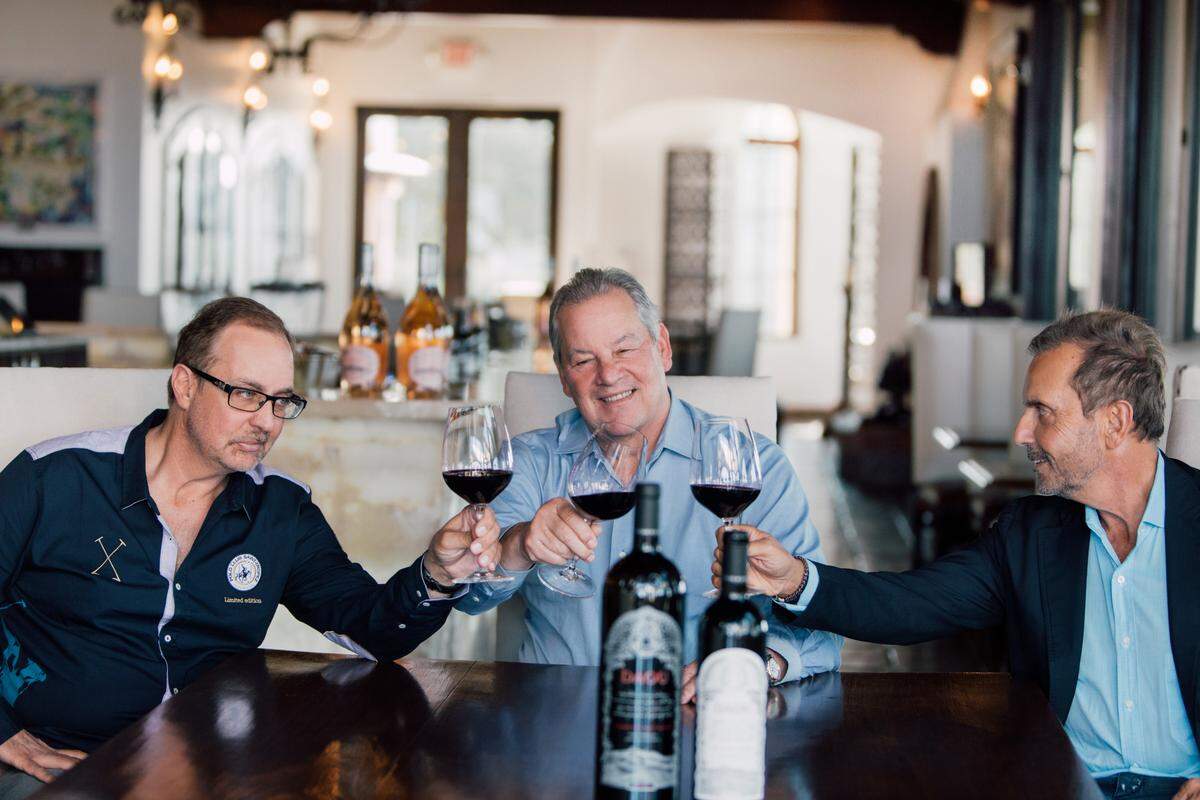
Who are Daniel and Georges Daou?
It’s not uncommon in the world of high-end California wine to make a fortune in one industry before starting a luxury winery. But there’s more to the story behind Daou.
That story starts in Lebanon, where the Daous led an idyllic childhood until an errant rocket blasted through their home at the start of the civil war in 1973. Shrapnel caught 8-year-old Daniel near the heart and left him with with some facial paralysis, and Georges, then 12, was in a coma for two days.
“I went to sleep a boy and woke up a man,” Georges said. “Almost dying together create a pretty unshakeable bond.”
The family left everything behind, including a successful furniture business, and fled to Paris. Spending the next few years there and in Cannes in southern France, the brothers became enamored of a life in wine.
But life led them to the United States, where they studied engineering at UC San Diego. At times they barely scraped by, but their fortunes turned with the success of their health care information technology business.
Daou Systems was valued at $700 million when the Daous took the company public in 1997 and then cashed out.
For Daniel Daou, that meant the chance to pursue his dream of making wine. “For 30 years, I wanted to be a winemaker,” he said. “I just had to find the right place.”
Georges Daou was ultimately persuaded by the vision of re-creating the life they remember from Lebanon, playing in their grandfather’s olive groves and gathering with family.
“It’s the best life we had in Beirut as kids, the conviviality, the joie de vivre,” said the older Daou brother, the visionary behind the lifestyle and hospitality aspects of the business. “It’s what we both wanted.”
Daou’s opulent tasting room, $100 wines and $40 tasting fees certainly fall at the highest end in a region better known for good value, smaller producers and rustic charm. But the winery’s influence, wide distribution and marketing energy are helping to expand the view the wine-drinking public has of Paso and its possibilities.
“They’re following in the successful mold of J.Lohr and Justin, getting their wines in front of a lot of people,” said Joel Peterson, executive director of the Paso Robles Wine Country Alliance.
Paso has numerous highly regarded wines, Peterson noted, but many are from small makers such as Saxum or Linne Calodo — wines that most people will never get their hands on.
“Daou has become a big player on the national scene,” Peterson said. “It gets people thinking about Paso and talking about Paso, here and nationally.”
The high-end tasting room experience adds another layer to what Paso has to offer visitors.
“Paso will always have a diverse array of tasting experiences, from small and quaint to modern and rustic,” Peterson said. “Daou falls into the wow factor.”
They are bringing people here, he said, and that’s only good news for other tasting rooms. “There’s space to bring more higher-end customers to Paso Robles.”
New Daou facilities in Cambria, Paso Robles
It’s space that Daou Vineyards is angling to fill more of. Some will come with the opening of Daou Ocean, though the Daou brothers are still tinkering with what the venue will offer.
They are also eyeing new heights – literally.
A couple hundred feet above the mountain-top estate lies a smaller plateau. This is where the Daous are planning a home for Patrimony, their highest-end line – a by-appointment-only, French chateau-style winery, entirely gravity fed, with accompanying caves.
Production of most other wines will move east, to a new facility by Paso Robles Municipal Airport, leaving the estate to be dedicated primarily to hospitality — with the possible addition of on-site accommodations at some point.
The Daous have acquired additional vineyards in and around Adelaida, making Daou one of the largest estates on Paso’s west side with 400 acres. They’re looking outside Paso as well, aspiring to add a Central Coast pinot estate to the portfolio.
Daou is a journey, the brothers like to say, one they invite customers to walk with them on, but the destination is already determined: making wine on the Central Coast.
“People are always surprised when they learn I make the wine, that I don’t hire someone to do all that,” said Daniel Daou, who spends two to three hours a day in the vineyard. “I want to make wine until the day I die.”
“There was always a sense we belonged somewhere else,” he said. “We found it here.”
Get the Daou experience
Daou Vineyards and Winery
2777 Hidden Mountain Road, Paso Robles
805-226-5460 or daouvineyards.com
A visit to Daou Vineyards is an indulgence that deserves some forethought – and probably reservations. Walk-ins are accepted only when there’s availability.
A basic tasting here is anything but basic. You’ll be greeted by a host and led to the panoramic patio or posh interior with a wine educator guiding you through the tasting.
But at $40 — waived with a three-bottle purchase or membership — it’s worth upgrading for a more personalized experience.
Delve deep into the wines with a vintage retrospective for $95 or cabernet-focused tasting for $65. Relax in Adirondack chairs in a private spot looking out over Paso Robles with a bottle of wine and picnic basket filled with goodies to go along. Or choose your own progressive pairing from a slate of culinary creations from the estate chef. Food ranges from $55 for cheese and charcuterie to $195 for a picnic of up to four people. Find details at daouvineyards.com/visit.
This story was originally published November 21, 2019 at 5:10 AM.