
SLO neighborhood faces ‘deep political divide’ this election season. Can corny jokes help?
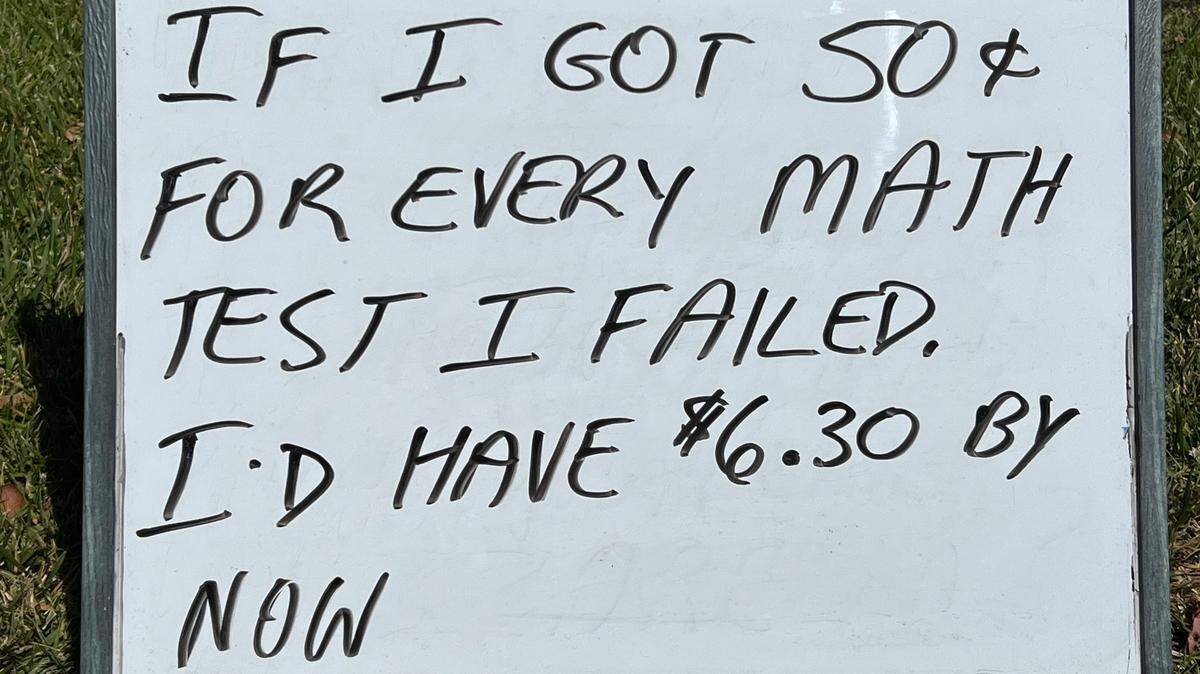
A man in our neighborhood posts a joke on a small whiteboard outside his home every day.
His material is light-hearted and innocent, mostly featuring dad jokes, puns and knock-knock jokes. Things you’d happily share with your fourth-grader.
His home is along a popular walking route, so everyone pauses to read his message before continuing around the loop.
The reaction upon seeing his whiteboard is universal: Everyone reading it cracks a smile.
If the walkers are in pairs or small groups, they turn to each other and grin. Many discuss the jokes as they stride away. Each feels brighter and more connected by his simple humor.
It’s as if a miracle is performed in a matter of seconds.
It’s an added miracle because many of the readers aren’t on speaking terms, especially during election season.
Like many neighborhoods across the country, ours faces a deep political divide.
Households hail from both sides of the political spectrum. Blue voters share fences with red ones.
Recent local and national events have turned next-door neighbors into bitter enemies. Candidates’ signage dotting neighborhood lawns indicate deep-seated beliefs that dare others to a political duel.
I’m nervous to broach current events for fear a melee will ensue.
And I’m not just imagining the schism.
According to a recent study conducted by the Pew Research Center, 76% of Republicans felt the U.S. government had done a good job handling COVID-19 pandemic, while only 29% of non-Republicans did. That 47% gap is the largest political disconnect between those supporting the governing party and those who don’t of 14 other wealthy, consolidated democratic nations. In addition, 77% of Americans feel the country is more divided now than in pre-pandemic times, according to the Pew study.
But my neighbor might be part of the solution. Research shows that shared laughter not only makes us feel good about ourselves but actually strengthens our relationships with strangers.
Participants in one study watched funny video clips while video-chatting with a same-sex viewer.
Afterwards, they answered questions about their positive and negative emotions and whether they liked or wanted to get to know their viewing partners.
Turns out, the more laughter the subjects shared, the more similarities they perceived they had with each other and the more they wanted to be together.
“Shared laughter signals that they see the world in the same way,” says Sara Algoe, social psychologist and co-author of the study with Laura Kurtz.
“Perceived similarity ends up being an important part of the story of relationships.”
The findings corroborate other research by the same scientists that compared the amount of time 71 couples spent laughing with their partners with the quality of their relationships, emotional closeness and social support. It turns out the more these folks laughed together, the stronger they perceived their bonds.
This brings me back to my neighbor, his whiteboard and his jokes.
Yes, his jokes are corny. His material will never make center stage. But it has the wonderful ability to unite and tickle every reader.
For that, he deserves a standing ovation.
This story was originally published May 16, 2022 at 5:05 AM.