‘Exciting stuff.’ Cal Poly grad’s Cold War spy thriller is set in a world where magic is real
Like the best ideas, the inspiration for Walter Goodwater’s first book came to him in a dream.
“I woke up one morning with the idea” of a Cold War espionage thriller set in a world where magic is real, the Arroyo Grande author recalled. “I just woke up and I had it.”
That book, “Breach,” was the first novel in a series that mixes sorcery and spycraft, ciphers and spells. Think John Le Carre meets Lev Grossman’s “The Magicians.”
“I like to describe it as chocolate and peanut butter,” said Goodwater, whose followup to “Breach,” “Revolution,” recently went on sale. “They’re great by themselves (but) you put them together and they’re even better.”
A passion for fantasy
When Goodwater talks about his influences, the names of fantasy authors — Terry Brooks, Brian Jacques, Guy Gavriel Kaye and Sarah Gailey, to name a few — come up often.
“Fantasy has always been my passion,” said Goodwater, a fencing coach and software developer at Cygnet Software in San Luis Obispo
A self-described “voracious reader” from an early age, he got some of his first fantasy books from a teacher who came to his class with a bag full of mass-market paperbacks.
“Her son went away to college, and she was liquidating his bookshelf,” Goodwater recalled. “I feel bad for that guy who lost his books, but it worked out for me.”
Although Goodwater said he’s “been writing forever” — he penned his first hard-boiled detective story at age 9 — he didn’t become a professional author immediately.
He took a break from writing entirely to study computer science at Cal Poly, graduating in 2006. “Once I didn’t have to do homework any more, then it was easy to get back into the writing game,” Goodwater said with a chuckle.
Goodwater wrote eight or nine manuscripts before he signed with an agent, who netted him a two-book deal with Penguin “within a couple of months — the fastest she said she’d ever seen,” the author said.
The first book in Goodwater’s Cold War Magic series was published by Penguin Random House imprint Ace Books in November 2018. (The cover bears Goodwater’s pen name, W.L. Goodwater.)
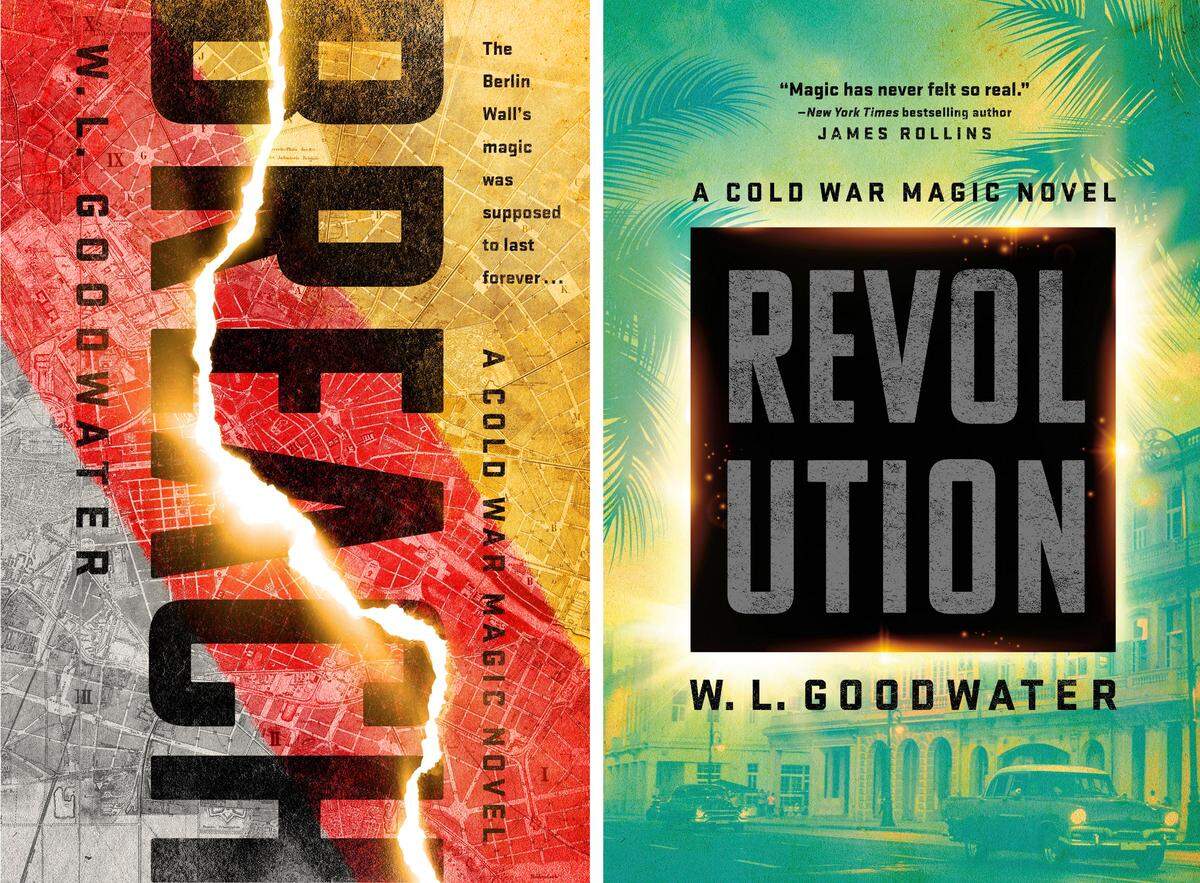
Cold War Magic book series
Set in the 1950s, “Breach” introduces readers to Karen O’Neil, an American magician in the employ of the Office of Magical Research and Deployment.
“She is a very talented magician in a period of time in the United States where people don’t trust magic and don’t like it,” Goodwater explained. “She’s also a very capable and determined woman in a time in the United States where people aren’t interested in that either.”
That puts Karen in the position of dealing with the perils of both magic and misogyny, he said.
She’s “trying to rise up through the bureaucracy of (the U.S. government) while also trying to do her job well and wishing she didn’t have to deal with all this crap from her coworkers,” Goodwater explained.
The story takes Karen to post-World War II Germany as she investigates a breach in the Berlin Wall, which happens to be constructed entirely of magic.
In “Revolution,” published Nov. 12, she journeys to pre-revolutionary Havana, where the American mafia and the military dictatorship of Fulgencio Bautista hold sway. They’re not the only ones interested in controlling Cuba; the Soviets and the CIA also have designs on the island nation.
While navigating “a world where she’s dealing with spies and revolutionaries and monsters that haven’t existed before,” Karen searches for a missing girl in desperate need of help, Goodwater explained.
Research for ‘Revolution’
Goodwater said a magical arms race is a perfect analogue for the mid-20th century struggle between global superpowers.
“The world of the Cold War is (defined by) this idea of mutually assured destruction,” he said, “both sides just building up more and more (power) and not really stopping to ask how much power is too much. …”
“Magic becomes an easy metaphor for that,” he added.
To capture the look and feel of 1950s Havana, Goodwater took a similar approach to how he researched “Breach”: “I read a lot of books,” he said.
One of the books he read in preparation for writing “Revolution” was “Havana Nocturne: How the Mob Owned Cuba and Then Lost It to the Revolution.”
The nonfiction history book by T.J. English highlights how, in the 1950s, American organized crime “owned Havana’s biggest luxury hotels and casinos, launching an unprecedented tourism boom complete with the most lavish entertainment, top-drawer celebrities, gorgeous women, and gambling galore,” according to the official description.
Goodwater also took inspiration from “Our Man in Havana,” a darkly comedic novel by Graham Greene about a vacuum cleaner salesman who takes a side job as a spy.
“It really talks about … what’s going on in the country, and it’s also really entertaining,” said Goodwater, who often writes in a home office decorated with vintage travel posters.
He also gives credit to LeCarre, the legendary author of “The Spy Who Came in From the Cold” and “Tinker Tailor Soldier Spy.”
“I hesitate to call him an inspiration because I think he has better life experience and is a better writer than I am, but I do enjoy him,” Goodwater said. “I wouldn’t have written ‘Breach,’ if I had not read his stuff.”
Asked what he’s working on next, Goodwater said there could be a third book in the Cold War Magic series. He’s currently writing a contemporary fantasy novel “set in a time that feels like now.”
Goodwater is just happy to be writing the same kind of “exciting stuff” that entertained him as a kid. Writing “went from my hobby with professional aspirations to my second career,” he said with a smile.
‘Revolution’
By W.L. Goodwater
$16
Ace Books