
A seawater temperature ‘blob’ could affect our expected El Niño
Last year was the hottest in California’s history. So far, 2015 is on track to be even hotter.
This past January, February and March were the warmest ever seen along the Central Coast. As a longtime resident of Los Osos, this was the first winter that our family never had to turn on our home’s heater.
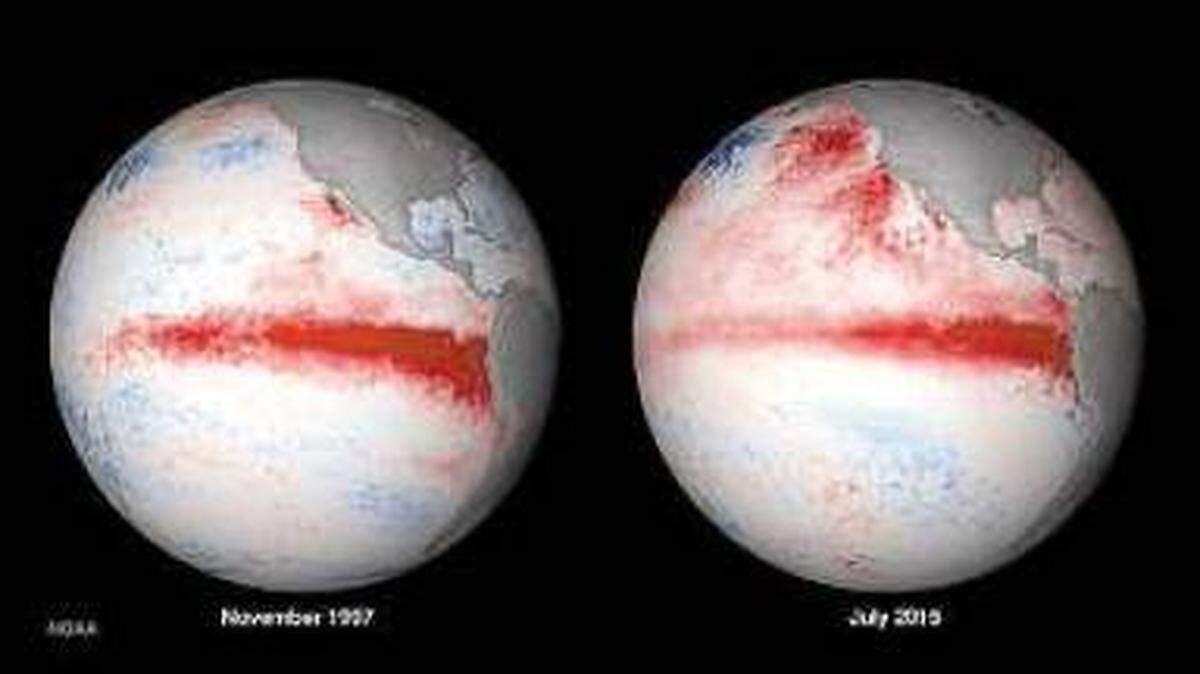
A potentially strong El Niño (higher than normal seawater temperatures in the equatorial Pacific) could become the strongest event in more than 50 years, according to the National Oceanographic Atmospheric Administration’s Climate Prediction Center (CPC).
Recently, this El Niño has been characterized as “Godzilla,” “Bruce Lee” and the “Beast” — strong depictions for sure.
According to the CPC, there is a greater than 90 percent chance that El Niño will continue through early 2016. Coupling this condition with unusually high seawater temperatures along the entire West Coast should assure continued higher-than-normal temperatures this fall and winter.
However, the question that is on everybody’s mind, and rightfully so after four years of drought is the promise of above-normal rainfall this year. Historically, strong El Niño events usually produce well above-normal rainfall. In fact, since 1950, 140 percent above-normal for our area.
But here’s the tricky part: The last strong El Niño event of 1997-98 strengthened and drove the southern branch of the polar jet southward toward California.
This condition brought plenty of moisture laden storms to the Central Coast and produced 44 inches at Cal Poly during the 1997 rain season.
However, the last strong El Niño event didn’t have to contend with the “blob” of abnormally warm seawater that is off the Pacific Northwest. William Patzert, a respected climatologist with Caltech’s NASA Jet Propulsion Laboratory in Pasadena, said, “That’s the question we should be asking.”
You see, the polar jet stream often forms the border between the frigid air to the north and the warmer air to the south.
As a rule of thumb, the greater the temperature differential between these two air masses the faster the upper-level winds will blow. The faster the jet stream, the more direct route it takes across the Pacific and more likely it is to bring storms to our part of the world.
The blob of warm water off the Pacific Northwest could decrease the temperature differential between the northern and southern air masses and diminish the speed of the jet stream, resulting in a more south to north pattern.
In other words, the jet stream could take the shape of Greek letter omega (Ω) off the Western Seaboard. Meteorologists call this phenomena an Omega block. These Omega blocks can remain in place for extended periods of time, and studies suggest they are becoming more common.
On the other hand, a warmer atmosphere can hold greater amounts of water vapor and the potential for heavier rains. But if we do get above normal rains, it probably won’t be enough to erase the past four years of bone-dry weather.
Cal Poly is 37 inches behind its normal four-year total. Consequently, to make up this deficit, the rainfall Cal Poly would need this coming season would be about 59 inches. The all-time record for Cal Poly is 55 inches, which occurred in the 1968-69 rain season.
As I’ve written before, El Niño does not guarantee above-normal rainfall; but, historically, the stronger the El Niño event, the higher the probability of greater amounts of average precipitation in California.
Did you know that PG&E delivers to its customers some of the nation’s cleanest electricity? More than 55 percent of the power comes from sources that emit no greenhouse gases, including Diablo Canyon Power Plant. To learn more, please visit http://www.pge.com
This story was originally published August 15, 2015 at 8:50 PM.