
Strong El Niño could refill reservoirs and start to recharge groundwater
Talk to anyone who closely follows the weather and water woes and you’ll inevitably hear two words: El Niño.
As San Luis Obispo County suffers through its fourth year of extreme drought, hopes are high that a wet El Niño winter will provide relief from the dry conditions. On the downside, a wet winter could mean localized flooding and washed-out roads.
According to the National Weather Service, there is greater than a 90 percent chance that there will be a strong El Niño weather pattern this winter. If that happens, it could go a long way to helping refill the four reservoirs in the county and begin recharging dwindling groundwater aquifers.
“This winter is looking similar to the last very strong El Niño of 1997-98,” said John Lindsey, PG&E meteorologist. “Historically, strong El Niños have produced more rainfall.”
An El Niño weather pattern is characterized by warm ocean water temperatures in the equatorial Pacific Ocean that causes California’s storm track to dip southward and pull in tropical moisture. The stronger the El Niño, the farther south the storm track will dip.
Eric Boldt, a meteorologist with the National Weather Service in Oxnard, said California has had six El Niño weather systems since 1950 and all have resulted in above normal rainfall for Southern California, including San Luis Obispo County. On average, an El Niño yields 1.34 inches of rain above normal.
However, Boldt and others are quick to point out that El Niño conditions do not guarantee a wet winter and one El Niño winter will not end the drought. Over the past four years, the area has racked up 30 inches of rainfall deficit.
“Even one above normal rainy season is likely not to eliminate the drought,” he said. “It might be a significant improvement, but we will need several wet years to get out of the drought.”
Refilling reservoirs
El Niño weather events typically drop much more than 30 inches of rain. The highest annual rainfall total for San Luis Obispo was 54.53 inches, which fell during the 1968-69 season. That amount would be more than enough to fill the reservoirs.
“A significant El Niño could fill our reservoirs; there’s precedent for that,” said Mark Hutchinson, deputy director of Public Works for San Luis Obispo County.
The 1997-98 El Niño also dropped enough water to fill the county’s reservoirs, with many parts of the state receiving more than 13 inches of rain just in February 1998. The city of San Luis Obispo received 36.51 inches of rain during the 1997-98 El Niño. Average precipitation is 24 inches.
The county has four reservoirs that are a crucial water supply for many communities in the county. They are Nacimiento Lake near the Monterey County line, Whale Rock Reservoir near Cayucos, the Salinas Reservoir east of Santa Margarita and Lopez Lake near Arroyo Grande. The Salinas Reservoir is also called Santa Margarita Lake.
The city of San Luis Obispo stands to benefit the most from an El Niño winter. It relies on three reservoirs for its water — Salinas, Nacimiento and Whale Rock. All three are less than half full with the Salinas Reservoir being the lowest at 14 percent.
In spite of this, the city estimates that it still has three and a half years of water left. A wet winter would extend the city’s water supply into the foreseeable future, said Aaron Floyd, the city’s deputy director of water.
“We are hoping that this winter will be the big one,” he said. “It could make a real huge difference and reset all of those reservoirs.”
Groundwater ‘a different animal’
A wet winter will also benefit the county’s dwindling groundwater basins but is unlikely to completely recharge them. The main benefit of a wet winter after a long drought is that the ground gets soaked and this reduces the amount of water pumped from aquifers for irrigation purposes.
“Groundwater is a very different animal than reservoirs,” Hutchinson said. “In general, the larger basins would take more than a single wet year to show a positive response.”
This is because the size and geology of each basin is different and those conditions determine how quickly a basin recharges. Smaller basins, such as the 12-square-mile Los Osos basin, often recharge faster than larger ones, such as the Paso Robles basin, which covers 790 square miles.
“For underground aquifers, we know that water can take decades to refill, but some can fill up rather quickly,” Boldt said. “We would need above-normal rain for multiple years to get out of this trend we are in.”
Recharge occurs when a basin gets enough rain to saturate the soil and cause creeks to flow. Over time, this water percolates into the aquifer.
The county has identified three groundwater basins that are being pumped in excess of their safe yield – meaning more water is being pumped out than is going into the basins. They are the Paso Robles, Los Osos and Nipomo Mesa basins.
Spencer Harris, a geologist, has studied the Los Osos basin for the Los Osos Community Services District. Even if the winter is a wet one, the community will have to continue its efforts to conserve water and move wells further inland to prevent saltwater intrusion into the aquifer.
“Certainly, the El Niño will be welcome, but it’s not going to solve the problem alone,” he said.
Potential for disaster
Conditions are so dry after four years of extreme drought, that it is unclear how much rain would be needed to produce enough runoff to begin refilling reservoirs. The county has water data that goes back as far as 1910, and the last two years were the driest on record.
Normally, it takes about 10 inches of rain to soak the ground to the point of getting runoff, but this winter it could take more. “We are well outside the range of historic precedent,” Hutchinson said.
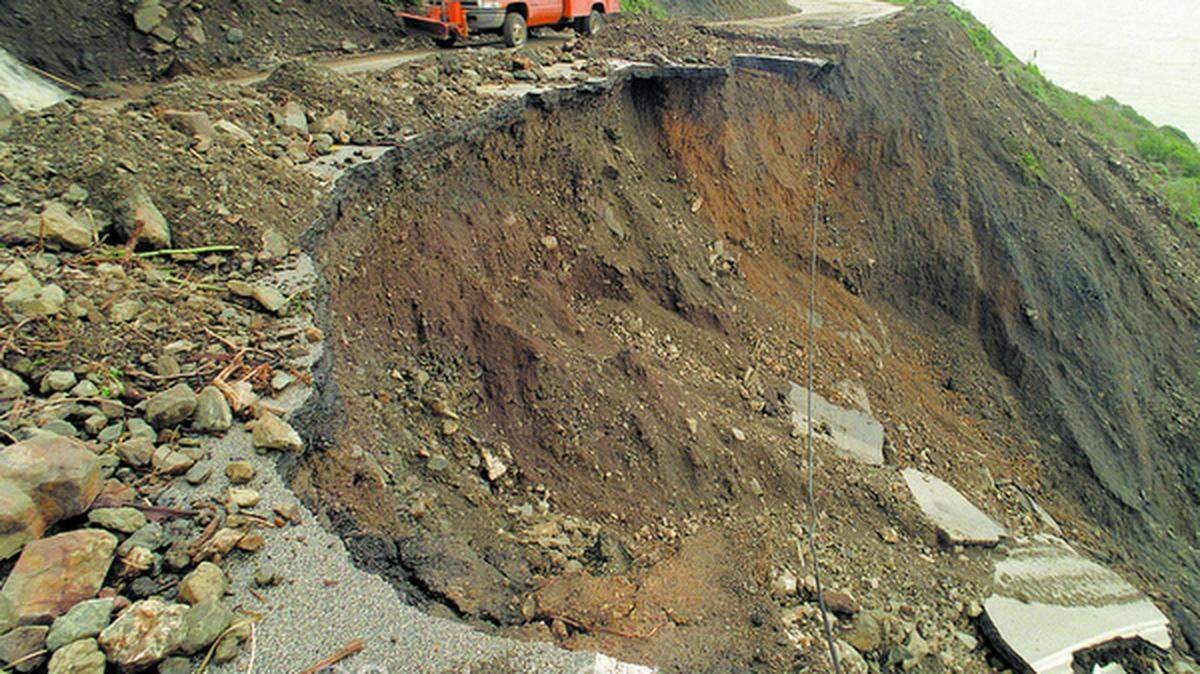
There is also the specter that an extremely wet winter could cause washed-out roads and localized flooding. The extremely wet February in 1998 washed out part of Highway 166 along the Cuyama River, killing two California Highway Patrol officers, whose patrol car tumbled off the highway and into the river with them trapped inside, and a civilian whose pickup truck also went into the river.
Also during that year, many parts of Highway 1 were closed due to washouts and mudslides, costing $1.5 million to repair. The damage was enough to prompt Gov. Pete Wilson and President Bill Clinton to declare San Luis Obispo County state and federal disaster areas.
Not a certainty
In spite of the optimism about a wet El Niño winter, some uncertainties remain. For example, a warm body of water is sitting off the coast of the Pacific Northwest that was not present in 1997-98, Lindsey said.
“That could keep the storm track north of us with fewer storms on the Central Coast,” he said. “That’s the big question mark.”
This story was originally published August 1, 2015 at 6:41 PM with the headline "Strong El Niño could refill reservoirs and start to recharge groundwater."