
Remembering Elwyn Righetti on Memorial Day
My grandmother, Betty Righetti Middlecamp, would never watch and wave when guests left the house. She would say goodbye in the driveway and then head down, pulling weeds; she seemed to ignore friends and family pulling away.
The last time she waved goodbye was when her brother, Elwyn, drove off to war. On Memorial Day, this is his story.
A P-51 Mustang looks impatient for the sky even when parked.
Yellow and green striped propeller tips pointed skyward as 55th fighter group mechanics readied their aircraft for the mission of April 17, 1945.
At Wormingford, in southeast England, the drone of lumbering heavy bombers had been in the air since the early hours, streaking the sky with contrails.
Streams of four-engine heavy bombers were miles long across the sky. The 8th Air Force would send 981 bombers into the heart of Nazi Germany this day, delivering 2,700 tons of bombs.
Bombers soon to be escorted by 756 fighters, including 54 from the 55th Fighter Group. A sergeant’s tongue got him in trouble.
When the first jeep rolled up, mechanic Sgt. Don Downes was told his P-51 Mustang would be flying today.
When the second jeep pulled up, Downes was under the fighter plane concentrating on tightening fasteners. The pilot climbed in the cockpit.
A few moments later he heard the pilot say, “Sergeant, help me with my parachute.” Downes assumed that the pilot was a young second lieutenant or flight officer. Replacement pilots came in regularly; some were gone before their name was learned around the base.
The mechanic replied, “If you can’t put on the goddamned chute, you can’t fly the plane.”
The request was repeated in a slightly more strained tone.
Downes jumped up on the wing to assist and was surprised to see the silver oak leaves of Elwyn Righetti, the commanding officer. The insignia looked as big as basketballs to the mechanic.
The pilot was wearing his shoulder-holstered forty-five automatic, and getting into the cockpit was a tight fit for his 5 foot, 10 1/2 inch, 167-pound frame.
Parachutes were never set on the ground to prevent rodent damage; they were often placed on the wing of the aircraft for the pilot to put on before takeoff.
After helping Righetti wedge himself in the cockpit, the officer turned, brown eyes flashing, and said, “I’ll see you when I get back.”
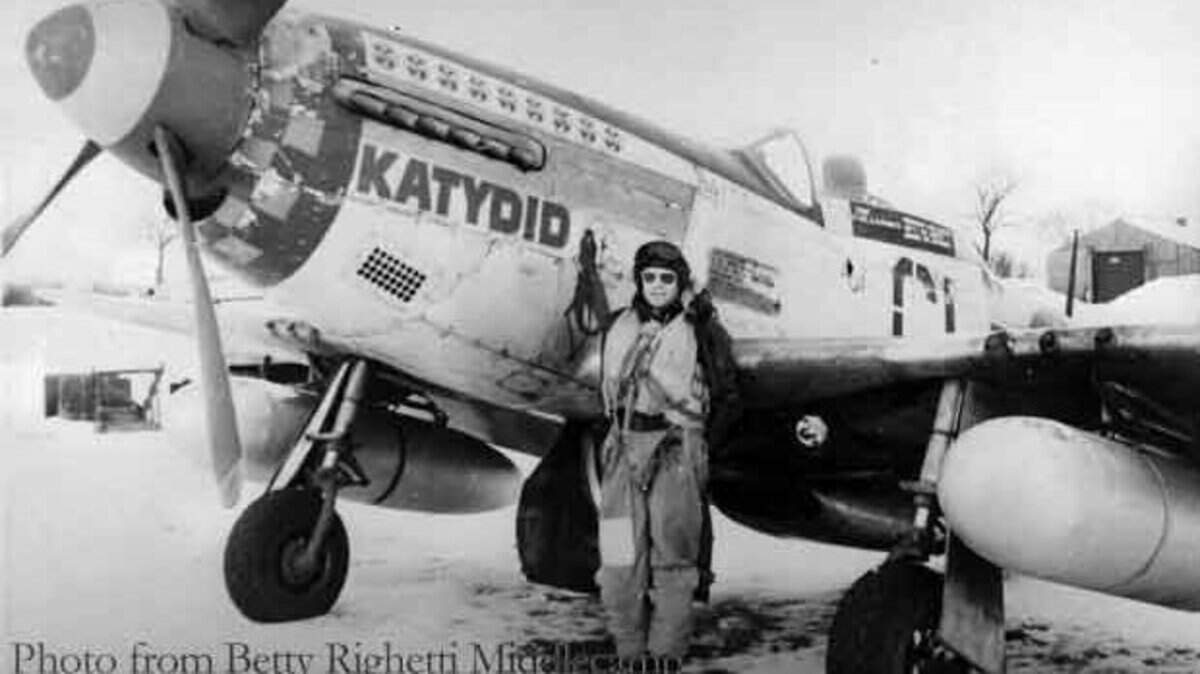
Downs was quoted in the book ‘The 55th Fighter Group vs the Luftwaffe.” Lt. Col. Elwin Righetti was not flying his personal plane, Katydid, named for his wife, Cathryn -- too many bullet holes in that P-51.
It had been damaged by ground fire during strafing of an enemy air base the day before, so today Righetti flew a replacement.
The Packard/Merlin engine roared as the P-51-D weaved down the runway. The high nose of the fighter prevented pilots from seeing straight ahead. A pilot had to kick the rudder back and forth at it taxied out to make sure the path was clear.
As Righetti taxied to the Wormingford runway, Downes knew he was in trouble and decided to ask for a three-day pass.
Righetti had a reputation for being tough but fair. Better to let him cool off for a few days before facing the inevitable.
As the P-51 climbed into the sky, the wheels retracted for the last time.
The day before Red Cross girl Jan Houston Monaghan had a conversation with Nelle Huse. The Red Cross was in charge of base entertainment, concerts, lectures, dances or coffee and doughnuts at a base that was often dreary, cold and muddy.
Monaghan said to Huse, “Tomorrow is Colonel [Elwyn] Righetti’s birthday. Let’s invite him for a really nice tea.”
“We have too much to do this week, Jan, we don’t have time for that tomorrow,” said Huse. “We’ll do something special for him next week.”
Monahan was quoted in the book “Air Command”, “I always wondered afterwards … if we had invited him, would he have come? And if he had come, he wouldn’t have flown that day. But he flew … on his birthday … and was shot down.”
Righetti’s nickname was “Eager El.”
The 30-year-old had joined the Army Air Corps before the war began.
His advanced age -- most fighter pilots were closer to 20 -- and his flying skill had Righetti assigned to a training base, Randolph Field in Texas, for most of the war.
Righetti requested a transfer to the fighting, and in fall 1944 he was in England. Righetti had quickly advanced from wingman, protecting a flight leader, to a leader in his own right.
If targets did not appear in the sky, the pilots would take the fight to the ground and shoot up enemy locomotives and air bases.
One of the biggest statistical threats to German generals in staff cars was strafing. The 55th had a reputation for loco-busting, and Righetti was a skilled strafer. He would finish his career with the leading mark in the 8th Air Force for aircraft destroyed on the ground.
Righetti was credited with 7.5 air kills and 27 aircraft destroyed on the ground. The price was high.
The P-51 was designed with coolant and oil systems on the belly of the aircraft; a single pistol shot could cause enough damage to bring down the fighter.
According to an after action report filed by wingman Carroll Henry, Righetti’s coolant line was hit while strafing an air base near Riesa.
Despite streaming coolant, Righetti turned back for another strafing run before turning onto a homeward heading.
Oil pressure fell, and the engine seized. It was not easy to land a nose-heavy fighter with no power.
The shoulder straps were not tight enough as his frozen propeller dug into the earth. His face smashed into the large K-14 gunsight at the front of the cockpit.
He radioed “I broke my nose, but I’m okay, I got nine today, tell my family I am OK, and it has been swell working with you.”
The war ended less than a month later.
It was hoped that Righetti would be among those released from prison camps, but hope faded as the months wore on. His body was never recovered.
The leader of the 55th fighter group completed 55 combat missions. When Downes returned from his 3-day pass, he was saddened to learn that Lt. Col. Elwyn Guido Righetti had not returned from his 56th.
This much is known:
The area where Righetti crashed was just north of Dresden, a city decimated by Allied firebombing two months earlier. The city had been filled with civilian refugees fleeing the Russian advance. Estimates range from 35,000 to 135,000 dead in the smoldering city.
Late in the war there was little sympathy among German civilians for Allied air crews, and civil authority had almost collapsed.
The best chance for survival was capture by regular military who adhered to the Geneva Conventions.
Many downed fliers were killed by civilians late in the war, including another pilot from the 55th Fighter Group shot down the same day.
Nazi Propaganda Minister Joseph Goebbels had called the Allied fliers terrorists in his radio broadcasts in an attempt to divert anger at the Luftwaffe’s inability to stop bombings.
Two weeks after Righetti was shot down, American troops first met the Soviet Army at the Elbe River, not far from Riesa. One account from an American soldier said there were so many civilian casualties at the bridge that it was hard to cross.
They may have been killed by Russian artillery or American and British air strikes. The territory was controlled by the Red Army, and only brief, tightly controlled searches were made before the Cold War cut off the investigation.
The Soviet Union lost over 20 million civilian and military lives -- Stalin had little empthy. Stalin’s eldest son Yakov Dzhugashvili died in a German concentration camp after being captured early in the war. Stalin refused to trade prisoners for his son.
Seventy years later, Elwyn Righetti is among the 73,000 American World War II veterans still missing in action, though even today new discoveries of remains and positive identifications are made.
Righetti was survived by wife Cathryn, 2-year-old daughter Kyle, mother Elizabeth, father Guido and brothers Ernest and Maurice and sisters Betty, Lorraine and Doris.
Lorraine, Doris and Kyle all live in the area.
This story was originally published May 21, 2015 at 8:12 PM with the headline "Remembering Elwyn Righetti on Memorial Day."