
The story of the menorah at Mission San Luis Obispo
This time of year the bronze eyes of the Father Serra statue look out over a menorah at the foot of the mission he founded.
The religious distance between the two symbols, a statue and candelabra, may be shorter than a casual observer would expect.
Serra was a devout Catholic of the Franciscan order and the founding father of the California mission system.
Serra personally founded the fifth mission in the chain, built on the bank of San Luis Obispo Creek, on Sept. 1, 1772, with a Mass celebrated under a cross.
He was born Miquel Joseph Serre on Nov. 24, 1713, on the island of Mallorca. Two children who died in infancy preceded Miquel.
The island had limited resources.
The boy’s path to education, a secure career, the New World and eventual fame would be through Franciscan schools that nurtured his deep faith.
As he committed his life to the Franciscan order, he assumed the name Junípero. According to the author of the book “Junípero Serra: California’s Founding Father,” by Steven W. Hackel, the choice was unusual.
Junípero was the name of a colorful companion of Saint Francis, an impulsive jester with a personality unlike the serious and driven Junípero Serra.
Hackel also wrote that Serra’s paternal great-great grandfather and grandmother had the respective surnames Abram and Salom.
Both names were Hebrew in origin, suggesting that they had been conversos, forcibly converted to the Catholic faith.
There was little free will in the matter. As recently as one generation before the birth of Serra, the Spanish Inquisition found 45 men and women guilty of practicing Crypto-Judaism.
In 1691 the convicted men and women were executed or fled.
More than 30,000 turned out to see the executions. Thirty-seven were strangled, then burned.
Three who refused to renounce their religious beliefs were burned alive.
In March 2000, Pope John Paul II apologized for the Church’s sponsorship of the Inquisition.
Local religious leaders were a decade ahead of the pope in taking visible steps to foster mutual respect and understanding.
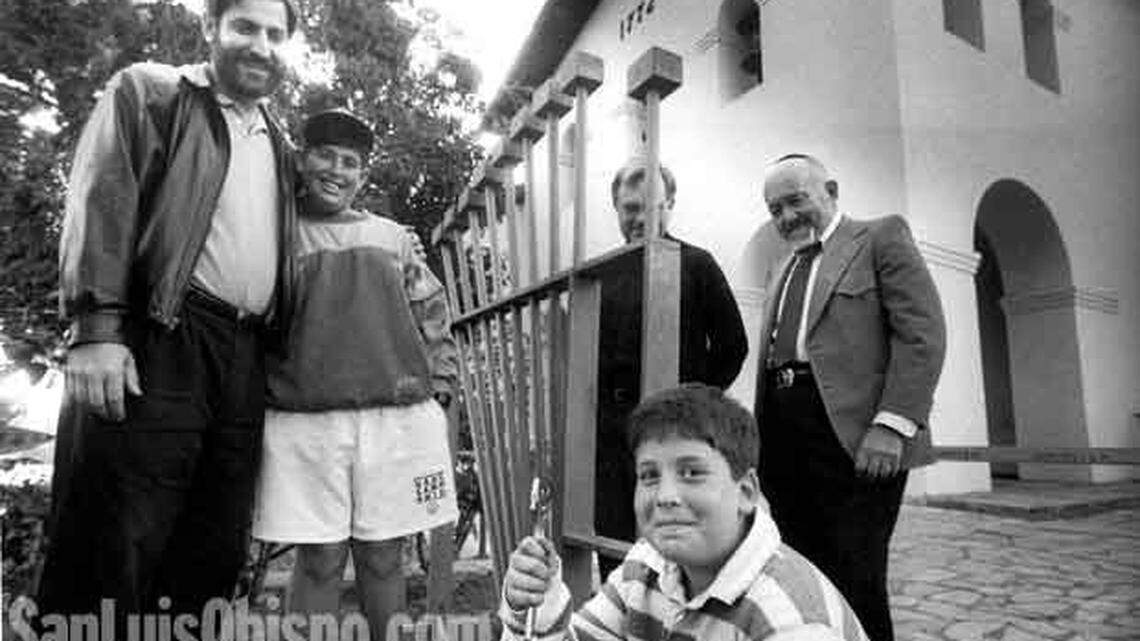
Rabbi Harry Manhoff of Congregation Beth David and Father Jim Nisbet of Old Mission Church made plans to celebrate Hanukkah at the center of town in December 1990.
The Mission has been the site of Catholic services most years since 1772.
As Dan Krieger noted in a “Times Past” column Dec. 19, 1992, two years earlier a 5-foot tall menorah was placed at the foot of the Mission, designed by Father Nisbet and built by Moises Lewis, chief of maintenance at Old Mission.
Nisbet, in addition to his religious duties, is an artist who studied traditional Jewish forms to design the candelabra.
Manhoff kept the tradition of the Mission Plaza menorah lighting going in the early years. Hanukkah celebrates religious freedom and the miracle of a lamp that only had oil for one day — but burned for eight.
The lamp was lit in the wake of a revolt won by the Maccabees over the Greeks allowing Jews to celebrate traditionally.
The statue of Father Serra commemorates a man whose ancestors may have been threatened with death and accused of “observing the Law of Moses.”
The bronze eyes look out over a Hanukkah candelabra built by a Catholic man named Moises.
Like Serra of Mallorca, Moises Lewis was also native to an island with limited resources, the Portuguese Azores.
The celebration in Mission Plaza has grown from the handful of faithful who attended in the early 1990s to more than 100, including Father Nisbet, who came to see the first candle lit Tuesday, Dec. 16, 2014.
Hanukkah in Mission Plaza is an enduring legacy. Rabbi Manhoff and Father Nisbet saw beyond divisions and brought communities with different traditions together, creating another tradition now 24 years old.
It is a beacon of interfaith comity in a world that sadly too often in history ignored the words of Luke 2:14 — “Peace on earth, good will toward men.”
This story was originally published December 19, 2014 at 11:44 AM with the headline "The story of the menorah at Mission San Luis Obispo."