
Loss of cropland among worries at forum on Cal Poly development
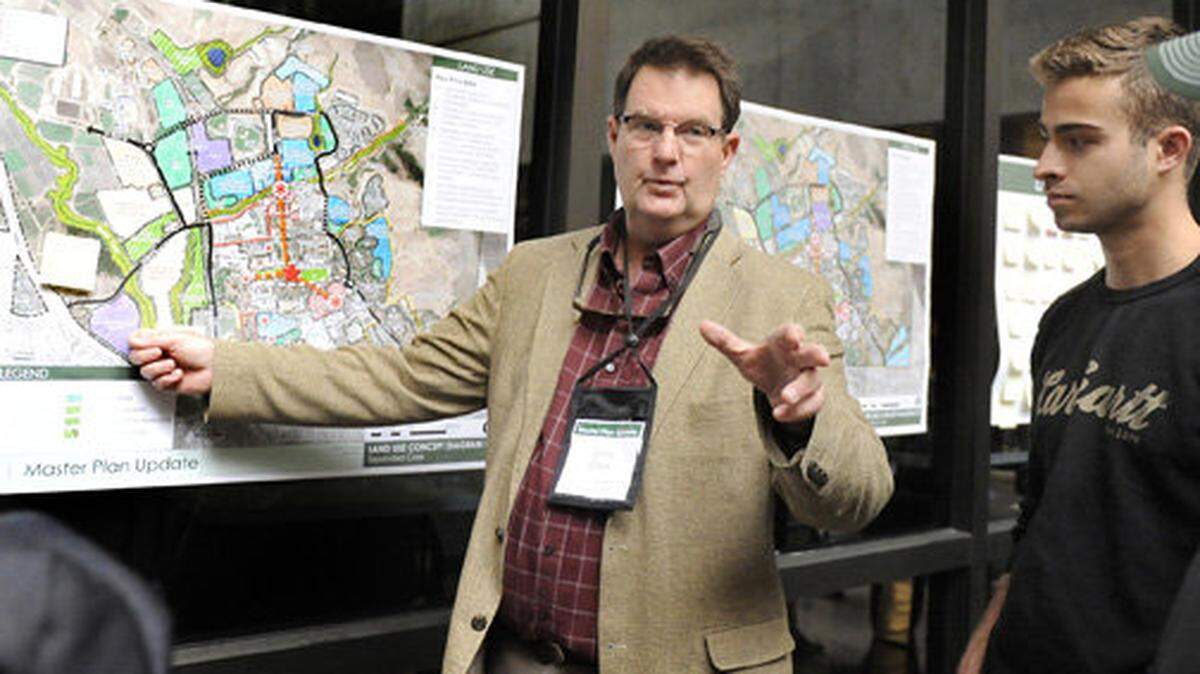
A group of Cal Poly agriculture students voiced complaints about the possibility of losing prime cropland on campus during an open house Thursday on the university’s conceptual Master Plan Update.
About 200 people attended the forum at the Kennedy Library, including students, faculty, staff, members of the public and local city government officials, such as San Luis Obispo Vice Mayor John Ashbaugh and Morro Bay Mayor Jamie Irons.
People had the opportunity to view the conceptual maps and renderings of possible land uses and developments that the university is considering over the next 20 years, as well as to talk with Cal Poly officials about them.
Among other concerns raised were the following:
- impacts on traffic and education from increased enrollment;
Several crop science students voiced their displeasure in conversations with Cal Poly staff and on sticky notes they attached to the poster boards.
The university is considering replacing fields on the western side of campus toward Highway 1 — where peaches, apples, kiwis, plums, grapes and other crops are grown — which the students said would hurt the program.
The crops help make Cal Poly one of the top agriculture schools in the nation because of its hands-on, learn-by-doing approach, they said.
“This plan shows they could be taking out nearly all of our orchards,” said Max Poswillo, an agriculture and environmental plant science student. “So much of what we learn about insects and plants and soil comes from being out in the fields. If you take that away to build a hotel or more housing, that’s going to seriously hurt the program.”
Classmate Joel Leonard said the quality of the soil in the location of where the crops exist now makes it the best place on campus to grow.
“This is prime ag land with Class 1 soil,” Leonard said. “Having to spend 30 minutes to get to your project, pushed out to some far end of campus, won’t work. The program won’t be cream of the crop anymore.”
Sticky notes on that issue included comments such as “Orchards take years to establish. Moving the orchards will require years of preparation and management before students will be able to learn on new orchards” and “If ag land ends up being moved/taken away I will not support Cal Poly as an alumni. ... It was the deciding factor of why I chose to come here.”
Linda Dalton, Cal Poly’s interim university planning officer, said the conceptual plans leave options for keeping the ag land in place as well as for potential development, which includes residential housing and a hotel.
“Nothing is a done deal at this point,” Dalton said. “Right now we’re weighing which areas have the most importance and highest value for use, and we’re taking input.”
Dalton said Cal Poly will conduct geological studies and environmental analysis to help decide where to build.
The university also will weigh the priority of whether certain housing needs to be close to the campus, or if it’s feasible to build farther away.
In response to Cal Poly’s emphasis on building more student housing on campus, Atascadero resident Eric Greening said he believes the diversity in the surrounding neighborhoods would suffer — hurting students and the community.
“There’s value in having students mix in with the community,” Greening said. “Many students are not partiers, and they are vital members of our cultural life. I question the whole premise of putting all the students on campus in a 24-hour-per-day monoculture.”
Cal Poly President Jeffrey Armstrong has said the university plans to move forward with building a hotel and conference center on campus, identifying multiple locations for its potential location.
Possibilities include the south side of campus near the University Union and the Performing Arts Center; the north end of campus near Brizzolara Creek; and a southwestern pocket of campus near Highway 1.
Ashbaugh said he’d like to see a scaled-down hotel built at Cal Poly. And he supports the construction of a conference center off campus, within the city limits, that Cal Poly could partner in.
“I’d like to see Cal Poly limit the size of the hotel to 40 rooms instead of a full-fledged hotel with more than 100 rooms and a conference center,” Ashbaugh said. “I believe the campus needs for a hotel are much more limited. And I think it makes sense to build the conference center in the city. We can find a way to make that happen.”
Cal Poly agriculture student Sandra Gonzalez said she didn’t believe a hotel was necessary and supported diverting money that would go toward its construction to educational programming and teacher pay.
“I don’t see how you can justify building a hotel when you have a library that fills every seat during finals and students who can’t get the classes they need because there aren’t enough teachers to teach them,” Gonzalez said.
This story was originally published May 7, 2015 at 7:14 PM with the headline "Loss of cropland among worries at forum on Cal Poly development."