
LGBT teens in SLO County face greater risks of bullying and depression
As the halls at San Luis Obispo High School cleared after lunch last Thursday, two students walked across the school grounds to show off a somewhat new addition to campus: two gender-neutral restrooms.
Last year, one was designated for girls and one for boys. But a request in the spring prompted school administrators to remove the markers and replace them with neutral signs.
“You never know when a trans student will be attending and you want them to know that they can go to the bathroom and not have to deal with a girl going into a boys' bathroom,” said senior Kelsi Bonzi, one of four co-presidents of the high school’s Gay-Straight Alliance club.
GSA club members meet weekly to talk about issues affecting the lesbian, gay, bisexual, transgender (LGBT) community. Similar clubs exist at many of the high schools in San Luis Obispo County as well as across the nation.
Students say the clubs provide a safe space for LGBT youth and questioning teens to find support. Even as some teens described their high schools as fairly accepting or tolerant of LGBT people, others shared experiences of teasing, bullying or harassment.
The differing experiences among students who identify as lesbian, gay, bisexual or transgender illustrate some of the findings of a recently released study. The study’s findings, however, reveal a darker experience for some students.
For the first time, information on students who identify as LGBT is available as part of a biennial California Healthy Kids Survey given last year to some middle and high school students in San Luis Obispo County.
Survey expands scope
The Healthy Kids survey has been given in California since the late 1990s, but in 2014, state officials decided to include a question on sexual identification. Elizabeth Meyer, a Cal Poly assistant professor and co-chairwoman and founding member of the Central Coast Coalition for Inclusive Schools, disaggregated the data from the survey to see how LGBT students responded.
In San Luis Obispo County, 6,669 seventh-, ninth- and 11th-grade students took the survey. Of those students, 6,623 answered the self-identification question — and of those, 350 identified as LGB, and 140 identified as transgender.
Among the findings:
View the fact sheet with LGBT student responses here.
The statistics reveal an underlying issue for educators: If students don’t feel safe on campus, they are more likely to skip school or engage in risky behaviors.
“That’s why we’re trying to shine light on this data,” Meyer said. “We are talking about lives. If they can’t feel safe, then how are they supposed to learn?”

Bullying exists
San Luis Obispo High School senior Izzy Kramer said some of the survey responses cut to the root of what students might be feeling — even if they don’t show it.
“It’s more than just external bullying,” she said. “It’s more how you feel.”
She and other students said it’s not uncommon to hear classmates make comments that are derogatory toward LGBT people — and even if the remarks aren't directed at them, the words still sting.
Arroyo Grande High School senior Tati Orr said she has heard students say words like “faggot.”
“It still hurts,” she said. “Replace what you’re saying with the ‘n’ word and see how that sounds.”
Orr said she was bullied in middle school, before she came out as a lesbian. Once, someone broke into her P.E. locker and wrote “whore” and “lesbian” on her clothes.
Orr is now involved in the high school’s GSA club. She said she wants to hold a “myth-busting” day, where students can ask questions about LGBT topics and get informed answers to common misconceptions.
“I want to make it (the club) a safe place, and maybe more people will come out,” she said. “It’s easier than living in that closet because closets are dark.”
Atascadero High School sophomore Audrey Roben, a member of the GSA club, said she experienced sexual harassment last year from two male classmates who frequently made lewd comments. Roben said she reported the harassment after one of them tried to touch her.
Her experience this year has been more positive. However, she sympathized with LGBT students who missed school because of emotional turmoil.
“It feels like a lot of people that I do know who identify as part of the spectrum feel more depressed, hopeless and anxious because they haven’t really found enough acceptance within their peers and their families,” Roben said. “I definitely see that trend among my peers.”
Chanel Viiperi, a transgender woman who attends Cuesta College, said she thought the LGBT survey data represented what she saw and experienced while attending Coast Union High School in Cambria. Viiperi later transferred to Leffingwell Continuation High School and graduated in 2012.
Viiperi said LGBT students skip class more regularly than heterosexual students because they’re afraid of being bullied. Viiperi, 19, knew for years that she felt different from other students but kept quiet at Coast Union so as not to draw attention.
“At school I would see other people be teased,” Viiperi said. “It was a living hell for them basically.”
Viiperi came out as gay at Leffingwell, but that still didn’t feel right. Viiperi later found the term “transgender” online, and started attending local support groups. Viiperi started identifying as transgender at the Gay and Lesbian Alliance’s Q Youth Group.
“Just being able to identify and say that this is who I am and being part of a group that was so accepting and loving made me feel like I was making the right decision and that I wasn’t alone anymore,” Viiperi said. “I didn’t feel like a freak, and going to those groups helped bring up my confidence.”
Administrators react
Meyer, who has authored two books on gender bullying and harassment, said she wasn't surprised by the results, though she noticed that a larger number of youth are starting to identify as transgender.
The responses shocked some local school administrators, however.
“My initial reaction to these results is that they are unacceptable,” Rick Robinett, assistant superintendent of personnel, innovation and education services for San Luis Coastal Unified School District, wrote in an email.
“In our county’s schools, no student should feel unsafe, be subject to bullying or harassment, etc.,” Robinett wrote. “But to have students in the LGBT community self-reporting such a higher percentage of these incidents and feelings, speaks to our need for more proactive approaches to supporting all students.”
He said he believes that the district and its board have been very responsive on issues of bullying and discrimination affecting all students, including LGBT youth.
Several other administrators said they didn't feel the data reflected their students’ experiences.
At Atascadero High School, Principal E. J. Rossi said the data didn’t seem to mesh with what he sees on campus. Students are very welcoming, he said, and it’s not uncommon to see same-sex couples holding hands, kissing or attending school dances.
“I don’t get a huge sense that students feel afraid here because of their sexuality but there is smirking at language,” added Meghan Beck, the school’s at-risk counselor and one of the GSA club advisers. “The word ‘queer’ still makes students feel uncomfortable.”
Arroyo Grande High School Principal Conan Bowers said he crunched the numbers for that school and determined, for example, that 8 percent of all students surveyed there said they were harassed or bullied because of their gender or sexual orientation.
“It was hard to digest these numbers,” he said of the survey data.
He added that he’ll step in when he hears a student make an inappropriate remark and explain why the comment is offensive.
“We have to treat it like it’s a physical slap in the face because it is to someone,” he said. “Ignoring it is accepting it.”
San Luis Obispo High School Principal Leslie O’Connor said he believes San Luis Obispo High is a very open, accepting school.
“I would say one of the things that has struck me about our student population is their awareness and welcoming demeanor or culture,” he said. “They’re very accepting.”
National trend
While local administrators question whether the results reflect their schools, Meyer said the San Luis Obispo County data aligns with national surveys showing the difficulties that LGBT youth experience.
“We think we are so kind and laid back that we don’t mirror those trends,” she said. Meyer and others who work closely with the LGBT community say that integrating lessons and awareness of LGBT topics into schools needs to start much sooner — as early as elementary school.
A law passed in 2011, the FAIR Education Act, amended the state education code to include LGBT people in school curriculum. But the state currently lacks curriculum materials to meet the law’s requirements, Meyer noted.
Curt Dubost, superintendent at San Miguel Joint Union, said his K-8 district has incorporated curriculum at appropriate grade levels.
“We also in current events have teacher-led discussions related to same-sex marriage, gay marriage and other civil rights issues with an emphasis on the prevention of discrimination,” he wrote in an email.
Meyer said other changes could be subtle — an elementary school teacher could address a class as “scholars” instead of “boys and girls,” to avoid isolating students who don’t feel they fit into those two categories.
Beck said she’s become more aware of her everyday language. Instead of asking students what their mom or dad thinks about their grades, for example, she’ll ask what their family or parents think.
That way, students with same-sex parents don’t feel like the exception at school. “It’s just the little things that we have to start changing,” Beck said.
Denise Taylor, a local physician who serves on the board of Tranz Central Coast, said school may be one of the only places that some LGBT students feel accepted, if they’re not getting support at home.
“We think it’s even more important to make sure that the schools are not only accepting but really embracing,” she said.
Steps taken
Steps have been taken at some schools to be more inclusive to LGBT students, including the gender-neutral restrooms at SLO High.
“The point is to allow that student to have physical and emotional space when they need it,” O’Connor said.
In the Lucia Mar Unified School District in the South County, an additional dressing room was created in all middle and high school locker rooms to give all students, including transgender teens, more privacy.
At Atascadero High School, Roben worked on a project to add more LGBT-themed literature to the school library.
“Our first priority is awareness and making sure that everyone in our school knows that it’s OK to identify as part of the LGBT spectrum,” Roben said.
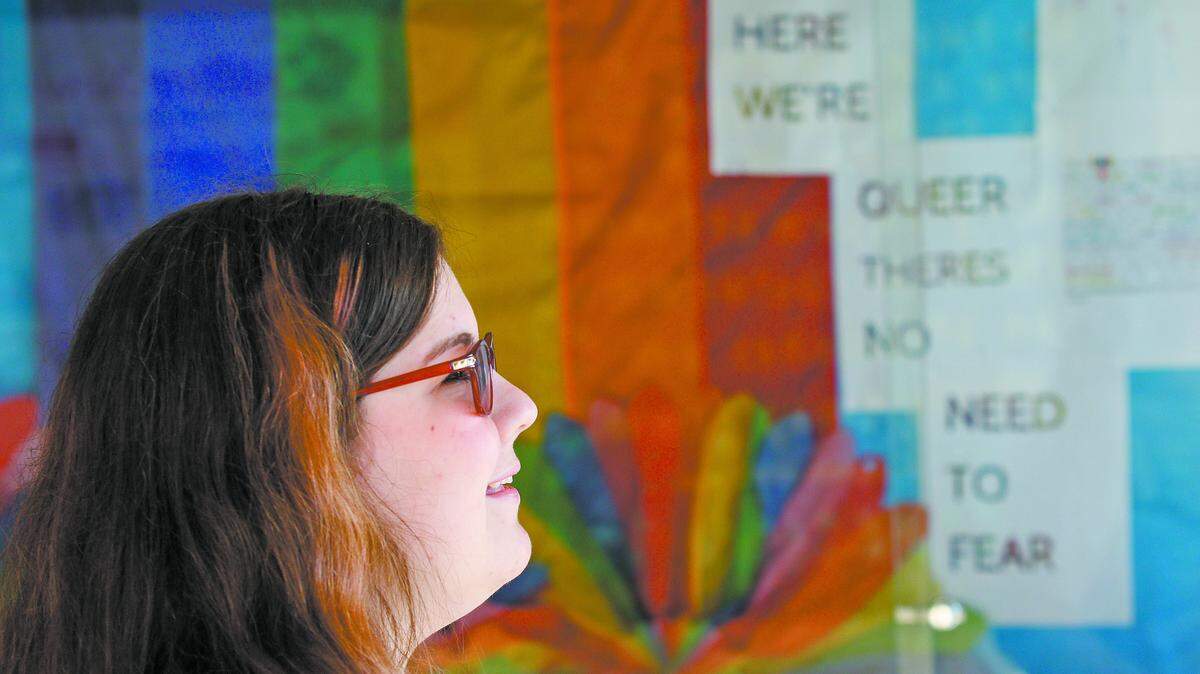
In addition, fellow GSA club member and sophomore Amanda Calmere created a display at the library with a definition of the word “queer” — a term that has been used as a slur but that some LGBT youth are rebranding to be inclusive of anyone who doesn’t want to label themselves — and a quote from Leelah Alcorn, a transgender Ohio girl who was killed by a truck in an apparent suicide in December.
“Think of queer as an umbrella term,” a printout created by Calmere in the display states. “It includes anyone who a) wants to identify as queer and b) who feels somehow outside of the societal norms."
The goal is to educate people and promote the LGBT community, said Calmere, who identifies as bisexual and gender fluid.
“We’re just normal people,” she said. “We’re not any weirder than you are.”
TWO STATE LAWS TARGET HARASSMENT ON CAMPUS
In 2011, the California Legislature passed two laws aimed at creating safe and inclusive environments for students.
The FAIR Education Act: Requires history and social science curriculum to include the roles and contributions of lesbian, gay, bisexual and transgender people; people with disabilities; and European Americans. (The education code already included men and women as well as numerous ethnic groups such as Native Americans, African-Americans, Mexican-Americans, Asian-Americans and Pacific Islanders.)
Seth’s Law: Named for a 13-year-old California student who committed suicide in 2010 after being bullied at school. The law requires school districts to update policies protecting students from unlawful discrimination and harassment to include protections from bullying based on sexual orientation, gender identity or expression.
Seth’s law requires districts to adopt policies with a specific process for reporting and investigating bullying, harassment and discrimination; school personnel to intervene if they witness bullying; public posting of the policy and complaint process; that materials be provided to support victims.
This story was originally published February 14, 2015 at 8:29 PM with the headline "LGBT teens in SLO County face greater risks of bullying and depression."