
Kindergarten immunization rate rises in SLO County as new law kicks in
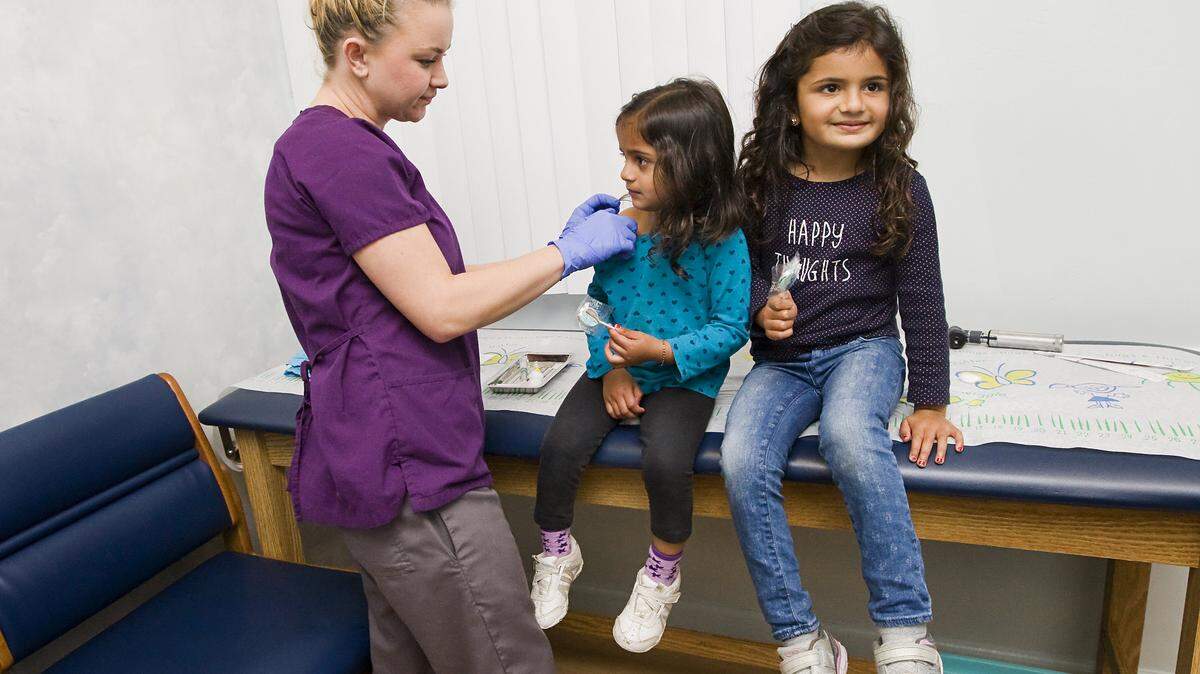
Sisters Ariya and Anaya Patel perched on the edge of an examination table and happily accepted lollipops from Kim Copeland, a medical assistant at Bravo Pediatrics in San Luis Obispo.
“You can open them when you’re done,” their mother, Jalpa Patel, said as Copeland prepared a flu shot for each girl.
Big sister Ariya, 4, went first and then put her arm around sister Anaya, 2, as she received the shot.
“Ow,” Anaya said.
“Good job,” Copeland replied. “You guys are tough.”
Jalpa Patel, who lives in Morro Bay with her daughters and husband, Hemant, said having the girls receive all recommended vaccines seems like the best way to keep them healthy and ensure they are up to date by the time they enter kindergarten.
“I’ve always gotten vaccinated,” she said. “Unless I have an issue, I always assume it’s going to be fine.”
Many other parents in San Luis Obispo County share similar views, as indicated by newly released data showing increased immunization rates for kindergarten students for the first time in three years.
Of 2,928 kindergartners attending public or private schools throughout the county, only the parents of 155 students, or 5.3 percent, had filed a “personal-belief exemption” for the 2014-15 school year, according to data from the California Department of Public Health.
In the 2013-14 school year, 230 students had personal belief exemptions on file, or 8.26 percent — the highest percentage the county had seen in more than a decade.
New law
This year’s drop in immunization exemptions coincides with a new state law that took effect in January.
California has long required proof of immunizations before children can start kindergarten, unless parents sign an exemption.
The new law requires parents filing a personal-belief exemption to have a doctor or other authorized medical provider sign a form stating the parent has been informed of the benefits and risks of immunization, and the health risks of specific communicable diseases.
“The point of the law is to make sure that families and parents are appropriately informed with substantiated facts before they make the decision to forgo vaccination for their children,” San Luis Obispo County Public Health Officer Penny Borenstein said.
Borenstein said she thought the number of exemptions had been increasing until this year for a few reasons. “Vaccine-preventable diseases have been becoming more rare, and younger families are not familiar with how devastating those diseases can be,” she said.
“Plus at the same time, they are bombarded by messages with non-medical people telling them they (vaccines) are not healthy, they are unnatural and they are not good for children,” she added. “And people are listening to those inaccurate messages.”
Opponents of the law argued that it would make it harder for parents to receive an exemption for their child, increase animosity and distrust in the medical system, and add more government intrusion into parents’ personal freedom to make health care decisions for their children.
“Patients will be forced to find another doctor to sign the form, submit to vaccines, or get kicked out of public school,” Dr. Bob Sears, a Dana Point pediatrician and author of “The Vaccine Book,” which suggests a delayed or alternative vaccination schedule, wrote in an opinion piece published on The Huffington Post in 2012.
What’s at play
It’s not clear whether the new form is responsible for rising vaccination rates, or just one of many factors.
“I would wait two to three years to see if it made a difference,” said Dr. Rene Bravo, a San Luis Obispo pediatrician. “I think you’re seeing more attentiveness to vaccinations because of outbreaks with whooping cough, meningitis, Ebola. The public is more aware and feels more susceptible to infectious diseases.”
Statewide, about 13,260 parents filed personal-belief waivers for their kindergarteners this school year, a drop of 20 percent from 2013-14, according to an analysis by The Sacramento Bee.
That translates to about 2.5 percent of kindergartners opting out of vaccines, down from 3.1 percent the prior year, the Bee reported — the first drop in at least a decade.
From the 2007-08 school year to 2013-14, the number of personal-belief exemptions in the state more than doubled, the Bee found.
The trend was largely attributed to fears among parents that vaccines could cause autism — a theory that has been discounted by numerous research studies. The U.S. Centers for Disease Control and Prevention has concluded that the benefits of immunizations outweigh other risks, which can include allergic reaction.
In San Luis Obispo County, the number of personal-belief waivers varied from about 3 percent to 5 percent from the 2002-03 to 2011-12 school years. It increased in 2012-13 to 5.68 percent before hitting a high last year.
The Lucia Mar school district in southern San Luis Obispo County, the county’s largest with 10,566 students, saw a significant drop this year in personal-belief waivers filed for kindergarten students, said credentialed school nurse Marilyn Cafarchia.
Last year, the district received 71 waivers for 805 students. This year, it has 54 waivers for 809 students.
“So I thought that was a huge difference,” Cafarchia said. “Just for that reason, I would think it (the new law) is having an impact.”
She said she met with about seven parents seeking personal-belief exemptions for their children, including students entering kindergarten and seventh grade (when a student must show proof of receiving a booster shot for tetanus, diphtheria and pertussis).
“We try to present the information to them, and I think it’s much more than we used to do, which is just sign the waiver,” she said. “It gives them an opportunity to reassess what they’re doing.”
Still, Cafarchia said, “I’ve only had two (parents) that have said, you know what, I’m really going to rethink that.”
How schools compare
While the countywide rate of immunizations among kindergartners has increased, the rates vary widely by school.
The private San Luis Obispo Classical Academy, which combines classroom learning with some homeschooling, had the highest percentage of personal-belief exemptions in the county this school year, with 60 percent of its 25 kindergartners filing a waiver. The school’s director was unavailable to comment.
In the Lucia Mar district, the number of kindergartners with exemptions rose this year at Shell Beach Elementary over last year, with 16 percent of students filing a waiver.
In past years, Grover Heights Elementary had the highest percentage of kindergarten students with an exemption from the 2008-09 to the 2013-14 school years.
Cynthia Ravalin, the district’s director of student services, said it’s difficult to know why a school might have a higher number of exemptions, but theorized that there may be a correlation between a school’s socioeconomic status and its immunization rate.
“It’s expected in some places that you go to the doctor and get your shots, plus there is evidence that it is safe and can keep your kid from dying if they get certain diseases,” Ravalin said. “If someone feels on an equal level to a physician or is a physician’s spouse, they may have a different viewpoint.”
Atascadero parent Kerrin Edmonds, who has three children under 4 years old, said she researched the pros and cons of immunizing and chose a pediatrician whom she trusted and with whom she could share her concerns.
Edmonds said she considered spacing out the immunizations and discussed that with her pediatrician, but ultimately decided to have the shots on the regular schedule.
“He was clear in explaining to me that if that makes you feel more comfortable then we can do that,” she said. “But is that going to be any benefit to your child? No, it won’t be.”
Edmonds’ decision was also influenced by her grandmother, who had polio when she was growing up.
“She did not have any long-lasting effects from it, but she had friends who didn’t make it or were disabled,” Edmonds said. “Hearing that from a generation that didn’t have that luxury (to vaccinate), that helped cement my decision to do that.”
This story was originally published December 13, 2014 at 12:22 PM with the headline "Kindergarten immunization rate rises in SLO County as new law kicks in."