
Cataloging Cambria's historic homes a labor of love
The Roman god Janus is depicted with two faces, one looking forward, and the other looking backward, so the first month of the year is named appropriately. It is also apt for our Cambria Historical Society, with a mission of preparing for the future of Cambria while preserving the heritage of its past.
This was brought home to me during the year as I have been doing extensive research with our native rancher/historian Dawn Dunlap, museum consultant Carolyn Shepherd, and local researcher Melody Coe. As we refined details about significant historic structures, I made a listing separate from their geographical locations, putting them in date order. A pattern emerged, it became obvious that the style of architecture was visible.
The eastern edge of town is marked by the remodeled 1880 Kaetzel/Williams House (Fog’s End); and the western edge of the village until the mid-1920s is identified by the present-day Bluebird Inn, built as a residence in 1880 by Cambria pioneer George Lull. In 1865, he built the beautiful two-story home/business with his partner, George Grant, now known as the Music House.
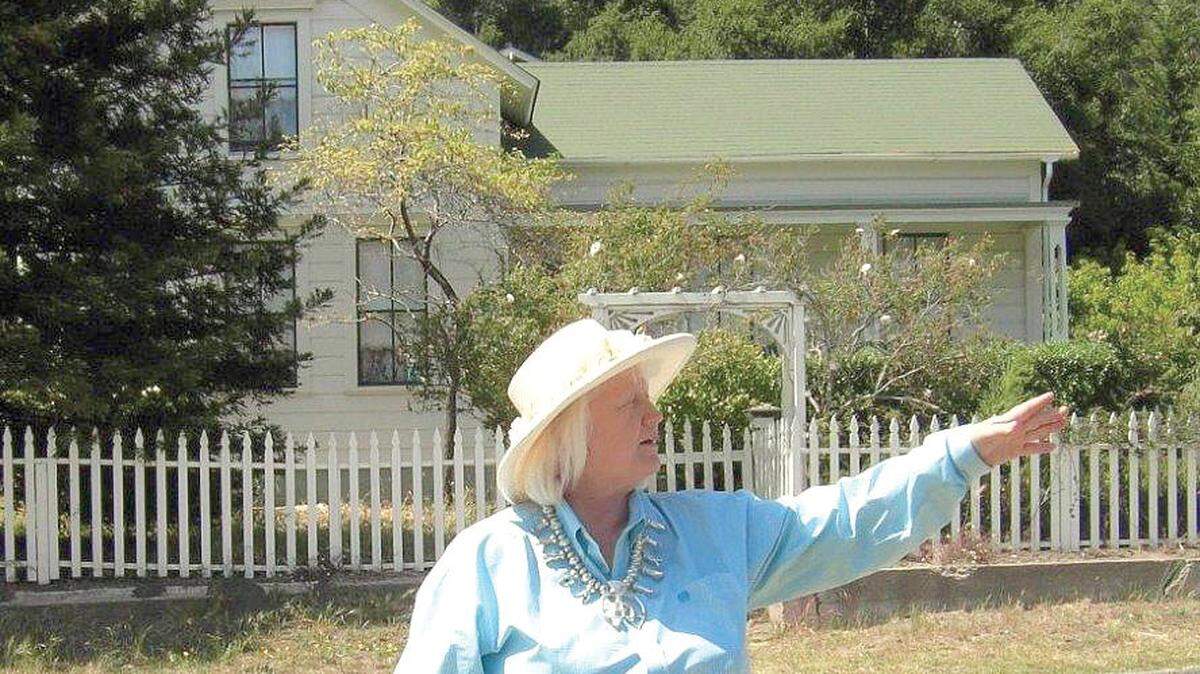
It is Cambria’s oldest house continuously lived in, conspicuous with its picket fence and roses. About 1880, George W. Proctor and George S. Davis, early-day speculators and developers of downtown Cambria, built two other identifiable structures, now Serendipity Herbs on Burton Drive, and Porte House on West Street.
Welsh immigrant Henry Williams provided us with the Santa Rosa Chapel on the hill in 1870, the Presbyterian Church on Bridge Street (now Bridge Street Inn), as well as the Williams/Thorndyke Bright Home next door (now The Tea Cozy.) His was the original house built on the site of the Greenspace Preserve.
The original one-room Guthrie Bianchini House that became the Historical Museum was also built in 1870, with other small houses (now gone) between it and the blue Maggetti House, constructed in 1875 on Center (or Centre) Street.
The lovely Darke/Van Gorden/Squibb House was built in 1877 on Lee Street (renamed Burton Drive in 1983), with its Victorian “twin” built on the corner of Lee and Center, before that was demolished for the stucco 1935 Souza House, now Robin’s Restaurant.
Architects unknown but clearly identifiable constructed the Bucket of Blood on Bridge Street in 1889, and in 1890, Mr. Carroll’s Blacksmith Shop (Burton Forge) on the street for which it is now named.
Relatively recent stuccos are the 1931 Mayfield/ Lyons House (Wise Owl) and the 1939 Bonomi Home (Wine: Taste) which Hearst Castle Superintendent George Loorz was built exactly like the Mayfield House. Roland Houtz replaced the wooden structure for J.M. Soto on Main Street with his fine new stucco store there in 1939.
On Bridge Street across from the Tea Cozy is the yellow family owned Lyons House, built in 1922. It was built on the site of a wooden house where Cambria’s first resident, Jeremiah (Jerry) Johnson, lived with his wife, Elizabeth, after 1863.
For more fascinating details on our historical walking tour, check out our website . Come and visit the museum on Friday-Sunday 1:00-4:00 p.m. and Monday morning 10:00-1:00 p.m.; stroll the Heirloom Gardens any time – no charge for admission, but donations support our operation. Information 927- 2891.
This story was originally published December 30, 2014 at 12:00 PM with the headline "Cataloging Cambria's historic homes a labor of love."