
Cambria's new flower-capped can accepts trash and recyclables
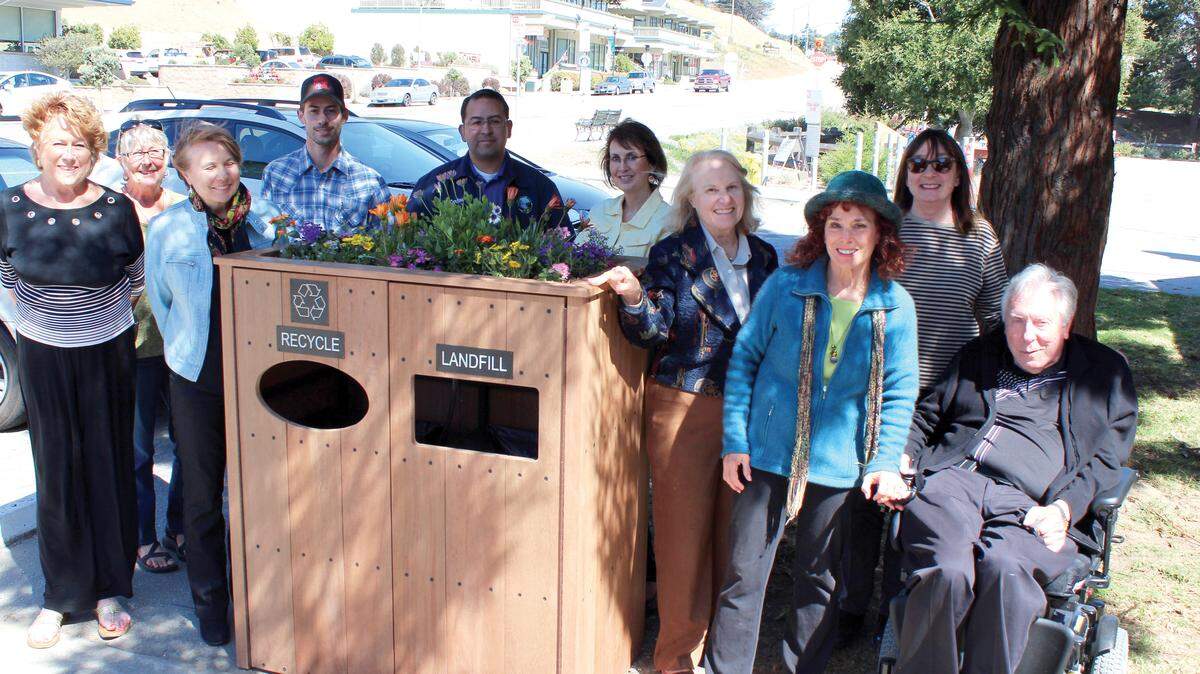
It was an unusual scene, with more than a dozen people celebrating May 27 around a new, flower-topped garbage-and-recycling can in front of Cambria’s Veterans Memorial Building.
There was good reason for the high spirits among members of the Beautify Cambria Association: Downtown trash cans are about to get a much-needed makeover.
After intense planning, design and construction, the association unveiled its prototype, paid for by the Cambria Community Services District. The prototype will remain in place for at least two weeks, so people can check it out.
Once businesses and community members approve the design, and Beautify Cambria finds sponsors to maintain individual planters and receptacles, construction will begin on 22 more, to be paid for by a $60,000 grant obtained from the county Integrated Waste Management Authority by Carlos Mendoza, CCSD’s resources and facilities supervisor.
“We got the grant because recycling is integral to the design,” he said.
Mendoza, the district and Beautify Cambria’s co-founders Claudia Harmon Worthen and Vari MacNeil had worked on the new can designs and funding for about a year. MacNeil said that among those who contributed to the design, construction and planting are students at Leffingwell High School, Michael Evans, architect Brent Berry, Jeremy Calvin of Lafferty Heating, Cristy Christie of Black Diamond Vermicompost and “local woodworkers who wish to remain anonymous.”
“The frame is powder coated, the panels are tongue-in-groove, the joints are precisely mitered, the latches are hidden, piano hinges are unobtrusive, even the corners are rounded,” MacNeil said. “These are works of art!”
Are other Cambrians impressed? CCSD Director Mike Thompson called the new container “flat-out beautiful.”
Historical cleanups
But concerned Cambrians have been seeking a solution for much longer, trying for years to replace dingy, aging, cracked public trash cans downtown and spruce up the business district.
The most recent push began about six years ago, when Native Daughters of the Golden West “got fed up with having a grubby looking downtown,” recalled Cambria historian (and Native Daughter) Dawn Dunlap.
“So we started crabbing about needing new trash cans and cigarette-disposal tubes.”
The women also put their elbow grease into the battle, cleaning street gutters, sweeping sidewalks, trimming bushes and generally sprucing up the historic East Village end of town. And they took their concerns to the services district and North Coast Advisory Council.
The daughters were following in the footsteps of “Cambria Pride” from decades ago (which is what they dubbed their quarterly chores).
Dunlap recalled that in the late 1930s, next-door neighbors Jack Soto of Soto’s Market and William Lyon of Lyon’s General Store had an ongoing competition to see who could get up earlier to sweep the sidewalk and street in front of his own shop.
“Jack got so disgusted that he slept in the store one night, to make sure he got there first,” Dunlap said with a laugh.
Community pride has surfaced occasionally since then. Among some of the cleanup campaigns:
- In the 1990s, members of the Cambria Historical Society sponsored an annual “Squibbing Day,” a townwide cleanup named after Paul and Louise Squibb (who preserved and lived in what is now Squibb House bed and breakfast), senior citizens who would collect trash on their daily walks and dispose of it.
- Soon thereafter, CCSD used a grant to buy the heavy, composite trash receptacles and place them downtown. But there was little money available to keep them clean, and some business owners were too busy or not concerned enough to maintain the areas outside their shops.
- In September 2009, the district hired a mobile sanitary cleaning service to do the dirty work, but environmental rules made the job much more challenging and expensive. Apparently, an agency can’t just rinse off trash receptacles, county officials told The Cambrian then, because clean-water standards restrict what can go down the storm drains into the ocean.
- A few months later, when the cans and surrounding areas had gotten gunked up again, Janet Huff and Diane Krom tackled the East Village receptacles again.
- Then, about six years ago, the Native Daughters took on the task, scrubbing and weeding, scouring and sweeping. But they’re busy, too, and getting older. They can’t do it regularly, which is what it takes to keep downtown looking clean and welcoming.
Last year, NCAC’s Heidi Santos and services district Director Jim Bahringer spearheaded a trial program in which business sponsors would put ads on “their” trash cans, which they would maintain. Sponsors were lined up, but unfortunately, the prototype receptacle was less than stellar. Proponents and sponsors quickly “discovered it was a piece of junk,” Santos recalled. “The cover didn’t work properly and the can fell apart. It was a real disappointment.”
Then Beautify Cambria stepped in, banding together with Mendoza and others on the team.
Now, many people are enthusiastically lauding Beautify Cambria for their diligent efforts, including a very pleased Dunlap, who’s seeing her dream come true, a dream of Cambria presenting a cleaner, more welcoming downtown face.
Beautify Cambria members are “the ones that got wheels on the wagon,” Dunlap said. “I salute them.”
More to do
What’s next? Safe cigarette disposal, another cause shared by Native Daughters and the Beautify Cambria team.
“Beautifying Cambria is an ongoing project,” Harmon Worthen said.
In this fourth year of drought, Dunlap said, having cigarette tubes for safe disposal of cigarette butts is “crucial. People can be careless with cigarettes, especially if there’s no obvious place to put them.
“Carelessness caused three terrible fires in downtown Cambria,” she said. “In 1889, the Great Fire destroyed most of downtown. In 1937, a cowboy smoking in bed caused a blaze that burned down a three-story hotel and killed two people. And in 1951, an untended electric hot plate left on in a meeting hall started a fire that destroyed the Rigdon Building.
“We don’t want anything like that to happen again,” Dunlap said. “We have to do something to make Cambria safer … and tidier.”
This story was originally published June 3, 2015 at 12:40 PM with the headline "Cambria's new flower-capped can accepts trash and recyclables."