
Cambria filmmaker shoots five-part miniseries at Covell Ranch
Two years ago, James Kelty came to the North Coast to film scenes for a five-part miniseries about Junipero Serra, the 18th century mission-founder soon to be canonized as a saint.
That’s expected to happen in September. But in the meantime, Kelty has embarked on another film project in Cambria, this one focusing on a woman already recognized as a saint.
Although Kateri Tekakwitha is not as well known on the West Coast as Father Serra, Kelty found her story compelling in its own right, and when the Global Catholic Network (EWTN) approached him about filming another five-part miniseries, he took up the challenge.
The story of Kateri
His story focuses on a Native American woman who lived only until age 24, but who became a symbol of piety during an age when European settlers were in the process of subduing the Iroquois tribes of upstate New York. Kateri belonged to one such tribe, the Mohawks, and she was among those who converted to Catholicism during this period of upheaval.
What made Kateri special?
For one thing, she had survived a smallpox epidemic that had ravaged her tribe a few years before the film’s first scene, set in 1667. The disease left her an orphan with facial scars and limited eyesight.
But the main thing that set her apart was her extreme acts of devotion.
“She was such an extreme mystic that … some of the priests were already talking about making her a saint before she died,” Kelty said. “A cult developed around her after her death, and it grew rapidly. She was an inspirational figure, and that took root, among the Montreal community especially.”
Kateri was canonized in 2012 after the church attributed a miracle to her: one that occurred more than three centuries after her death. Prayers to Kateri were credited with healing a boy in Seattle who had been diagnosed with flesh-eating bacteria. While Kelty said that portion of Kateri’s story isn’t dramatized in the film, interviews shown in its documentary segments elaborate on what’s depicted in the drama.
Cambria’s involvement
“Kateri” is Kelty’s third project for the network, coming on the heels of the Serra miniseries and an earlier miniseries called “Foothills in the Wilderness.” Like “Kateri,” that film focused on Jesuit missionaries in the northeast.
Portions of the miniseries — the documentary segments and winter scenes from later in Kateri’s life — were filmed in the Canadian province of Quebec. But when it came time to depict the arrival of French Jesuit missionaries in Kateri’s village, Kelty turned to Cambria.
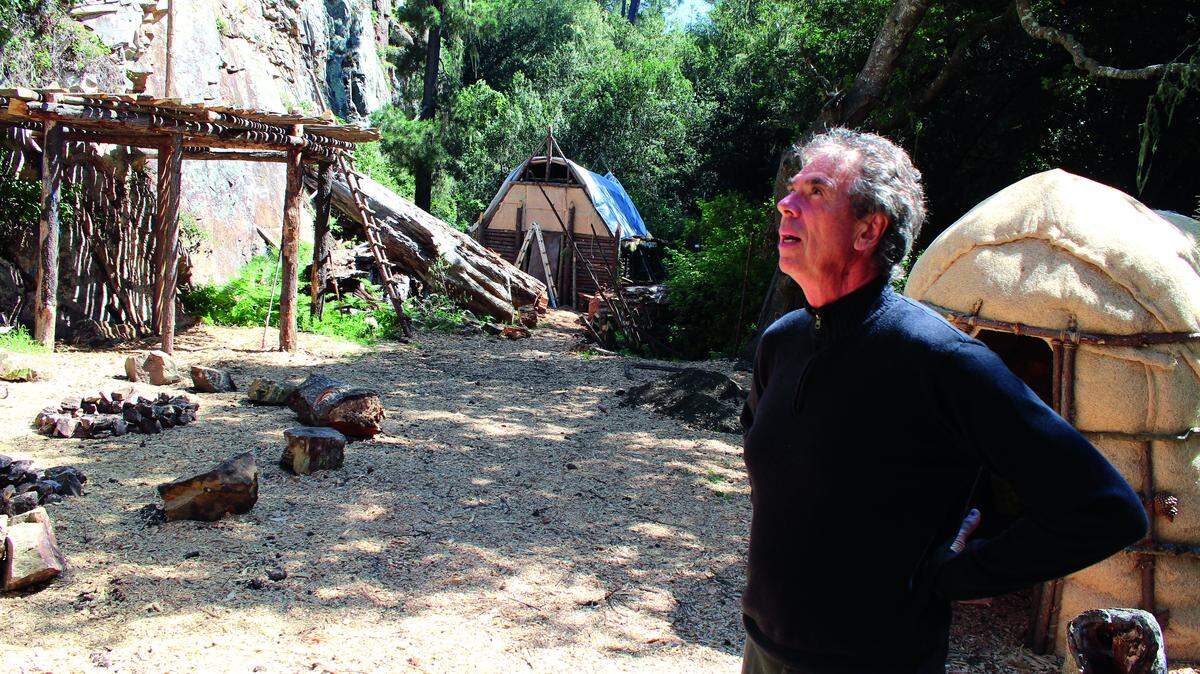
He re-created the Mohawk settlement on Covell Ranch, complete with Native American dwellings and a 12-by-25-foot structure that, for filming purposes, doubles as a longhouse and the missionaries’ chapel.
The scale of the production is larger than either of Kelty’s two previous projects for EWTN, he said. For one thing, it’s the first time the network has funded the filming in its entirety. It has a bigger budget (which Kelty describes as “twice as much as I had for ‘Serra’ ” but still “well under $1 million”), along with more extensive sets and more actors.
“These guys are the salt of the earth,” Kelty said of EWTN, short for Eternal Word Television Network. “(There’s) none of this Hollywood chicanery. We’re really thrilled with the support this network provides. They’re really a good outfit to work for.”
In all, Kelty said the production of “Kateri” included 60 actors, 40 of whom were only scheduled to be in Cambria for one day.
Several Cambria residents have roles in the film. Among them are Laurelle Barnett, who plays the part of Anastasia, Kateri’s clan mother and mentor, and Toby Madrid, who portrays Poudre Chaude, a Mohawk who led the sight-impaired Kateri when she fled her native village for a Catholic outpost in Canada.
Other Cambrians who have signed on to appear include Michael Shanley, Larry Frost (the Coast Union High School teacher who produced the school’s spring musical, “Young Frankenstein”) and Ruth Armstrong. Rafael Castaneda, along with brothers David and Roberto Fabela, all worked on the Serra film, as well.
“This is a bigger deal in that we had more to work with in terms of resources,” Kelty said in comparing the current project to his two earlier films for EWTN.
“This is the first time we were able to build a set this extensive. This is more international; this one has a higher-caliber crew out of New York and Los Angeles.”
Filming in Cambria took place during the last week of March, while the shooting in Quebec was done last year.
Goals of the film
Kelty not only served as producer and director, he also wrote the script, a process he said took him two or three months. As both a historian and a Catholic, one challenge he faced in crafting his story was remaining true to both the historical account and the faith he shares with the network underwriting the project.
“Why did this girl torture herself at the end of her life?” Kelty asked, referring to acts of extreme piety that included lying on a mat of thorns and walking into a frozen river to say the rosary. “I had to give her a psychological underpinning for this as well as a theological basis.”
Kelty added: “There’s facts, and there’s truth. Facts don’t always reveal everything. Filmmakers have a big responsibility, drawing out of a set of facts — the truth about them.”
As with the Serra film, he’s taking on a subject that involves some controversy: The nature of the church’s relationship with the Native Americans in both regions has been the subject of criticism.
“What we’re trying to promote is the good that the missionaries brought,” Kelty said. “But it’s always such a mixed bag, because they came in bringing Christianity at the point of the sword, which was not what the message of Christ was about.”
Kelty said each episode of the five-part miniseries includes an 18-minute dramatic segment, followed by 10 minutes of documentary footage and historical analysis. Plans also call for the dramatic portion to be released as a 90-minute movie.
If all goes according to schedule, he said, the mini-series will run starting on a Wednesday and concluding on a Sunday in October, barely a month after Pope Francis is expected to canonize the subject of Kelty’s previous film, Junipero Serra.
This story was originally published April 2, 2015 at 12:48 PM with the headline "Cambria filmmaker shoots five-part miniseries at Covell Ranch."