
Cambria writing groups attract authors, poets
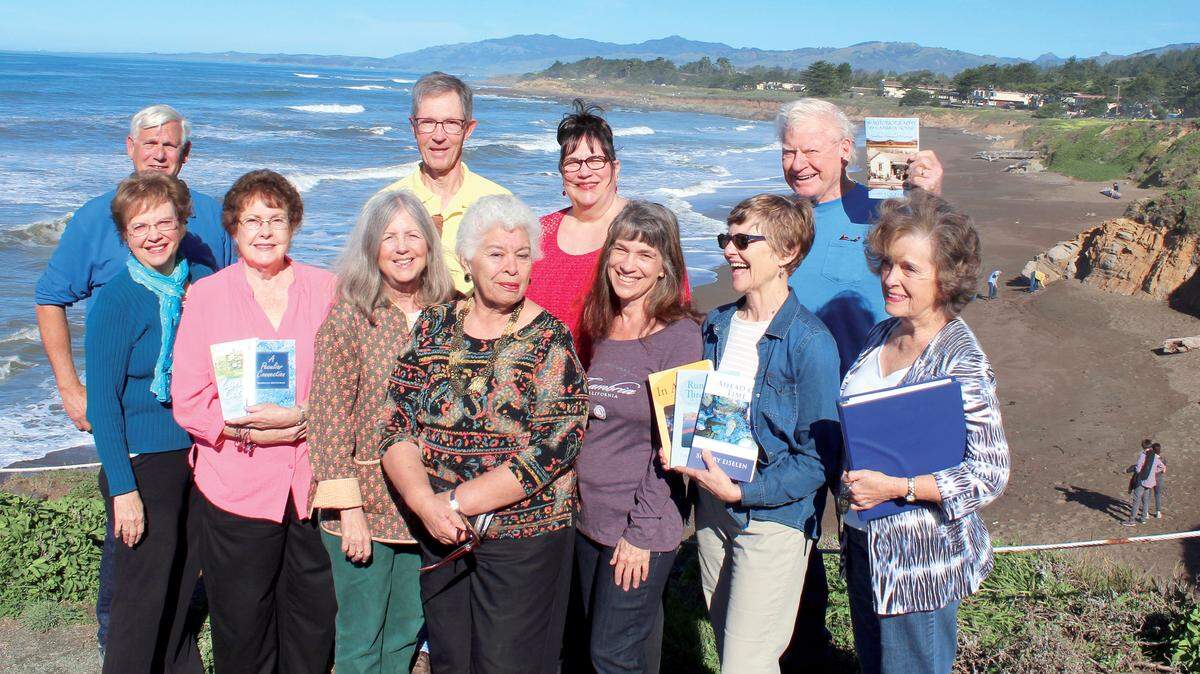
It’s common to picture writers hunched over their typewriters (or, these days, their computers), pounding away at the keyboard as they sip a cup of java, and occasionally staring off into space as they search for the right word … before finally giving in and starting to leaf through their thesaurus.
Writing has a reputation as something done in solitude. Interruptions are met with scowls of disapproval at trains of thoughts derailed, and “Shhhh! I’m working,” is almost a mantra.
Yet despite the occupation’s natural solitude — or, perhaps, because of it — writers need, every so often, to get out of their own heads and listen to what others have to say about their work.
As it turns out, the Central Coast, and Cambria in particular, is a great place to do just that.
SLO NightWriters in San Luis Obispo offers speaker presentations at its monthly meetings, critiques and an annual writing contest.
Down in Nipomo, the California Writers Club launched its Coastal Dunes chapter just last year. The group, which traces its origins to informal meetings involving Jack London and his contemporaries in the Bay Area more than a century ago, had 19 chapters across the state but none in San Luis Obispo County until now. Its meetings offer writers an opportunity to network and hear presentations from authors and others in the field.
But Cambria residents don’t have to venture any farther than the Joslyn Center on Main Street to connect with other authors. That’s where not one but two local writers’ groups meet weekly to provide feedback, critiques and encouragement to their members.
Cambria Writers’ Workshop
A hand bearing a coffee mug reaches across the table at the Joslyn Center conference room, accompanied by a light-hearted voice asking for a contribution. The reader of a poem that’s being critiqued deposits a $1 bill.
His offense? He’s used the word “lay” in his composition where “lie” would have been correct.
Welcome to a meeting of the Cambria Writers’ Workshop, where writers take turns sharing selections of poetry, fiction, children’s literature and nonfiction. Readings last up to 10 minutes and are followed by critiques from other members of the group.
CWW has 25 members, 15 of whom attended at meeting in late January at the Joslyn Center.
“Many of our members are retired, so they have time to dedicate to writing,” said Linda Reed, who leads the group with George Burns. “For some, this has been a lifelong goal, so they are quite dedicated.”
As to the group’s purpose, she said, “The goal of members is publication.”
Many have achieved that goal.
Reed cited bestselling authors Jean Brody, Christopher Moore and Catherine Ryan Hyde, each of whom she said began their careers as members of CWW. She added that members Sherry Shahan and Elizabeth Spurr each have more than 30 books to their credit.
Shahan’s most recent novel, “Skin and Bones,” focuses on teens in a hospital unit for eating disorders: The main character is struggling with anorexia, and his roommate is a compulsive overeater. Her works have been carried by major publishing houses such as Random House and Penguin Group, but they all get a hearing first at CWW.
“I wouldn’t dream of sending a manuscript — novel or otherwise — to an editor before running it by CWW first,” Shahan said. “This group has an amazing sense of story craft and structure. If a manuscript has a problem, they aren’t shy about pointing it out.”
Sharon Lovejoy, who has 10 published works to her credit and estimates she has sold close to a million copies, has been part of the group since 1992. Five years later, she sold her business — Heart’s Ease in the East Village — to become a full-time writer. These days, she makes a living at it. Her historical novel “Running Out of Night” has been chosen as one of the 2015 Notable Social Studies Trade Books, among other awards.
In addition to her novel (and a second in the works), Lovejoy has written gardening, nature and lifestyle books, also providing illustrations for many of her works.
Membership in the group, she said, involves a lot more than sitting back and listening to writers present their works.
“You have to critique and you have to be courageous,” she said.
Courageous enough to read an extended passage from your work, then listen while others in the group provide feedback.
“It’s very daunting. Your voice shakes, but they’re doing it for your own good,” she said of the critiques.
“We’re not here to write memoirs. We’re doing it to be published. We’re a professional group.”
The group has specific guidelines on how a critique is to be handled. Authors are asked not to offer a rebuttal to the feedback they receive. Critiques don’t touch on the author’s subject matter but focus on the quality of the work.
“Our goal is to critique the work, not the person,” Reed said. “Learning to provide good critique not only improves an individual writer’s work, but the knowledge and skill of the whole group.”
Shahan praised the diversity of the feedback.
“The group is diverse in their critiques,” she said. “Some have great ears when it comes to plot, some tap into characterization or dialogue. Others find grammar or punctuation errors.”
Rough Writers of the Central Coast
The Rough Writers group, which meets on Monday afternoons, began seven or eight years ago as an emeritus program through Cuesta College, under the guidance of Paula Cizmar, an award-winning playwright. When the college discontinued its program, members decided to continue meeting independently, with Cizmar staying on as their mentor.
As at CWW, writers read their works aloud, then other members of the group offer feedback. One key to the group’s success, according to John Lamb, is that those offering critiques focus on the positive first.
“Our practice has been that we tell a reader what we like, then ask questions, and only after that make comments on how the writing could be improved, what doesn’t work, and so on,” Lamb said, adding that the reader is encouraged to participate in the discussion.
“This approach works,” he said, “as evidenced by members whose initial goal was to do just a little sketching of ideas, and who have wound up writing novels.”
Some members of the group have had their works published: Three books by D. Arthur Gusner are available via Galaxy Press, while Sheri Humphries announced at a January meeting that she’d signed a deal with Boroughs Publishing Group to distribute two of her works in e-book form and via print-on-demand.
Others have self-published various works, all of which are available on Amazon. Ken Renshaw, for instance, has eight books available, including a short work recounting the history of Cambria’s Guthrie House titled “The Autobiography of a Cambria House.” The story is told from an unusual perspective: It’s written in first person from the home’s point of view.
Sherry Eiselen has published three novels, and Patricia Heineman has two books to her credit; both published their works independently using CreateSpace, and they’re available on Amazon.
Ted Siegler, who joined the group in May at the invitation of Lamb — one of his neighbors — is working on a novel in his retirement. Siegler writes a monthly education column for The Cambrian, but before that, most of his writing had consisted of “things like shareholder records and SEC filings.” Working 10- and 11-hour days, he didn’t have the time or energy to pursue writing a novel until he retired.
“I never would have considered it without being part of the group,” he said. “It gives me a reason to engage in creative writing. There’s sort of an expectation, if you’re part of the group, that you actually will write.”
He added that he enjoys the encouragement and fellowship he gets from being a part of the group. He hopes to finish his book, tentatively titled “That’s Life,” by the end of the year and will probably self-publish it.
“It’s for me,” he said. “If somebody else reads it and enjoys it, that’ll be a bonus.”
Lamb said others in the group share that motivation.
“I think we’re all primarily writing for our own enjoyment, in the sense that we like to write and want to learn and grow as writers,” Lamb said. “I imagine that a couple of members would like to write professionally, and that any of us would be happy to make a little money from our works.
“Many people go through their adult lives thinking they’d like to write ‘someday,’ It seems that Cambria is a place where those sleeping ambitions can come to life.”
Rough Writers
- Meetings: 1 to 4 p.m. Mondays, Joslyn Recreation Center, 950 Main St., Cambria
- Online: www.RoughWriters.org
- Information: RoughWriters@sbcglobal.net
- Meetings: 9:30 a.m. to noon Wednesdays, Joslyn Recreation Center, 950 Main St., Cambria
- Information: 924-1324
This story was originally published February 25, 2015 at 2:35 PM with the headline "Cambria writing groups attract authors, poets."