
Hearst admirer Mary Levkoff takes charge of Castle
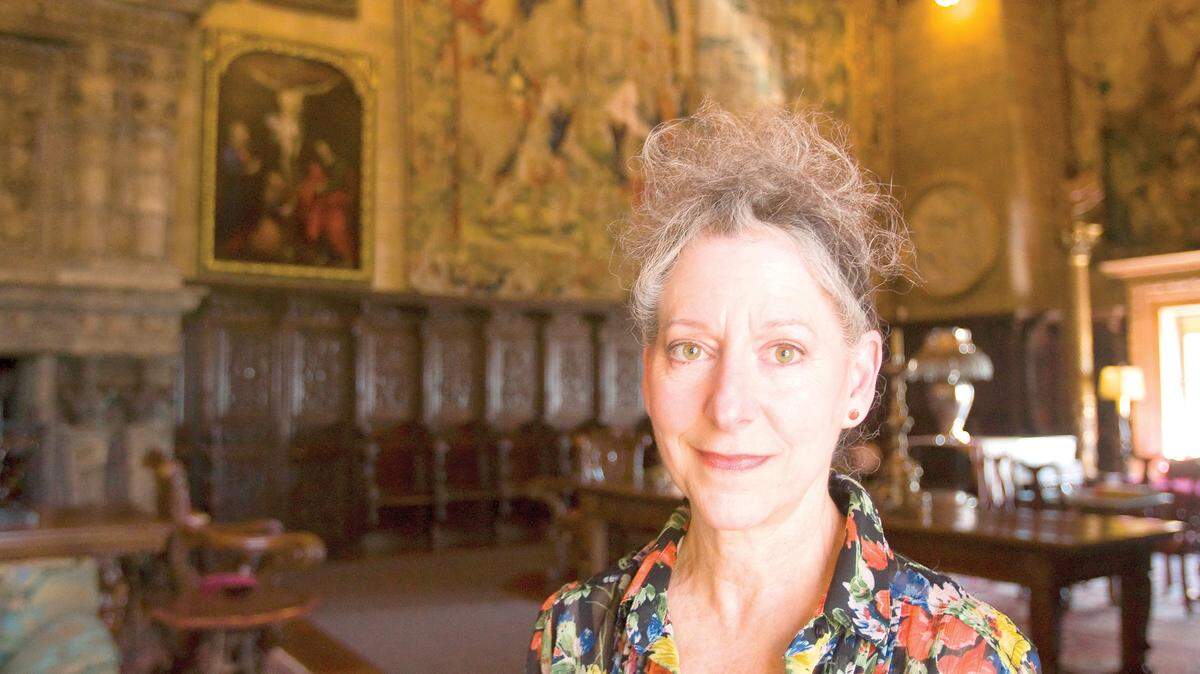
Hearst Castle is all dressed up for the holidays (especially for the annual night tours in December), with an especially festive air, estate-sized wreaths, 18-foot-tall Christmas trees, many poinsettias and a sprightly elf who’s in charge of it all.
Someone shadowing petite Mary Levkoff at work or play discovers quickly that she truly loves Hearst Castle year-round, which is a really good thing. Three months ago, she began her new job as the Castle’s museum director, and as such, Levkoff is a primary spokesperson for the lavish 127-acre historic-house museum and its more than 20,000 treasured artifacts and works of art.
And speak about it, she does — often and knowledgeably — to individual visitors she encounters during strolls around the grounds, castle guides and docents, representatives of the nonprofit associations that partner with State Parks, other nonprofit groups, top-drawer museums and art collectors, and in large international lecture halls packed with elite curators and art authorities.
In fact, a lecture Levkoff gave in 2011 at The Louvre in Paris is included in recently published French anthology of symposium papers, “Connoisseurship: L’oeil, la raison, et l’instrument,” which, loosely translated, is “sight/eye, reason, and the tool of connoisseurship — the eye.” (Yes, she’s fluent in French, and speaks basic Italian and some German.)
Levkoff, 61, has spoken and lectured about the Castle for nearly 20 years, since an education-department head at the prestigious Los Angeles County Museum of Art (LACMA) organized a 1995 program that was to feature early donors to the collection. Levkoff was curator of European sculpture there from 1989-2009.
The department head asked her to lecture about gifts to the museum from eccentric multimedia mogul William Randolph Hearst. He was the driving-force genius and bankroll behind the lavish 56-bedroom estate (with more than 80,000 square feet of living space), now an accredited museum that has become one of the most recognized and frequently visited units in California’s State Parks system.
Learning about Hearst
The research Levkoff did about Hearst and the place she’d first visited in 1990 (escorting the Louvre’s curator emeritus Sylvie Beguin) would change her life.
Her sleuthing showed that Hearst donated about 900 objects to the L.A. museum from 1946 to 1951, the year he died. He also donated “hundreds of thousands of dollars to buy more,” she said, “and no strings attached, unlike the terms that many donors try to impose today.”
Levkoff said her studies for the lecture “triggered my interest in Hearst, but the decisive moment came a few years later, when a great art dealer in Paris, Alexis Kugel, asked me to help him prove that Hearst had once owned a stupendous 16th-century mother-of-pearl box.
“It was more than a foot wide, it had once belonged to François I, king of France, and dated to 1533. The Louvre was trying to buy it from a private collection in Great Britain,” Levkoff recalled, “and the American history would be helpful, Alexis believed, in obtaining the export license.
“When we started to review the inventory at the Castle, I noticed detailed information about several sculptures that were in LACMA. Hearst had given them to the museum, but the information had been lost over time. It was a revelation to me.”
Since then, she’s learned much about the man and his estate. Some of her favorite Hearst tales illustrate his level of caring about people, stories she learned while reading his letters in the Bancroft Library and other repositories, and from subsequent conversations.
For instance, when Carlotta Pignatelli Monroe and her sister, daughters of the head of Hearst’s news bureau in Rome, came to visit, Hearst knew the girls were fans of the actor Van Johnson. Hearst asked the girls’ mother to “make sure they thought they were going to a special event in Cambria, so they would look their best. Hearst then asked them to meet him at the door to the Assembly Room” … where Johnson was reclining on a sofa that faces away from the doors.
When the visitors came in, Johnson sat up, “and two young girls had an unforgettable experience.”
First impressions
Amid the holiday splendor of Hearst Castle in December, Levkoff is learning even more about Hearst, the estate and about working for State Parks.
The museum director’s job is exhaustive, and can be exhausting. It covers all aspects of the monument … the theater, concessionaires, ticket office, guides, collections and the two nonprofits (Friends of Hearst Castle and the Hearst Castle Preservation Foundation).
“The only thing that’s not involved is handling security personnel,” said her predecessor, mentor and friend, Hoyt Fields.
Levkoff is experiencing firsthand the energy and dedication that members of the two nonprofits have.
For instance, the Friends group is sponsoring at Hearst Castle Theater a “Date Night” movie event Saturday, with a pre-show reception at 6:30 p.m. and the screening of the Academy Award-winning film, “The Artist,” at 7:30. For details, go to www.friendsofhearstcastle.org/special_events.asp.
The event “kicks off the transition between Thanksgiving and Christmas at the Castle,” Levkoff said, and “it’s a wonderful movie, very appropriate,” because it reflects the Castle’s heyday.
A week later, Friends will host its popular (and pricey, at $1,250 a ticket/$1,000 for members) Holiday Feast, complete with luxury coach ride to the hilltop, wine reception and five-course meal served in the Refectory dining room. Levkoff called it “one of the key celebrations of the holiday season.”
Fields and Levkoff’s new boss are already giving her high marks.
Nick Franco is superintendent of the State Park district that includes Hearst Castle. “Mary is doing a great job,” he said in an early October email interview. “She has so much experience with museums and with the Hearst collection that what she most brings to the Castle is a fresh perspective and best practices from other museums.”
He said Levkoff’s biggest challenge will be “learning the process to accomplish museum work within the state system.”
Fields has worked there for about 40 years and has retired but continues to work semi-regularly as a retired annuitant. His current assignments are shepherding restoration and repairs to the Neptune Pool and the roof of the Castle’s main house, and filling institutional-knowledge gaps for Levkoff.
He has known Levkoff since she began working at LACMA, said she won the job during a rigorous and competitive interview process in part because of her “vast knowledge of Hearst. She’s been a Hearst-o-phile for many years, and had done a lot of homework before she ever came to visit us. She lectured on Hearst. That was a big thing. And the knowledge she brings from the two great institutions she worked for, LACMA and the National Gallery of Art, is going to be stupendous.”
Her background
Levkoff’s journey from her childhood in Miami Beach, Fla., to the Castle via Paris, Los Angeles and Washington, D.C., reads like a how-to for prospective curators with dreams of hitting the big time.
“Born and raised in a modern city with beautiful scenery but no museum,” she said, “I went to Europe for the first time when I was in high school and was entranced by the beauty, atmosphere and fantasy of old European art and architecture.
“In college, I wanted to continue the connection through international relations, comparative literature or art history,” she recalled. “I soon discovered that my university’s school for international relations was geared almost exclusively toward social sciences and not civilization/culture, but the professors in the department of art history were eager for me to join their department.”
For three years in graduate school (history of art, New York University’s Institute of Fine Arts), she worked part-time as assistant/receptionist at Serge Sabarsky Gallery, “which helped me to understand how to be a good client.”
The Princeton grad volunteered as an art handler at the university’s art museum, and then as an assistant to the director at Busch-Reisinger Museum at Harvard. She served two internships at the Metropolitan Museum of Art, and then was hired as a researcher and curatorial assistant in the department of European sculpture and decorative arts.
She took her formal curatorial training at the Metropolitan Museum of Art.
While many have given Levkoff advice about her new job, she said she always comes back to something Fields told her.
“You can do this,” he reassured his friend about her new job, and Hearst Castle’s newest elf is well on her way to proving him right.
Levkoff’s accomplishments
- Her studies in the field of French Renaissance art have been published under the auspices of the Louvre, the Musée national de la Renaissance and the École du Louvre.
- She wrote a catalog of Los Angeles County Museum of Art’s 19th-century European sculpture, “Rodin in his Time.”
- A separate study on William Randolph Hearst’s classical antiquities appeared in the October 2008 APOLLO magazine.
- Her paper on Hearst’s Spanish art was published in 2012 by the Frick Collection’s Center for the History of Collecting, in conjunction with the Centro de Estudios Europa Hispánica.
- Her groundbreaking exhibition and book, “Hearst the Collector,” were presented at Los Angeles County Museum of Art from 2008-09, in collaboration with Hearst Castle, to celebrate the 50th anniversary of opening the Castle to the public. The book won Sotheby’s 2011 prize for a distinguished publication in the history of collecting.
- She lectures frequently on the entire span of Hearst’s collections, including at the École du Louvre (on Hearst’s connoisseurship) and at the Wallace Collection in London, speaking about the British aspects of his acquisitions.
- At the National Gallery of Art, she oversaw exhibitions on “The Sacred Made Real,” “The Invention of Glory: The Pastrana Tapestries,” and the display of the Capitoline Venus, a celebrated Roman antiquity.
Six things you probably don’t know
Six things you probably didn’t know about Mary Levkoff:
1. Her first job was Christmas-time wrapping gifts in her uncle’s general store in Georgetown, S.C. She was 13.
2. Her personal favorite work of art at Hearst Castle is the Spanish polychromed wood sculpture of the “Virgin as a Young Girl.” It was included in Levkoff’s 2008 exhibition, “Hearst the Collector,” at the Los Angeles County Museum of Art (her book of the same title is available at the Castle Visitor Center bookshop.) Her favorites among items easily located on public tours are the five marble sculptures by Danish sculptor Bertel Thorvaldsen, and the “Venus Italica” by Antonio Canova, all from around 1810, and on display in the Castle’s Assembly Room. She calls them “major works of art, worthy of any world-class museum.”
3. While Levkoff was working at the National Gallery of Art, a rare, magnitude-5.8 earthquake hit Virginia and Washington, D.C., on Aug. 23, 2011. The quake “made me so homesick for California,” she said with a laugh. “Moving to Washington was a major opportunity for professional advancement, but California is my true home,” quakes and all.
4. Her favorite aspects of her new job are “being able to experience the Castle whenever I want to,” driving up Highway 1, seeing the Castle on the hill, or driving back down from the hilltop. Other highlights include walking in the gardens, seeing the aoudads (Barbary sheep), and the early-morning fog, “which is very poetic. Anticipation of arrival at the hilltop makes my heart sing. I am brimming with a sense of my good fortune to be here.”
5. She bought her Cambria home over Labor Day weekend in 2011, before she knew the museum director’s job would be available. “I loved Hearst Castle, and Cambria was the Magic Kingdom and Brigadoon.”
6. Levkoff’s hobby is pet rescue and adoption. She plans to join Cambria’s Homeless Animal Rescue Team (HART) after her household is set up.
This story was originally published November 25, 2014 at 3:28 PM with the headline "Hearst admirer Mary Levkoff takes charge of Castle."