
Cambria water reclamation plant to start operating soon
Officials with the Cambria Community Services District plan to flip the switch Nov. 15 on a $9 million water reclamation plant that will provide the community with a desperately needed new supply of drinking water.
When that happens, Cambria will join an elite group of coastal communities in California that rely on purified seawater as an important part of their domestic needs. Sand City in Monterey County, Avalon on Catalina Island and Orange County are the only other communities in the state that regularly use desalinated water.
Construction of the plant has been fast-tracked using emergency permits from the county. This is because the town faces the frightening prospect of running out of water before winter rains can refill the two coastal creeks that are its main water supply.
“This is a real emergency,” said Jim Bahringer, Community Services District president. “Water shortages could lead to health hazards and force businesses to shut down.”
Everyone in Cambria is acutely aware of the pending water shortages and is doing a heroic job of conserving water. Many residents tell of showering every other day and taking buckets into the shower to use the collected water to flush toilets. As a result, water usage in Cambria was down 44 percent this summer compared to last.
But many in the community, as well as some government regulators, question the way the district has handled the emergency. Criticisms range from charges that it responded too slowly to the extreme drought now in its third year to suspicions that the district is using the emergency to ram through a permanent water reclamation plant without proper vetting by the community.
“I think this is a bait-and-switch system,” said Rick Hawley, land conservationist and who unsuccessfully ran for a seat on the district’s board of directors. “We had no reason to get into this very dire situation.”
On Oct. 14, an environmental group called Land Watch San Luis Obispo sued the district in Superior Court, arguing that a permanent plant is being built without the proper environmental review under the guise of an emergency.
District officials counter that they will fully comply with all environmental requirements as part of the ongoing permitting process. They expect to complete the regular permitting process next year.
In the meantime, using the emergency permit from the county, they are pursuing what they are calling “a permanent emergency solution.” Under the emergency permit, the plant will only be permitted to operate during periods of Stage 3 drought conditions, which is the most extreme emergency.
The plant design is based on a study by the U.S. Army Corps of Engineers that identified a brackish water reclamation plant along San Simeon Creek as the most technically feasible option. Brackish water is water that has more salinity than freshwater but not as much salt as sea water.
The idea is to meet the needs of the current emergency while, at the same time, build a plant that is permanent enough to be able to handle drought conditions and water shortages that could last for years, Bahringer said.
“It’s a health and safety issue,” he said. “People are suffering too much and we want them to get back to normal.”
However, state regulators and many in the community have been critical of this approach. In a strongly worded letter to the district, the California Coastal Commission said the district could have used a portable reclamation plant like the kind used along the Gulf Coast in 2005 following Hurricane Katrina, which could have been up and running by July.
“Emergency permits are meant to be for the short term,” said Tom Luster, an environmental scientist with the Coastal Commission. “This has turned into something more elaborate and permanent.”
The district board looked at this option but rejected it for a variety of reasons, Bahringer said. These included the inability to get a loan to finance the portable unit as well as concerns that a more permanent facility would be needed.
“It was clear from the get-go that was a nonstarter,” he said.
A quick solution
The facility under construction is designed to be quickly installed by housing the filtration and treatment units and other equipment in shipping containers and installing distribution pipes above ground, said Robert Gresens, district engineer.
The plant could be easily modified if the district decides to make it truly permanent, Gresens said. These modifications would include installing solar panels to provide electricity and burying the pipes.
District officials also acknowledge that the water reclamation plant under construction is likely to become permanent, operating at least during droughts and other low-water periods. One of the main reasons for this is the fact that the district took out a 20-year loan to pay for it.
“It will be very difficult to pay back that loan without operating the plant,” said Amanda Rice, who sits on the district’s Board of Directors.
When interest paid over those 20 years is factored into the price of the plant, the cost rises to about $13 million. The district estimates that a typical customer’s water bill will go up $18.50 a month to pay for the plant.
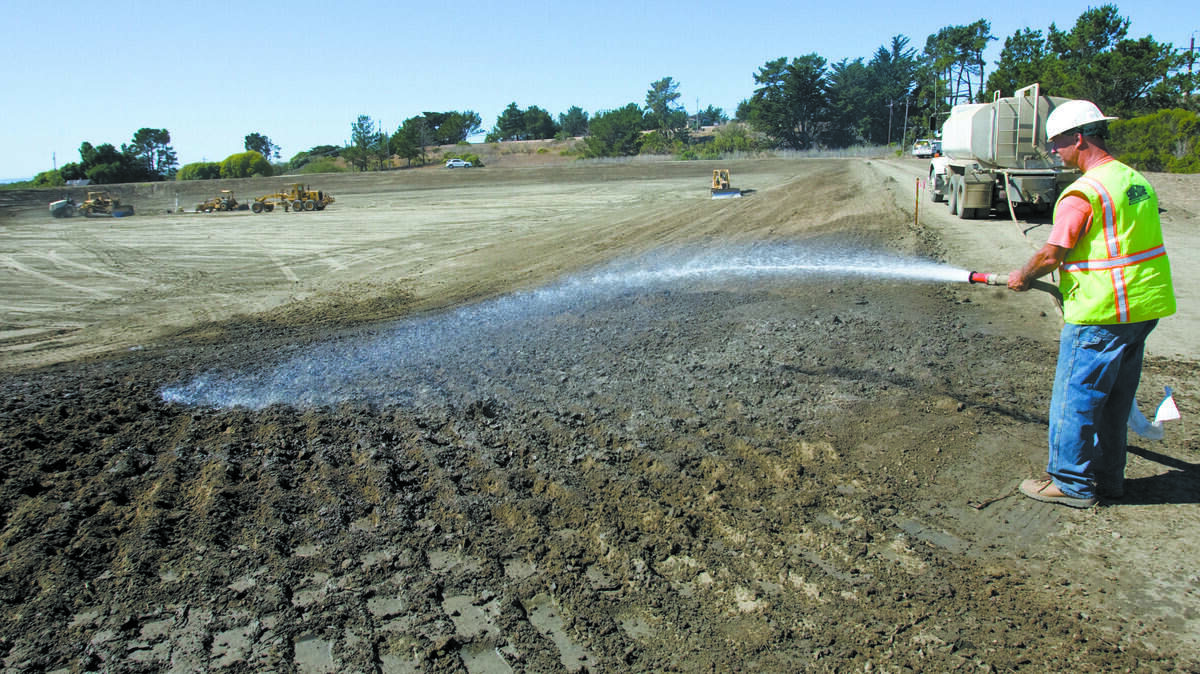
The water reclamation plant is under construction a half-mile up San Simeon Creek Road from Highway 1 behind the Hearst San Simeon State Park campground. Workers are pouring concrete pads that will support the shipping containers that will contain the plant’s filtration components while others are building a large pond that will be used to dry the brine the plant produces.
When complete, the plant will take brackish groundwater and filter it using reverse osmosis into as much as 250 acre-feet of freshwater per year, or about 35 percent of the district’s annual water consumption. The water will be re-injected back into the San Simeon Creek watershed where it will be available for domestic use and recharging the creek and its lagoon for environmental purposes.
Why brackish water is preferred
The use of brackish water rather than seawater in water reclamation is a growing national trend. The desalination plants in Sand City and Orange County as well as more than 100 plants in Texas use brackish water.
“Until recently, brackish water was not considered usable,” said Kyle Frazier, director of the Texas Desalination Association. “But with chronic drought conditions, it is suddenly becoming more and more useful.”
The advantage of using brackish water is that its salinity levels are often much less than seawater, making it cheaper to turn into freshwater. The water to be used in the Cambria plant is about 8 to 10 percent of the salinity of the ocean.
Using less salty water reduces the cost of running the powerful pumps used to filter the salt out, and reduces the stress on expensive reverse-osmosis filtering membranes. It also reduces the amount of salt residue that needs to be disposed of after the brine is evaporated.
The water reclamation plant will still have several potentially significant environmental impacts that the district will have to fully analyze and deal with once the plant is up and running.
These include dropping water levels in San Simeon Creek that could have adverse impacts on coastal wetlands, streams and sensitive habitats that could harm four rare and endangered animals -- steelhead trout, tidewater gobies, red-legged frogs and snowy plovers.
“The department believes that the project will result in direct and cumulative adverse impacts to fish and wildlife resources of the San Simeon Creek and lagoon, Van Gordon Creek and Santa Rosa Creek and lagoon,” said Jeffrey Single, regional manager for the state Department of Fish and Wildlife in an Aug. 22 letter to the district.
The State Parks Department shares those concerns and has its own. The brine pond is very close to the State Park campground which could be negatively impacted, said Nick Franco, State Parks superintendent.
A combination of misters and powerful fans will be used to help dry out the brine since simple evaporation and time would not accomplish that quickly enough. Noise, unsightly equipment and brine mist drifting over the campground are the main concerns.
The district plans to minimize these problems by screening the brine ponds and restricting use of the equipment to non-windy times.
State Parks is waiting to hear more from the Community Services District about how it plans to deal with these issues before making a judgment on the plan.
“We recognize that there is a water issue that needs to be addressed,” Franco said. “We’d like to see a solution, but we can’t have a solution that will negatively impact the purpose of the park.”
Critics of the reclamation plant say there is an alternative that would avoid many of these environmental problems – construction of a reservoir or series of reservoirs off of San Simeon Creek that could store as much as 700 acre-feet of water.
“I have very mixed feelings about the desal project,” said Tina Dickason, who heads a group called Cambrians for Change. “We want a different source of water and a way of doing it that won’t destroy threatened and endangered species.”
Citing the Army Corps of Engineers alternatives report, district officials say the idea of using reservoirs was studied and rejected, mostly due to cost and the time it would take to build and fill the reservoirs. The cost of building three reservoirs to hold 1,200 acre-feet of water was estimated to be $70 million. No cost estimate of a single 700-acre-feet reservoir has been made.
County Supervisor Bruce Gibson, whose district includes Cambria, has followed the community's water saga. He agrees that the water reclamation plant is the quickest and cheapest solution to Cambria’s water problems.
“I don’t see that a reservoir is going to be a long-term solution,” he said. “I think desal is more cost effective and closer to implementation.”
In the meantime, the Community Services District is getting ready for a crucial deadline. On Nov. 14, the Central Coast Regional Water Quality Control Board will decide whether to issue a series of water discharge permits for the desalination plant.
All of the permits are focused on protecting water quality and ensuring that San Simeon Creek will have enough water to healthy wildlife habitat, said Harvey Packard, supervising water resource control engineer with the water board.
“Once they get those permits, they plan to turn the plant on,” Packard said.
This story was originally published November 8, 2014 at 6:00 PM with the headline "Cambria water reclamation plant to start operating soon."