
How to save Cambria's native Monterey pine forest
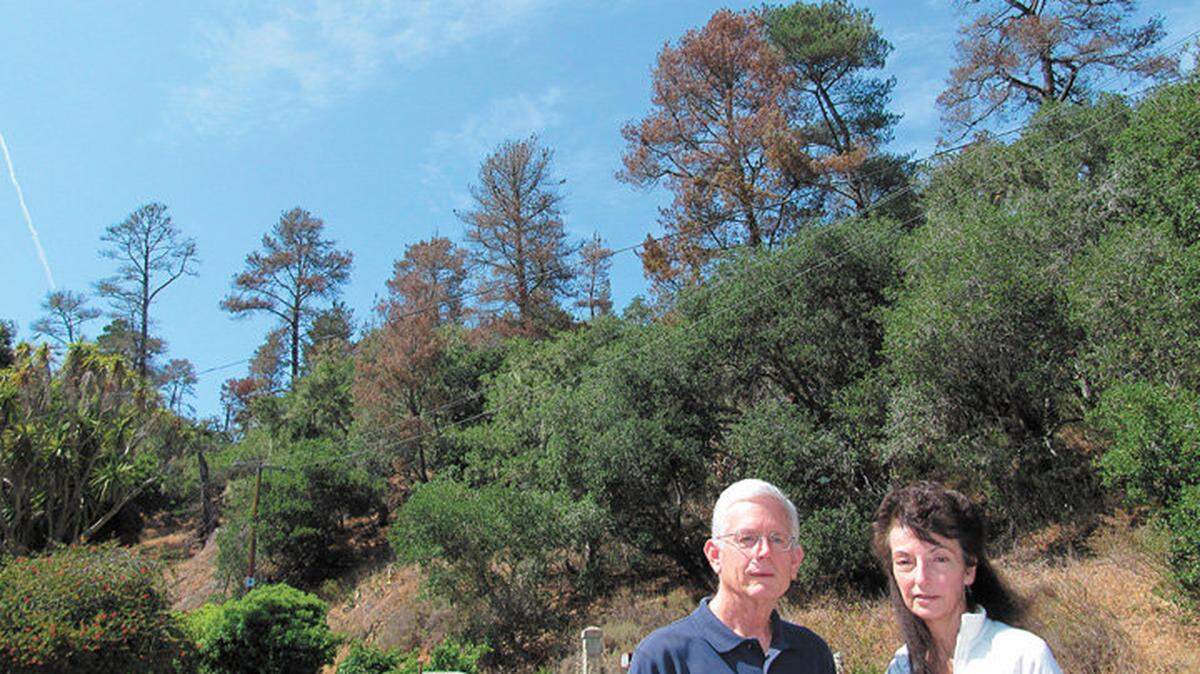
Parts of Cambria’s trademark forest of native Monterey pines are being ravaged by consecutive years of drought, according to several experts who love the trees and want to help protect them.
Some trees’ needles went from green to rusty orange to bare in a short time. Many already are dead or dying.
The sheer devastation worries many Cambrians, who are of two minds about the possibility of winter storms: The area desperately needs the rainfall to replenish aquifers and provide moisture to the trees, but storm winds and wet ground could bring down many of the dead pines and other trees. That’s a safety issue that ranges from tree strikes to electrical interruptions.
An upcoming survey of the forest by Cal Fire Forester Kim Corella may document the extent of the devastation, which her boss, Unit Forester Alan Peters, estimates could kill as much as 40 percent of the pines.
Cambria’s forest
The rare native stand is one of only three such forests left on the U.S. mainland, with two more on islands in Baja California.
There are plans for managing the forest, but the Cambria Forest Management Plan has never been funded, and a recently completed plan for the forest on the Fiscalini Ranch Preserve hasn’t been implemented yet.
Meanwhile, the aging forest is in danger.
Many of Cambria’s pines are near the end of their normal lifespan of about 80 to 100 years, and the tall, shallow-rooted trees have lived through droughts before. They’ve also survived onslaughts by the pitch canker fungus, attacks by various kinds of beetles, moss and other parasites.
Normally, the pines receive their annual moisture from the area’s variable amounts of rainfall and from heavy fogs that frequently blanket the area parts of most days during the summer, and less often in other times of the year.
This year’s fog has been, on average, less dense and moist than usual, despite some monsoonal humidity. That has left many of the pines — especially those on south-facing ridges that are in the sun longer and are more buffeted by the winds — literally high and dry.
For some of the trees, it’s already too late. By the time the wood has dried past a certain stage, the tree can no longer take on the water that keeps it alive. The tree begins to die, sometimes rapidly.
A dying or dead tree is more dangerous than a healthy specimen, especially when it’s within striking distance of a home, a road or other place where people are.
Experts convene
At a Cambria Forest Committee meeting Aug. 13, more than a dozen members and guests brainstormed for an hour or so about how to save the forest, given the drought and other problems affecting the forest.
It’s a daunting topic, but ideas bounced around the room like kernels in a popcorn popper on high. Discussions ranged from obtaining possible grants and starting an “adopt a tree” program to conducting a survey and steps that property owners can take to try to save trees.
There are several grant opportunities, according to Peters and Mark Miller, chief of the Cambria Fire Department. One of the grants, Peters said, is specifically targeted toward helping to improve the condition of forested areas on nonfederal lands.
Committee members will meet Friday, Aug. 22, to discuss the potential grant applications.
While Cambria’s odds of beating out the competition for two grants to be given statewide might appear slim, several factors could help boost its chances, Peters said. Those include the two completed plans for managing all or part of the forest, Cambria’s high visibility in statewide offices as one of the state’s most drought-affected communities and the rare nature of the native stand of Monterey pines.
The committee meets at Rabobank, 1070 Main St., at 6:30 p.m. on the second Wednesday of every month. The public is encouraged to attend and participate.
If a tree is sick
According to Crosby and Laura Schwartz, who co-chair the forest committee, it’s less expensive to haul in water now to irrigate prime, healthy trees than it is to pay later to have them removed.
A healthy tree will “have a bright, vigorous green color,” according to committee member Rick Hawley of Greenspace.
However, a tree with some yellowing needles could be fighting off a virus that affects new growth, a disease from which most trees recover, according to biologist Galen Rathbun.
But all the committee members agreed that if all of a pine’s needles have turned reddish orange, the tree is dying or dead, and cannot be saved. Also, according to Hawley, “if there’s a lot of frass (insect droppings), that means the beetles are attacking the tree,” which has likely been weakened by the drought.
However, some beetle attacks can be treated by a professional licensed to handle the necessary chemicals, the Schwartzes said.
Cal Fire
The Cal Fire survey of Cambria’s Monterey pine forest would “assess the amount of mortality in the forest and what size class of trees are being affected or not affected by particular diseases,” according to forester Corella, who said the survey “is still in the planning phase.”
She said Cal Fire foresters suspect that Cambria’s Monterey pine forest is being affected by the severe, ongoing drought, diseases and insects, such as the pitch canker fungus and Western gall rust. “The planned survey will give us the details we are looking for and the amount of mortality” in the forest.
“Monterey pines have a low tolerance to drought and restricted water conditions,” she added.
Corella said the dry years “were especially dry during the spring. Late winter and spring precipitation is important because it provides soil moisture that helps trees make it through California’s dry summer months. Without adequate precipitation, trees do not have enough water for normal growth and may be severely drought stressed by the end of the summer.”
Consecutive drought years compound the problems. “If drought lasts more than one year,” she said, “tree defenses begin to weaken,” and beetles begin attacking and killing the most susceptible trees. Tree mortality increases.
Having a drier than normal 2014, with little to no precipitation in February and March, “has exacerbated the problem,” Corella said.
PG&E
Meanwhile, PG&E is doing a second round of regular maintenance surveys this year, because so many trees are dying from a lack of water. If those dying or dead trees could strike a power pole or electric lines, PG&E’s contractor Davey Tree Service cuts them down or “tops” or trims the trees to remove that portion that might damage the electrical system.
According to spokesman Blair Jones, “Because of drought conditions, similar to routine work, we are inspecting trees that may have died since our last inspection earlier this year to determine if any additional vegetation hazards exist. We will be inspecting over the next few weeks.”
Because the inspections haven’t been completed yet, “we have not determined the amount of dead trees that may need mitigation at this time.”
Cambria began developing as a community in the 1860s. Builders cut trees for lumber with which to construct the homes, businesses and ranch buildings. In the 1920s and ’30s, developers started building homes on some of the heavily wooded hills, intermingling the houses in the forest.
In firefighter lingo, that’s referred to as an “interface zone,” and it’s one of the most dangerous places in which to live, due to the possibilities of falling trees and fires in the crowns, or tops, of the trees.
In the end, it doesn’t matter whether the fire starts in the forest and spreads to the houses, or vice versa. Any fire in the forest is a potential disaster, and firefighters have to be prepared to respond fast.
A fire within a drought-ridden forest is apt to spread more quickly.
Firefighting resources can be stretched thin statewide in a drought, and there’s less water available with which to fight any blaze.
The silver lining
Even in a drought, with trees dying, Cambria’s pine forest is still a magical place.
It’s what makes Cambria different from most other coastal towns in the state, according to the Schwartzes.
“We love hiking in the forest, taking care of it, making sure the next generation of trees is healthy and strong for future Cambrians,” Laura Schwartz said.
Drought or no drought, they and other Cambrians plant young healthy trees to replace those at the end of their lifespan. They urge others to do the same, including owners of individual properties and businesses, ranch owners, agencies and land conservancies.
“We’re all aware of the hazards of the forest,” Crosby Schwartz said. “What may not be as obvious, beyond the beauty of the trees, are the benefits of living among trees. They collect mist to water themselves and the species around them. They improve air quality and Cambria’s ambiance. We need to care for them now, so they can make our lives better for a long time.”
How to keep your trees viable
Forest committee members advise checking every tree on your property, and determining which already are dead or past the point of no return.
Calculate what could happen if those trees should fall. Are there any houses or other structures, roads, vehicles or people in their path? If so, the trees should be removed, or at least topped so that the remaining trunks won’t damage anything or hurt someone when they fall. If a tree is alive but struggling, “then if you can, water the tree’s root zone every so often,” Laura Schwartz advised. “It can’t hurt, and it just might save the tree, especially the younger generation of trees.”
And recheck the trees regularly. It doesn’t take long for a tree to dehydrate, discolor, drop its needles and then die. Just ask Carl Brandt of Cambria, who recently removed two trees that went from healthy to dead in about two months.
This story was originally published August 21, 2014 at 11:21 AM with the headline "How to save Cambria's native Monterey pine forest."