
SLO Council OKs items aimed at controlling disturbances around Cal Poly
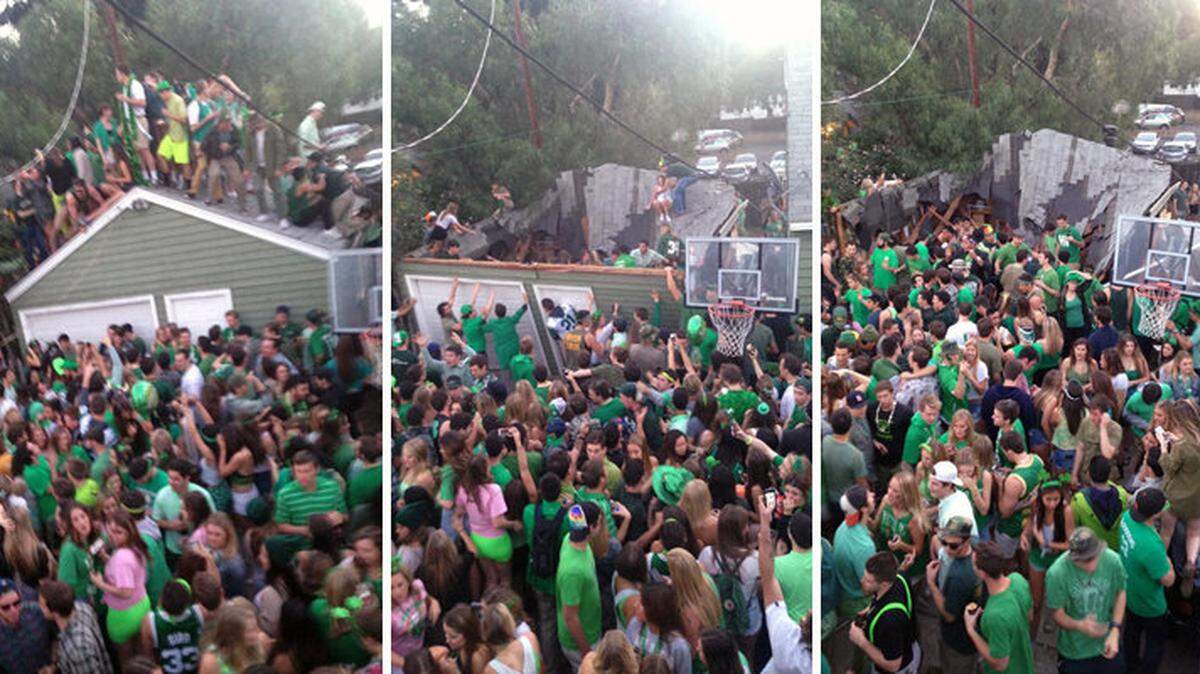
While many Cal Poly students are out of town enjoying their summer vacations, San Luis Obispo leaders took steps Tuesday to respond to ongoing complaints about large parties, noise and alcohol-related problems in neighborhoods around the university.
The San Luis Obispo City Council unanimously approved two separate items: changes to its rules on unruly gatherings and an agreement with Cal Poly to allow university police to issue citations for city violations within a one-mile radius of campus.
The changes to the unruly gathering rules still have to come back for final approval and then would go into effect 30 days later — just in time for Cal Poly students as they return to campus in September.
“We aren’t outlawing the parties,” Mayor Jan Marx said. “But we are saying when they become a disruption to the people living there, it’s something that has to be dealt with.”
The changes are an attempt to make the rules easier to understand and more enforceable for police officers responding to such gatherings. They also aim to hold partygoers — not just the host or property owner — responsible for misconduct.
Councilman Dan Rivoire, who voted to approve the ordinance, expressed concern that students may feel targeted.
“We may be taking steps backwards to build mutual respect in the community,” he said, noting that the purpose of the ordinance is to address huge parties with bad behavior, and yet it defines an unruly gathering as 20 or more people.
“That’s a small gathering,” he said.
Unruly gathering law
At least eight people were injured when a garage roof collapsed under the weight of more than 50 revelers.
After the party, some residents implored the city to do more to enforce its laws, including the unruly gathering rules, which were adopted in 2010.
The ordinance currently penalizes hosts of gatherings of 20 or more people where public drunkenness, fights, obstruction of public streets, vandalism, littering or serving alcohol to minors occur.
Twelve unruly gathering citations have been issued in five years.
The changes would ensure that party attendees — not just party hosts or property owners — could also be cited.
New additions to the definition of an unruly gathering, all of which could trigger a citation, are: unpermitted live bands, amplified music or DJs; being on a roof not designed for occupancy; and throwing bottles or other objects or substances at law enforcement or other people.
A few residents, including current or former students, said it was unfair to consider the changes while Cal Poly students are on vacation.
Jake Rogers, a recent Cal Poly graduate and former chief of staff for Associated Students Inc., said many of the changes would only add to the rift between residents and their student neighbors.
David Ritter, a Cal Poly electrical engineering student, wrote in an email to the council that he doesn’t believe the rules will have a big impact.
“This is not going to decrease parties and noise throughout SLO,” Ritter said in an email to the council. “Parties will still happen because this is a college town, whether you like it or not.
The only thing you will be doing by giving policemen more power to issue fines is increase the number of college students with fines.”
Carolyn Smith, secretary of Residents for Quality Neighborhoods, said more large parties have been held over the last several years, according to police logs, from 50 parties in 2011 to 95 in 2014. There were 50 large parties in the first six months of this year, she said.
“All of this demonstrates that the message is not getting across — that large parties will not be tolerated in residential neighborhoods,” she said.
An initial violation for partygoers contributing to an unruly gathering would result in a $350 fine, with a second violation costing $700 and each additional violation carrying a $1,000 penalty.
Currently, those responsible for a party receive a $700 fine, increasing to $1,000 for each subsequent violation.
Campus police agreement
Cal Poly University Police Department
Currently, the state-run university police have no means to enforce municipal code violations that occur in neighborhoods directly off campus, where many students live.
The agreement allows university police to issue citations for violations within a one-mile radius of the Cal Poly campus. Officers can now write citations under five sections of the city code — possession of open containers or public consumption of alcohol, underage persons in possession of alcohol, noise, unruly gatherings and a section that covers miscellaneous prohibitions such as urinating in public and certain vehicle uses on public property.
With the agreement approved, San Luis Obispo police may immediately begin training university officers and create a process for handling the citations they write.
Exceptions may vary, but citations for those five sections typically are $350 for a first offense, $700 for a second and $1,000 for a third. Unruly gatherings ring in at $700 for a first offense and $1,000 for subsequent offenses.
University police will also be able to write those citations under the city’s “Safety Enhancement Zone” ordinance, which doubles those fines during certain party-heavy holidays.
This story was originally published July 21, 2015 at 8:44 PM with the headline "SLO Council OKs items aimed at controlling disturbances around Cal Poly."